

The Disability Rights Center of Kansas is the Protection and Advocacy agency for the state of Kansas.
- Tweets362
- Following135
- Followers305
- Likes59
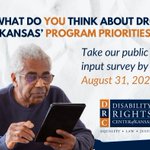








ALT Graphic with blue and orange text reads: "What do you think about DRC Kansas' program priorities? Take our public input survey by August 31, 2026." Stock image of an older man using a tablet in the bottom left hand corner. DRC Kansas blue and orange logo in the bottom right hand corner.

ALT Graphic with dark blue text on a light blue background reads: KANSAS WITHDRAWS FROM TEXAS v. KENNEDY! Thank you, AG Kobach, for listening to Kansas' disability community." Stock image of a woman in a purple shirt smiling and celebrating, sitting in a wheelchair. DRC Kansas' blue and orange logo in the top right-hand corner.

ALT Graphic with white text on blue and orange backgrounds reads: "TIME-SENSITIVE ACTION ALERT. SUPPORT SELF-DETERMINATION FOR KANSANS WITH DISABILITIES. The Supported Decision-Making Agreements Act Needs Your Help!". Stock photo of a woman with Down syndrome smiling in the background.

ALT Graphic with white text reads: "Know Your Rights: KanCare Grievances and Appeals." Stock photo of a man with limb loss, smiling in an outdoor setting and looking into the distance. DRC Kansas blue and orange logo.

ALT Graphic with white text reads: "Subscribe - Sign Up for Email Alerts." Stock image of a man looking at his phone, sitting at the breakfast table in a wheelchair. DRC blue and orange logo in the top left-hand corner.

ALT Orange graphic with white and blue text that reads: "TOP 5 CHANGES YOU SHOULD KNOW ABOUT THE NEW KANSAS GUARDIANSHIP LAW"

ALT Orange graphic with white and blue text that reads: "NUMBER ONE: Every Guardianship Must Have a “Guardianship Plan" If the court finds someone is in need of a guardian, their guardianship MUST have an individualized "guardianship plan." The plan clearly says what the guardian can and cannot do. The plan helps limit the powers a guardian has over the person under the guardianship. If you have a guardianship from before Jan. 1, 2026, you can ask the court for a guardianship plan. Contact DRC for help!" Stock image of a young man who has Down syndrome smiling and looking into the distance. DRC blue and orange logo in the bottom right-hand corner.

ALT Orange graphic with white and blue text that reads: "NUMBER TWO: Guardians Must Consider What the Person Under the Guardianship Wants The new rule is that guardians must use "substitute decision-making" instead of the "best interest" standard. This means the guardian must consider what the person under the guardianship wants, not just what the guardian thinks is "best." This change applies to both new guardianships and existing guardianships created prior to Jan. 1, 2026." Stock image of two young women laughing together. Both girls have developmental disabilities. DRC Kansas blue and orange logo in bottom right-hand corner.

ALT Orange graphic with blue and white text that reads: "NUMBER THREE: Guardianship Is a Last Resort Courts must first consider alternatives to guardianship, like: - Supported decision-making: having people you trust help you with decisions - Power of attorney: allowing someone you trust to legally help you with financial and/or health care decisions - Limited guardianship: where you only need a guardian for a short period of time or for certain services These options let the person with the disability keep more control over their own lives." Stock image of a young woman smiling for a selfie with her mother. The young woman is sitting in a power wheelchair. DRC Kansas blue and orange logo in the bottom right-hand corner.

ALT Orange graphic with white and blue text reads: "NUMBER FOUR: Strong Protections End of Life - the new law fixes a flaw in the guardian's end-of-life powers under the prior guardianship law. Under the prior law, guardians had powers to stop life-sustaining care (like medical treatment, food, or water) too easily. The new law limits the guardian's power to stop life-sustaining care. Grievances - The new law also allows for anyone to file a grievance (complaint) if a guardian isn't following the law, the guardianship plan, or even if they believe the guardian limits too many of the person's rights. Courts will review the complaints and fix problems when needed. These new protections apply for all guardianships, established before or after the effective date of the law (Jan. 1, 2026)." Stock image of two young men, brothers, smiling with their heads together. One brother is in a wheelchair. DRC Kansas blue and orange logo in the bottom right-hand corner.

ALT Orange graphic with blue and white text reads: "NUMBER FIVE: The Law is "Person-Centered" The new law requires that people under guardianship get clear written notice of their rights. They must be involved in decision making. The new law also uses person-centered terminology like "individual subject to guardianship" instead of "ward" or "incapacitated person." The law moves Kansas towards a more person-centered system—one that respects choice, dignity, and independence." Stock image of a middle-aged man smiling and showing a thumbs-up. DRC Kansas blue and orange logo in the bottom right-hand corner.

ALT Graphic with white text reads: "Know Your Rights: Disability Rights in Housing" with an orange arrow. Stock photo of an individual opening a door for another individual who is using a wheelchair. DRC Kansas' blue and orange logo in the bottom right-hand corner.


ALT A graphic reading “Assistive Technology Awareness Month” and “Technology doesn’t just make life easier; for people with disabilities, it often makes life possible.” On the left, Black a woman with curly hair sits smiling while holding a prosthetic leg. The National Disability Rights Network logo appears at the bottom right.

ALT A graphic titled “What is Assistive Technology (AT)?” with text defining AT as items or systems that help a person with a disability increase or maintain independence. A list of examples appears on the lower left. On the lower right is a photo of a young girl smiling and holding hearing aids.

ALT A graphic titled “What is NOT Assistive Technology (AT)?” explaining that services not considered items or equipment are not AT. A list includes live sign language interpreters, guide dogs or service animals, and access to support staff. On the lower right is a photo of a guide dog wearing a harness while walking beside a person.

ALT A graphic titled “Assistive Technology (AT) IS an affordable solution” with statistics from the Job Accommodation Network showing most accommodations cost little or nothing. On the lower left is a photo of a man in a wheelchair using a ramp outside a building. A text box emphasizes that assistive technology is more accessible and efficient than most people think.

ALT This image features a navy blue background with white and pink text. There is a graphic of a fist holding a megaphone. The NDRN, AAPD and Verified Voting logos are also present. It reads: "VOTE Election Day 2025."

ALT The image reads: "Find out all you need to know about elections in 2025. Have questions about voter registration deadlines, requesting absentee or mail-in ballots, or how to vote in-person during early voting or on Election Day? Contact the Election Protection Hotline to report issues or to seek assistance. Call or text 866-OUR-VOTE (866-687-8683) to speak with a trained Election Protection volunteer." The Election Protection Hotline logo is featured.

ALT A group of diverse young children, including a child with Down syndrome, smile and laugh together in front of a chalkboard background. Bold white text reads, “The future of disability education is on the line.” The National Disability Rights Network logo appears in the corner.


ALT Blue background with heading: “What is a shutdown?” Explains that if Congress does not approve a budget, the government cannot keep all programs running and some federal offices pause.

ALT Blue background with heading: “Key Services Will Continue.” Lists Social Security, SSI, SSDI, Medicare, Medicaid, Veterans Affairs benefits, and Postal Service mail. Includes photos of a healthcare provider, an older adult, a veteran, and a postal worker.

ALT Blue background with heading: “What could be delayed?” Lists customer service at Social Security offices, new applications, appeals, support for veterans at regional offices, and new housing or mortgage approvals.

ALT Blue graphic says “Stay Informed. Read more at DisabilityRightsFlorida.org (Link in Comments)” above a yellow warning sign that says “Government Shutdown” and a blurred U.S. Capitol in the background.

ALT Photo of group of disability advocates in front of the John Brown Mural at the Capitol.

ALT Graphic with stock photo in background of person counting money. White and orange text on blue background reads: "DRC helps protect beneficiaries of Social Security from financial exploitation or other abuse." DRC Kansas blue and orange logo in top left-hand corner.

ALT World Suicide Prevention Day September 10, 2025 If you or someone you know needs support now, call or text 988 or chat 988lifeline.org You Are Not Alone. Graphic of phone with image that reads: "988 Suicide & Crisis Lifeline. You Matter. Text. Call. Chat."

ALT A dark blue graphic with red, white, and blue decorative waves. Text designed to look like a neon sign reads Vote for an Accessible Future. A banner at the bottom reads: Disability Voting Rights Week, aapd.com/disability-voting-rights-week.

ALT Graphic with blue and white text reads: How can we best serve you? Let us know by completing our 2026 Public Input Survey! Survey Closing Soon: August 31, 2025" DRC Kansas blue and orange logo large in the top center of the graphic.