

Paleoclimate scientist, Quaternary geology and geochronology, Northern Arizona University. IPCC AR6 Lead Author. Helping to reduce paleoclimate data casualties
Flagstaff, AZ
Joined January 2009
- Tweets56
- Following192
- Followers491
- Likes142
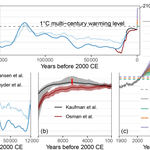
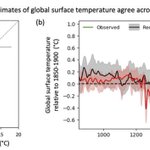


When was the last time it was this hot? More than 100,000 years ago? As I discuss in The Conversation theconversation.com/is-it-re…, timescales matter. And see cp.copernicus.org/articles/1… for more background and a compilation of underlying data.

Rosh delivers well-researched, high-value climate science!!
This Post is from an account that no longer exists. Learn more
Truly an honor to collaborate with the talented communicator @RSalgadoDArcy on this topic. Read more about how we compared recent plus future warming to paleotemperature records on similar multi-century timescales at doi.org/10.5194/cp-18-911-20…, with coauthor @npmckay.


A common talking point of climate deniers is that global warming is unexceptional. In my latest video, I put the climate crisis in its historic context. Massive thanks to paleoclimate scientist @DKaufman1 for his help with this one!
youtu.be/2aCG6umksys via @YouTube

Such a thrill to be back on Seward Peninsula again after some 30 years, this time with the multi-talented @elliebroadman. Salmon Lake was just crying to be cored. Thanks to the ace team from @AWI_de for the invitation to join the expedition. Looking forward to what comes next…

What a week! @DKaufman1 and I are back in AZ after a fun, beautiful, soggy, and stimulating week at Salmon Lake in the Kigluiak Mnts north of Nome. Our colleagues from @AWI_de are still out there, hammering away on the coring platform. We got to see some beautiful views… (1/4)


1
24
Darrell Kaufman retweeted

Only good news from Eightmile - @leahpmarshall has mastered GPR and surface coring 😎 @DKaufman1 and I have mastered paddling the inflatable canoe into the wind in ~the right direction 👏🏼 Snuck in a trip to Denali NP while the lake was too windy to core 🤗 Good people, good work! – at Alaska, USA


Darrell Kaufman retweeted
Stoked to be back in Alaska for field work after a 4 year hiatus! Our first stop (after the good ol’ storage locker in Anchorage) is Eightmile Lake near Healy. So far we’ve been spoiled with sled dog puppy cuddles, good weather, and minimal bugs🤞🏽 @leahpmarshall @DKaufman1


Darrell Kaufman retweeted

@leahpmarshall & @DKaufman1 from @nau_ses split cores from Eightmile Lake, AK today. The 4 cores represent a transect across the lake – sediment carbon content and grain size will help them determine how lake levels have changed over time #paleoclimate

Flagstaff, AZ Weather Alerts - The Weather Channel | Weather.com weather.com/weather/alerts/l…
IPCC recently concluded that global temperatures are rising to levels unprecedented in >100,000 yrs. This conclusion considers both recent and likely future warming to compare with paleotemperature reconstructions on multi-century timescales. With @npmckay doi.org/10.5194/cp-18-911-20…

“Understanding how Earth's biota responded to past climate dynamics is essential to understanding…vulnerabilities of ecosystems and human livelihoods dependent on them” See CH1 PaleoBox for a paleo perspective on Adaptation, Impacts, Vulnerability in the new #IPCC #ClimateReport
New article in “The Conversation” summarizes the long-term context needed to gauge how recent and potential future climate changes are unusual.
Read more about the basis for the “warmer-now-than-in-120,000-years” conclusion in a new preprint here: cp.copernicus.org/preprints/…

Messages from Earth's past for #COP26 :
‼️ Temperature is greater than at any time in the last 120,000 years
‼️ CO2 concentration is higher than at any time in at least 2 million years.
See this article in The Conversation, out today:
theconversation.com/humanity…
Great overview by @leafwax explaining how the new @IPCC @ClimateReport is put together. Another great feature of the report are the 34 Frequently Asked Questions. They explain key aspects of the entire report for a broad audience. Download at: ipcc.ch/report/ar6/wg1
This Post is from an account that no longer exists. Learn more
4
Because climate is rapidly shifting to a state more and more akin to conditions deeper in Earth’s history, the new #IPCC #ClimateReport includes information on climate changes extending back over many millions of years (1/5)

Paleoclimate model output based on PMIP3 and PMIP4 ensemble means for precipitation and temperature during four reference periods can be visualized alongside climate projections through the Interactive Atas, a major new resource in the WGI report (4/5)
1
New #IPCC #ClimateReport concludes that global temperatures are rising to levels unseen since at least the Last Interglacial, around 125,000 years ago. This compares to AR5, which concluded that the N Hemisphere had warmed to levels unseen in 1400 years. What’s changed? (1/4)

2nd, there’s more paleoclimate data now. Global coverage of proxy records has increased, and their resolution and age control has improved. Major new global data compilations have benefited from internationally coordinated campaigns and from better practices for data reuse (3/4)