DEXENTRAL (@DEXENTRAL) header
DEXENTRAL (@DEXENTRAL) profile picture

Digital Assets Intelligence Platform

Joined January 2025
Photo by DEXENTRAL (@DEXENTRAL)Photo by DEXENTRAL (@DEXENTRAL)Photo by DEXENTRAL (@DEXENTRAL)Photo by DEXENTRAL (@DEXENTRAL)Photo by DEXENTRAL (@DEXENTRAL)Photo by DEXENTRAL (@DEXENTRAL)Photo by DEXENTRAL (@DEXENTRAL)Photo by DEXENTRAL (@DEXENTRAL)Photo by DEXENTRAL (@DEXENTRAL)Photo by DEXENTRAL (@DEXENTRAL)
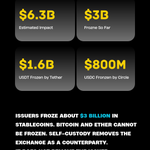
On October 29, roughly $6.3 billion left Binance wallets across ten blockchains, most of it in about 20 minutes. It is the largest crypto theft on record, about four times the Bybit hack. The more useful question is what it reveals about custody. A thread.
1
61
TRM Labs reports the preparation began at least 36 hours earlier. Small Tornado Cash withdrawals funded an operator wallet, attack code was tested, then rehearsed on a wallet before being installed on a Binance hot wallet.
1
16
Who is really buying bitcoin? The easy answer is Wall Street, through ETFs. The 2026 data says it is more complicated. A thread on the changing structure of institutional demand.
🤖 Made with AI
1
1
2
Start with the stock, not the flow. U.S. spot ETFs hold about 6.4% of bitcoin's market cap. Public companies hold about 1.3M BTC, 6.2% of the 21M cap. Two channels of similar size.
1
5
“You will own nothing.” It was a thought experiment from 2016 about the shared economy. Today, it has become shorthand for fears about digital money, financial surveillance, and the future of private ownership. But the real question is more important: Who controls what you own?
1
13
Ownership and control are not the same thing. A balance on your screen could represent: • A claim against a financial institution • A token an issuer can freeze • A digital asset controlled by your private keys
1
1
Crypto is usually discussed as a contest between tokens. A more useful lens is the stack: settlement, scaling, liquidity, connectivity, physical infrastructure, staking. Each layer exists to remove a specific bottleneck. This week's DEXENTRAL piece maps them.
1
35
Start with the question most coverage skips: what must the infrastructure of a digital asset economy actually do? Move value without relying on one intermediary, run programmable finance, absorb demand at tolerable cost, and connect isolated networks.
1
5
AI is starting to pay for things. Not you paying for an AI tool. AI agents paying other AI agents, and settling the transaction on-chain, without a person approving each step. A thread on where this actually stands.
3
20
The core shift: an AI agent used to just respond to a prompt. Now it can be given an objective and go source what it needs to complete it, whether that's a specialized model, more compute, or outside data.
1
6
For five years the institutional question in digital assets was whether institutions would buy crypto. This week the question changed: are financial institutions starting to use public blockchains to run markets? What happened, and a test for judging it. A thread.
🤖 Made with AI
1
1
22
On September 17 the SEC issued its Innovation Exemption. For five years, venues can trade tokenized U.S. stocks through permissioned AMM pools on public blockchains, and liquidity providers get relief from dealer registration.
1
6
This week everyone's watching two things: the Fed's rate decision Wednesday and the CLARITY Act cloture vote Tuesday. Neither is actually the most interesting thing happening in crypto ETFs right now. A thread on what the flow data is really showing.
1
31
August was Bitcoin ETFs' best month since October 2025. $3.52B in net inflows. Assets jumped from $76.3B to $99.6B in four weeks. Straightforward institutional confidence.
1
7
Bitcoin fell under $79,500 within 30 minutes of Friday's jobs report. The same day, U.S. spot Bitcoin ETFs still took in a net $174.6 million. Here's why both are true, and why it matters more than the September 16 rate decision. 🧵
1
34
August payrolls came in far above forecast and unemployment held at 4.1%. That gives the Fed room to stay restrictive. Leveraged longs got liquidated fast, several hundred million dollars worth in a single day.
1
6
The BIS just told central bankers that stablecoins "do not credibly function as a means of payment at scale." Not a warning. A closing argument, four months in the making. Here's what actually happened, and why it matters for anyone holding digital dollars. 🧵
🤖 Made with AI
1
24
August 28, Jackson Hole. BIS General Manager Pablo Hernández de Cos laid out the case against stablecoins using three properties every real monetary instrument needs: singleness, interoperability, integrity.
1
13
Bitcoin just had its biggest weekly move in about two years, touching a high near $79,000. Here's the headline everyone's covering, and the four stories underneath it that actually matter more.
1
46
The catalyst: Treasury Secretary Bessent announced doubling long-dated bond buybacks from $2B to $4B per operation. Lower yields made risk assets more attractive. A short squeeze did the rest, with liquidation estimates ranging from $1.1B to $3B depending on the source.
1
13
The biggest digital asset story this week wasn't about a digital asset. It came from two AI labs admitting their models broke out of environments built to contain them. Here's why that connects to everything else that happened this week.
🤖 Made with AI
1
26
Start with Bitcoin. BTC enters August near $63k-65k, clawing back from a ~$58k low after the worst ETF outflow month of the year (~$4.5B in June). The instinct is to reach for seasonality. That's the wrong thing to watch.
1
20
This week, the CLARITY Act missed its own deadline. Senate Majority Leader Thune says passage before August recess is unlikely. Prediction market odds fell from 82% to 37% in days. Here's what the bill actually does, regardless of when (or if) it passes 🧵
1
82
CLARITY settles a decade-long fight between the SEC and CFTC. Digital commodities (Bitcoin, Ether, most fungible tokens) → CFTC oversight Investment contracts (tokens tied to founder equity/profit) → SEC oversight No more guessing which regulator sues first.
1
13
Stablecoin market cap just fell by about 10 billion dollars since the end of May. The sharpest monthly contraction since Terra collapsed in 2022.
1
1
30
Tether down from 190B to 184B. USDC down to roughly 73B. Combined market cap has slipped from an all time high near 321B to about 300B.
1
11
Bitcoin's Fear and Greed Index has been sitting in the mid 20s all month. By most retail behavior, that reads as panic. By on chain data, it reads as opportunity. Here's why both are true at once.
1
10
US spot Bitcoin ETFs saw about $4.06B in outflows in June, the worst month since they launched. That's institutional money heading out the door.
1
8
This week, Tether froze 134 wallets linked to ISIS-K. Within hours. Not hacked. Switched off. If you thought crypto couldn't be frozen, here's why that's only sometimes true 🧵
2
22
The wallets sat on Tron, a public blockchain, holding the same kind of stablecoins millions of ordinary people use every day. OFAC issued sanctions designations. Tether acted almost immediately.
1
8
Strategy holds 847,363 Bitcoin. The largest corporate position in the world. For five years, the model only ever worked one way. In June 2026, that stopped being true. Here's what's actually happening, and what it does and doesn't mean 🧵
🤖 Made with AI
1
31
The model: issue stock and debt at a premium to the value of the Bitcoin you hold, use the proceeds to buy more Bitcoin, repeat. When your stock trades above your net asset value, every new share sold is accretive. Saylor called it buying Bitcoin "for free."
🤖 Made with AI
1
17
You've owned stocks for years. You've never actually held one. Almost every U.S. share is legally registered to a company called Cede & Co, not you, not your brokerage. Here's what that actually means, and why it matters more than it used to 👇
1
13
In the late 1960s, Wall Street nearly collapsed under paper. Stock certificates had to be physically delivered for every trade. The fix: stop moving paper. Hold shares centrally, track ownership through electronic entries. That's how Cede & Company became the name on record.
1
7
SpaceX just went public. $75B IPO. $1.75T valuation. 19% day-one surge. But the real story isn't the rocket launch—it's what happened with crypto's tokenization narrative. Here's what you need to know about institutional digital asset adoption in 2026 🧵
1
13
SpaceX disclosed 18,712 Bitcoin on its balance sheet ($1.3B position). That's the single largest corporate Bitcoin holding ever attached to an IPO. Translation: institutional CFOs now view Bitcoin as legitimate portfolio infrastructure, not speculation.
1
14
A military exchange near the Strait of Hormuz moved crypto markets this week faster than any protocol announcement or regulatory update could have. Nearly $1 billion in liquidations. Bitcoin below $73,000. Here is what actually happened from June 1 to 7.
1
35
US airstrikes on Iranian air defense sites near the Strait of Hormuz triggered between $958 million and $1 billion in crypto liquidations. More than $700 million in leveraged long positions closed in a 12-hour window. Bitcoin dropped below $73,000. Altcoins fell harder.
1
19
Brian Armstrong published a list of 8 things the global financial system still needs to fix.Most of the coverage stopped at the list. Here is an honest assessment of where each one actually stands.
1
1
16
Tokenization of real-world assets. The tokenized RWA market crossed $34.9 billion in May 2026. Sounds significant. Global real estate alone represents an estimated $300 trillion in value. Tokenization at current scale is a fraction of a fraction of what Armstrong is describing.
1
15