

Engineer and founder, 18 years in. Building with AI where it meets real hardware. I post what I measure.
Dnipro
Joined January 2009
- Tweets2.6K
- Following355
- Followers538
- Likes1.5K







Pinned Tweet
A 2.1 GB file on my laptop writes code, answers history questions and speaks a dozen languages. No internet.
Where does it keep all that?
"In the weights" is the usual answer, and it explains nothing. Here's what is actually in the file.
Everyone's sharing ω = 9/4: AI proved the true cost of multiplying matrices, n^2.25. Engineer's footnote: don't expect it in your GPU soon. Even Strassen's 1969 trick barely shows up in real libraries; GPUs still multiply the old n³ way, in tiles. What lands in real code first?
17
This week's trend in plain words: new models think by running the same layers 2-3 times instead of adding more. @dlouapre's toy tests: more passes give longer reasoning chains, not more stored facts. The catch on a laptop: each pass reads the weights again. Worth it?
27
Years of engineering behind me, now bringing it into open-source AI, the quiet way: run things, measure, fix what breaks. Today two of my fixes landed in oMLX, @jundotkim's 24K-star Mac LLM server. Small, but a start. How did you find your way in?
26
Got curious how clean the test split of an open gauge-reading dataset is.
101 of its 302 test rows point at a training image, and in train that image has a different reading. The right images sit in the repo unused, as _ds6 twins.
2.8K downloads. Fix PR is up. Checked yours?
26
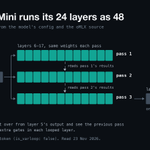
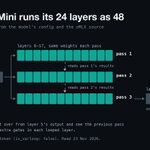
The difference from the 2021 ladder I find most interesting: Inkling 2 Mini's config loops only the middle 12 of its 24 layers, three passes. The first and last 6 run once. Ladder repeated the whole stack.
Did the edge layers resist weight sharing back then?

The loop is complete! 🔁
In 2021 we introduced looped transformers (called "ladder attention") [& compared to universal transformers, looped is much better] with @stephenroller – he's now at Thinky where they've released a looped Inkling 2.
Classical blog post: github.com/facebookresearch/…
Classical paper: arxiv.org/abs/2106.04279


1
54

Tried running Claude Code on a local Inkling 2 Mini on my 2021 MacBook.
With my usual setup the first request was 74,775 tokens. 11 minutes in, the model had read half. I gave up.
Even "hi" from an empty folder is 18,904 tokens. With six tools: 6,129.
What do you cut first?

3
2
97
Everyone posts Inkling 2 Mini numbers from an M5 Max. Mine is a 2021 M1 Pro, so I tried it there.
One prompt: a night highway racing game in a single HTML file.
265 lines in 4.5 minutes, about 20 tok/s. It ran on the first try, demo mode included.
Got curious how much of a local model's wait is just re-reading the same prompt.
Almost all of it. Same 11K-token context, same question, on my M1 Pro:
cache off: 46.3 s to first word
cache on: 1.8 s
oMLX keeps what it has read on the SSD, even across a restart. Side by side:
Because it keeps the skill and not the facts, it can't look anything up. It reconstructs.
Usually right. Sometimes wrong with a straight face. I showed two small models a table and asked how many columns it had. One said 7, the other 5. It had 8.
1
16
Most AI talk assumes a datacenter.
The interesting engineering starts when the model has to live somewhere small: a few GB of memory, a few watts, an answer due in milliseconds, no retry.
I've put vision models on single-board computers. Now I'm measuring language models on a laptop.
What's the smallest thing you've run a model on?
37
This month an AI model built 948 Linux root exploits in one run.
I asked two models that fit on my laptop to find one known WordPress bug.
Qwen3-4B: sees nothing, 0 of 18. Then flags the patch.
Ministral 3B: flags everything, the patched code too.
That gap is the story.
43
Gave two small local models a 25k-token prompt with a table in it and asked one thing: how many columns does the table have?
Qwen3-4B: 7.
Ministral 3B: 5.
The table has 8.
One try each, so not a benchmark. What's the simplest thing your local model gets wrong?
1
37