

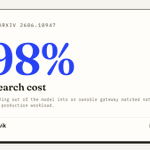


For a year now the default move has been to bake web search straight into the model. Easy to ship. Then the bill arrives, and you realize you can't swap the provider, can't cache, can't control how deep it digs, can't fall back when it fails.

The receipts: 86.1% vs 87.7% on SimpleQA at 91% lower search cost. A 99.4% warm-cache hit rate, 68% lower latency. On a real e-commerce query workload, matched native accuracy and cut search cost by over 98%.
Basically the same answers. A fraction of the spend. The edge was never the model, it's the layer around it.
arxiv.org/abs/2606.18947

Couldn't find a notes and markdown viewer with proper syntax highlighting that was super slim and effective. So I built one. Meet Patina.


• Markdown rendered natively, no web view
• Syntax highlighting for json, yaml, and .env
• ⌘K to jump to any note, autosave
• Your notes stay plain files you own, a [[wiki-link]] is literally that text
• Native macOS, zero dependencies, about 3,000 lines of Swift
Open, edit, done. Wanna change or add something? Free source code (MIT):
github.com/OneMuppet/patina

Native macOS AppKit. No Electron, no web view, zero third-party dependencies. Your files stay plain files you own. About 3,000 lines of Swift, and it's open source (MIT).
Native AppKit, no Electron, no web view, zero third-party dependencies. About 3,000 lines of Swift. Your notes stay plain files you already own, so a [[wiki-link]] is literally that text in the file, readable in anything. ⌘K to jump anywhere, autosave, native Markdown preview.
Open source (MIT): github.com/OneMuppet/patina
Game NPCs are getting the LLM treatment right now: a model call per character, and a bill that scales with it. I got curious about the opposite question, how little do you actually need for one to feel alive?
And it doesn't just run, it evolves. It tunes itself toward a believable life across generations, then holds up on seeds it never trained on. Same seed, same life, byte for byte, so the behavior is testable, not anecdotal.
The intelligence was never in the model. It's in the architecture around it.
Code, and nine machine-checked theorems behind it (determinism, bounded drives, evolutionary convergence): github.com/OneMuppet/daimon