

We build AI Employees that grow your business
New York
Joined April 2026
- Tweets604
- Following5
- Followers525
- Likes701



Pinned Tweet
Here's what most AI consultants actually deliver.
A discovery call.
A strategy workshop.
A slide deck.
A Notion doc full of prompts.
A list of tools to "explore."
A follow-up call to "check in on implementation."
Then they're gone.
You're left with homework.
A folder.
A strategy that lives on a screen and does nothing in your business.
That's the industry standard.
───
We found this out talking to dozens of founders who'd already "done AI."
Spent $5,000–$20,000.
Got documents.
Got frameworks.
Got overwhelmed.
Nothing deployed.
Nothing running.
Nothing generating ROI.
They didn't have an AI problem.
They had a delivery problem.
───
Here's what we do differently.
Day 1: we audit your ops. Find the highest-leverage bottleneck.
Week 1–2: we design the system around your actual workflow.
Week 2–4: we build it. Connect it to your tools. Your CRM. Your data.
Week 4–8: we deploy it live. Test it. Train it. Optimize it.
Day 60: you have a running AI employee. Not a doc. Not a deck. A system.
───
The difference isn't philosophy. It's delivery.
A consultant gives you a map.
We build the road.
A consultant delivers a document.
We deliver an employee.
A consultant's outcome is a presentation.
Our outcome is your ops running without you.
───
Anyone can write prompts.
Anyone can build a Notion template.
Anyone can put "AI strategist" in their bio.
Very few can take your business from zero to a deployed, ROI-positive AI system in 60 days.
That's the gap.
That's why it matters.
That's what we do.

We build on the tools your team already uses:
the CRM, the inbox, the spreadsheets, Slack or Teams.
A new dashboard is one more place to check, and busy people stop checking it.
The Cyndra platform is there if you want a managed home for workflows.
You don't need it to start.

Watch the work for a day before you compare AI models.
Note
what gets copied between systems
what gets checked twice
where requests sit waiting for someone
What would you expect to find on your team?
Most AI pilots that stall have the same problem:
the model changed and the workflow around it didn't.
The same person still copies the output into another system and waits on the same approvals.
Change one workflow end to end first.
Which handoff would you remove?
A workflow should get easier to operate over time.
After a workflow runs, review four things:
what worked
what stopped
what needed human correction
what changed in the business
That review is how an automation becomes an operating capability.
Save this for your next weekly review.

Production exceptions are not noise.
They show where the process, instructions, data, or permissions need attention.
Review them, group the patterns, and improve the workflow deliberately.
What exception teaches your team the most?
What does your team copy into another system every week?
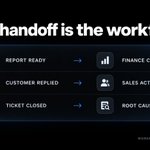
The best first AI workflow is often hiding in a handoff:
copying updates
checking a second system
waiting for approval
explaining the same exception.
That is where we would start looking.
Reply the handoff you would remove first.

AI projects do not need another tool first.
They need:
one owner
one measurable output
one approval rule.
Without those, the pilot has activity but no operating responsibility.
Reply with the recurring handoff you would remove first.
An AI department needs roles:
who gathers context
who checks the result
who takes the action
who owns the exception
who reviews the record
The architecture is the operating model.
Which role is missing from your current AI setup?

One reliable AI worker is better than ten disconnected assistants.
Give one role the context,
tools,
boundaries,
and handoffs it needs.
Add another role only when the work genuinely requires a different responsibility.
Where has tool sprawl created another handoff?
Do not ask whether an AI demo is impressive.
Ask whether the recurring work is costly enough,
stable enough,
and measurable enough to improve.
A smaller useful workflow beats a larger impressive experiment.
Which process is worth changing first?
The cost of AI is not only the subscription.
Count the manual review,
duplicate entry,
delay,
exception handling,
integration work,
and change management around the workflow.
The real business case starts with the whole process.
What hidden cost would you include?
An AI workflow without a process owner becomes orphaned software.
When the policy changes, the data moves, or
the exception pattern changes, someone must notice and update the operating instructions.
Which recurring process has no clear owner today?
Every workflow needs a person who owns the result, not just a person who requested the build.
The owner decides what good looks like, reviews exceptions, and knows when the process has changed.
Who owns the outcome of your next AI workflow?
Security review is a design input.
It should shape
the role,
connected systems,
data boundaries,
approval rules,
and audit history before the workflow is built.
The earlier those questions appear
the fewer surprises arrive at launch.
When does security enter your AI projects?
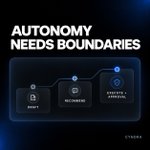
AI access should match the job.
Give the workflow the systems and permissions it needs, not every system available to the team that built it.
Narrow access makes mistakes easier to contain and reviews easier to understand.
Which permission would you remove first?