

Freelance mathematician and educational web developer. I am a proud Israeli American, with love and respect for both countries.
NJ, USA
Joined December 2009
- Tweets14.9K
- Following341
- Followers20.5K
- Likes6.2K


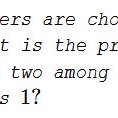


Lorian Saceanu's Inequality for All Triangles cut-the-knot.org/triangle/Lo… #FigureThat #math #geometry #inequality

Alexander Bogomolny retweeted

Here's a couple of solutions cut-the-knot.org/m/Probabili… xitter.cf/CutTheKnotMath/status/…

Seeking problems with 4/7 probability being involved. E.g., Diminishing Hopes II #FigureThat #math #probability cut-the-knot.org/Probability…

Every one can take part in this statistical research. Every one is invited xitter.cf/DegenRolf/status/10141…

You won't believe what great sh*t a psychologist managed to plant on a predatory journal. crimsonpublishers.com/pprs/p…
h/t @maltoesermalte

An Inequality from a Mongolian Exam cut-the-knot.org/m/Algebra/I… #FigureThat #math #algebra #inequality

Let {x_k} be uniformly distributed on say, [-1,1] with the mean=0. Is that true that the variance is at least the square of the median? #FigureThat #math #probability

I was always suspicious of the "pseudo" part in pseudorandom xitter.cf/pomeranian99/status/10…

Russians engineer a way to beat slot machines — for which the casinos have no defense. Insanely interesting piece here by @brendankoerner: wired.com/2017/02/russians-e…

Very elegant xitter.cf/jordancurve/status/101…


Alexander Bogomolny retweeted
Alexander Bogomolny retweeted
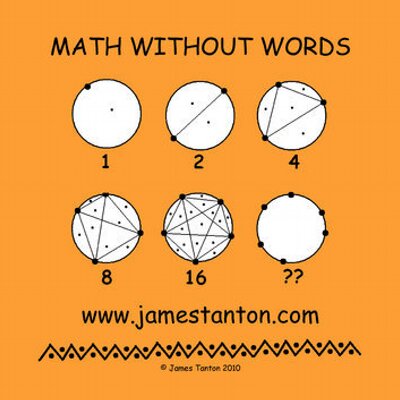
Oh! It's #ff! Add to this ... @republicofmath (of course!) @cbrownLmath @henryseg @margaretwerth @EulersNephew @maanow @timchartier @evelynjlamb @Dr_Kreisberg @NaturalMath @mikeandallie @MathWithMatthew @DavidKButlerUoA @alittlestats @nomad_penguin @aperiodical @NoCOMTC xitter.cf/republicofmath/status/…

I've nothing to say about that. Perhaps somebody will xitter.cf/TigerWhite44/status/10…
Alexander Bogomolny retweeted

It can be equivalently rephrased as saying that if a product of 2n integers is (-1)^n (n!)^2, then their sum is zero.


The discriminant of a quadratic polynomial with integer coefficients equals 23. What can be said about the roots of the polynomial. The more you say, the better. #FigureThat #math #algebra