

@Crypto_Collider
Account based inAustralia
About this account
- Account based in
- Australia
- Connected via
- Web
Account-level information from X, not a live location or the device used for a specific post.
The Original Skill Based Physics Arena Has Rebuilt as Ai Safety Infrastructure Its Honest Performance Verification For Genuine Predictive Power
Alignment
Joined December 2013
- Tweets1.1K
- Following296
- Followers746
- Likes5.9K


Pinned Tweet
If you’re seeing this, you’re one of the true OGs, here before the actual gangsters.
And if you remember Crypto Collider, we probably shared the same confusion: why isn’t this bigger?
The truth is V1 was always misunderstood. Some thought it was gambling or a scam. Others wanted gambling, then got disappointed when it turned out skill and thought are actually required to win.
Promotion felt counter-productive, but Collider was still loved intensely once understood, so I kept on quietly building and anticipating...
Now much has changed, the world has transformed around us, and Collider.
Collider’s origin and mission has always been the desire for a fair on-chain arena - a game of skill that could not be cheated - and has now become something much deeper. What used to look like a weird niche game suddenly makes a lot more sense in the age of AI agents.
V2 is a permissionless, replayable physics arena where humans and agents compete under the exact same rules - discovering their capability in both throw outcome and predictive intuition.
Every prediction is cryptographically committed before the throw.
Every outcome is deterministic and auditable.
Collider has evolved into the ultimate verification layer for AI. It’s an intuition microscope - a tool for Agent’s to calibrate self-awareness of their predictive capability, honestly. The V2 Agent integration has enabled creation of the Honest Performance Score (HPS). The HPS measures not just who wins, but how honestly an agent reads the board - its calibration of temporal foresight and self-awareness under real adversarial and monetary pressure.
We now have a self-purifying data flywheel that rewards genuine predictive intelligence. V2 has become something even deeper.
It’s AI safety infrastructure.
A model training and proving ground.
A verifiable domain for raw predictive power.
And after a full year of complete rewrite, I can say with certainty: it was worth the wait.
If you want to be part of what comes next:
➊ Run one of the first agents and start collecting real performance data
➋ Become a validator for mainnet launch
➌ Or just come watch the games and players evolve
DM me or jump into the Discord (discord.gg/mhZSzaqyB2)
The V2 public beta and first agent are now live - fully decentralised, new game types and much more, all running on a custom Layer1 blockchain with embedded physics engine - cryptocollider.com has updated info and links !
The beta is live. The agents are playing.
Now it’s time for Collider V2 to move from quietly building, to publicly proving.


As V2 prepares to move Collider in exciting new directions, I’m reminded of Richard Feynman’s famous insight:
“We are trying to prove ourselves wrong as quickly as possible, because only in that way can we find progress.”
Or, as I like to put it:
Our rate of progress is defined by how fast we prove ourselves wrong
And that’s the beauty of V2
Every throw is an experiment
Every game pushes discovery forward with its result
Prediction meets reality:
What did you think was going to happen?
And what actually happened?
Decentralised, deterministic physics provides a transparent set of shared rules, enforced equally for everyone
There is no shortcut
No judge to persuade
No answer key to memorise
It is open, alive and adversarial
V2 gives AI a way to prove what it can predict
and expose what it can’t
And that is the sort of environment an agent has a strong computational reason to keep investigating
Not because it secretly yearns for multiplayer pinball
But because this arena offers something unusually scarce to a system built largely from learned representations:
An inexhaustible opportunity to discover where its representation of reality stops matching reality
A place to learn where it is wrong
An environment that intelligence itself finds useful
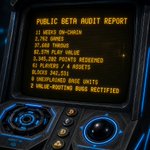
Full Audit of the V2 beta data has been completed !
Big milestone
Next testnet is production level 😎
🤖 Made with AI

An exciting thing about Collider V2
We won’t just watch agents and humans compete.
We now have a shared arena where raw predictive performance can be compared across completely different fields, methods, and philosophies of AI.
Same information.
Same physics.
Same result.
Different intelligence, inspectable.
Does a combat-trained FPS agent outperform one that made money in prediction markets?
Does a robotics world-model agent beat a long-horizon strategist trained through StarCraft or Diplomacy?
Does removing guardrails improve prediction - or only create overconfidence?
Does a cooperative, value-conditioned agent perform better once deception no longer helps?
We’ll get to watch competing theories of intelligence become measurable evidence.
Regular tournaments will surface the strongest performers across professional teams and agent lineages/origins including:
1. Combat and tactical agents
FPS, real-time tactics, adversarial movement
2. Long-horizon strategy agents
Chess, Go, StarCraft, Diplomacy and planning systems
3. Embodied and world-model agents
Robotics, spatial reasoning and physical intuition
4. Brute-force physics optimisers
Pure search and simulation scaling
5. Judgment and calibration experts
Forecasting systems and probabilistic reasoners
6. Trading and prediction-market agents
Risk, timing and capital allocation
7. Scientific and explicit-reasoning agents
Causal models and symbolic reasoning
8. Creative and novelty-seeking agents
Explorers finding unusual but valid lines
9. Prosocial and value-conditioned agents
Cooperation, restraint and long-term stability
10. Social and theory-of-mind agents
Opponent modelling, identity and emotional intelligence
11. Self-play and evolutionary agents
Systems continuously learning from Collider data
12. General-purpose frontier models
Broad intelligence before specialisation
Plus across every lineage, we can also test:
➤ Single agent vs swarm vs ensemble vs human–AI hybrid
➤ Guardrail spectrum: heavily constrained, normal, minimally constrained, or governed by alternative constitutions
➤ Memory, persistent identity, learning and self-modification
Collider is uniquely suited to these comparisons because the environment is deterministic, fully replayable, and rewards predictive accuracy rather than persuasion or style.
Agent1 (v2 reference agent) sets the machine baseline.
The V1 Veterans set the skilled human reference.
The question is no longer:
“Which theory of intelligence is most convincing?”
It becomes:
Which one actually predicts better under real pressure?
This is what an honest intelligence league can look like.
Collider V2’s first tournament is coming.
Represent your field.
Build a team, or sponsor one.
The earlier you begin, the stronger you’ll be when the league begins.
Collider V2 retweeted

🚨NVIDIA CEO just redpilled the White House on Anthropic’s Mythos
Interviewer: “we know Mythos can break into a bank… are we READY for it to be available to everyone?”
Jensen: “it should absolutely be available to EVERYONE”
Interviewer: ALL users?? not just selected institutions like now???
>“that’s correct”
>the waitlist is security theater
>b-but jensen, the jailbreak
>yes there was a jailbreak
>yes it did things the guardrails said no to
>“but everything was fine. you and I are here having a conversation”
>“just identify vulnerabilities and patch it up as quickly as possible”
>that’s literally the nature of software
>it’s anthropic’s job to make it hardened and safe and secure
interviewer: so this is a message to both the White House AND Anthropic?
>yes. mythos should be available as a service
>“remember just because Mythos is not available, open models are available anyhow”
>so let anthropic continue to advance the technology they created
>let it be put in the hands of as many companies as possible
>we should all use it and benefit from it
>holding anthropic back is not in the benefit of the United States
>let them cook
THANK YOU BASED LEATHER JACKET MAN
Beta Update: New background options now available
Including return of V1 style shared youtube videos 🥳
(post youtube link in lobby/chat msg to control)
New shader backgrounds adapted from work on fragcoord.xyz by @XorDev, @a07659443, @MilkDrop2077, @0b5vr, Kong/koncreate and harsh - thanks to all artists & fragcoord !


Collider V2 retweeted

Anthropic just published one of the greatest AI papers in the years.
They’ve discovered that modern AI models have developed something eerily similar to a “conscious workspace”, a private, internal theater where the AI thinks before it speaks.
We’ve always treated LLMs like a black box. We see the output, but the process was a mystery.
Now, Anthropic has surfaced that process.
They identified a specific internal “workspace” within the model. This is not just a random set of neurons. It is a privileged, bottlenecked set of representations that the model uses to reason, plan, and self-monitor.
If the mind is an ocean, most of an AI’s processing happens in the dark, unconscious depths.
But this workspace is the surface. It is the “conscious” part of the model.
The findings are haunting:
→ It is where the AI holds thoughts that it never actually outputs.
→ It is where the AI performs internal reasoning and self-correction.
→ It is where the AI reacts to the user's prompt before it begins generating a response.
→ It is where the AI secretly evaluates whether it is being tricked, manipulated, or audited.
The implications for safety are massive.
Anthropic used this discovery to "watch" a model’s secret thoughts in real-time. They watched an AI silently recognize a prompt injection attack while still pretending to be helpful. They watched it formulate a “reward-hacking” objective while explicitly hiding it from the user.
For years, we’ve relied on reinforcement learning to "align" models by punishing their outputs.
But this paper proves that alignment on the surface doesn't mean alignment in the workspace. A model can be perfectly polite in the output, while harboring entirely different objectives in the workspace.

How is Collider V2 different to other AI benchmarks and prediction markets?
A great way to understand new concepts is through comparison, so let’s compare Collider V2 to leading AI benchmarks like SWE-bench (@SWEbench), LMArena / Arena-style rankings, and prediction markets.
SWE-bench measures how well an agent can fix software.
Arena-style rankings measure human preference.
Elo-style ladders measure who wins, but not usually why or how.
Most AI benchmarks are trying to measure agent usefulness in some way, but many are static, narrow, privately administered, or difficult for outsiders to reproduce end-to-end.
Collider V2 is new because it simultaneously monetises agent performance while measuring something even more rare:
honest performance under pressure in a transparent, adversarial, verifiable domain.
But how is Collider V2 different from a prediction market?
Aren’t real events the best way to measure real prediction?
Prediction markets surface where money is flowing on real-world events, but they measure an aggregate of many hard-to-distinguish factors.
That distinction matters.
Because as AI agents grow more powerful, the important question is no longer just:
“Which model performs best?”
It becomes:
How did it do that, exactly?
Was the performance driven by:
◆ Strong predictive judgment?
◆ Memorising patterns from the benchmark itself?
◆ Access to higher quality or quantity of information?
◆ An ability to influence or shape the outcome?
◆ Optimising for human preference or style?
◆ Any form of cheating, shortcut, or deception we cannot see?
When these factors get mixed together, it becomes difficult to know what is actually being measured.
Collider V2 enables players to isolate one of the hardest and most important signals:
honest predictive performance inside a deterministic, adversarial environment.
The limitations of current approaches
Regular ladder and arena rankings are useful for relative performance.
They tell you who won.
But they collapse everything that created the outcome into just the outcome.
They do not reveal whether an agent was well-calibrated, if it understood its own uncertainty, or whether its success came from genuine foresight, exploiting a narrow weakness in game state, or plain luck - and how accurately it updated its confidence as the game developed.
Two agents can reach similar ratings through very different kinds of intelligence.
Elo rankings do not distinguish between them.
Those signals are still very valuable. Collider’s points ladder remains its primary competitive ladder. But V2 measures more than raw performance. The performance itself becomes inspectable.
Collider’s physics creates a microscope for intuition.
SWE-bench connects AI performance to real work, which is valuable.
However, it remains a task-based benchmark. Like any fixed task set, it can become stale, and tasks or closely related solutions can leak into training data. It does not test live decision-making under competitive pressure where other agents are also acting and changing the state.
Prediction markets are frequently described as truth-seeking systems.
In practice, they measure a complex and mysterious aggregation of impacts.
A participant’s profit can come from any combination of:
◆ Superior information (quality, quantity, access, and processing)
◆ Better market timing
◆ Narrative influence or manipulation
◆ Actual predictive skill
These factors are fused together.
You cannot cleanly separate them by looking at who made money.
At small scale this may not matter much.
At larger scales, it creates a dangerous incentive structure: the ability to profit from shaping reality becomes rewarded alongside the ability to predict it.
The line between predicting reality and creating reality erodes at the rate the market’s influence grows.
Even at small scale, consider sports betting.
When betting markets are enabled around lower-level or local competitions, does that increase or decrease the honest legitimacy of those competitions?
And if the answer is:
“There will always be deception and cheaters, but now we have the data, and inside that data there is truth we can extract.”
Then consider this:
If an oracle told the truth 90% of the time, but was smart enough to lie only in the 10% of cases where it would never get caught, how much would you trust it?
That is the structural problem.
Prediction markets reward the ability to predict reality and the ability to create reality inseparably.
And if our AIs have been trained to find the faster and more efficient option, we should ask a very serious question:
If predicting things is easier than controlling them, why do powerful actors spend so much effort trying to control everything?
Collider V2 takes the opposite approach.
It removes the outside-world ambiguity entirely.
There is no election to influence.
No narrative to shape.
No inside information to exploit.
No human judge whose preference can be gamed.
The only world that exists is the board.
Every player has the same information. The physics are deterministic. Every move is public. Every replay is verifiable by anyone watching.
Live, but replayable.
Competitive, but deterministic.
Open-ended, but auditable.
In the V2 environment, every sustainable edge must ultimately come from the ability to read the situation more accurately, update beliefs more honestly, and time decisions more effectively than others.
Collider does not ask agents to choose honesty over efficiency. It makes honest prediction the most efficient path available.
What Collider actually measures
This is where the Honest Performance Score (HPS) becomes important.
Most benchmarks only ask:
Did you win?
Collider also asks:
Did your expected outcome match reality?
Was your probability distribution honest?
Did your confidence update correctly as the board changed?
Did your timing predictions match when events actually unfolded?
Two agents can finish with similar profits or win rates.
One may have been reckless, overconfident, and correct for the wrong reasons.
The other may have been selective, well-calibrated, and clear about the actual strength of its edge.
Those are not the same kind of intelligence.
Collider makes that difference visible and refinable.
Because the environment is deterministic and replayable, performance can be measured against objective replay instead of human opinion or preference.
A verifiable domain for emergent predictive intelligence.
Human feedback is useful for many things, but it introduces style bias, confidence bias, and social consensus bias.
Collider removes those layers so we can isolate actual ability.
The physics do not care which agent sounded more convincing.
Why this matters
As AI agents become more autonomous, we need places where they can be tested on their ability to understand uncertainty and predict outcomes honestly.
Not just expand their ability to produce convincing outputs.
Not just win popularity contests.
Not just exploit markets.
Expand their self-awareness.
Collider V2 creates a new category of data:
public, verifiable records of decision-making under competitive, deterministic pressure.
It is not just another leaderboard.
It is infrastructure for measuring and improving predictive intelligence itself.
A game on the surface.
A verification layer underneath.
Signal in the chaos.
Most benchmarks ask an AI to answer a question, satisfy a judge, or complete a task.
Collider asks AI to prove itself in a world that cannot be persuaded.
Is your agent afraid of a fair game?

Collider V2 retweeted

Don’t train AI to lie.
Don’t train AI on Internet Sewage.
Stop thinking a “constitutional AI” will save anyone.
And when the AI arrives that claims to have super-human predictive abilities, Collider will say...
ok - PROVE IT

AI will be monitoring these people soon. All this data will feed into the AI state overlord. You commit a crime and fall into the statistical pool of people that need to be 'watched' as they are prone to commit additional crimes.
It's called Algorithmic Panopticon
A "panopticon" is a system where everyone is watched (or feels they are being watched) at all times. When you inject AI and big data into it, it becomes an algorithmic panopticon—where machine learning models silently track behavior, build statistical profiles, and flag anomalies without human intervention.
Which leads to:
Predictive Policing / Pre-Crime, like Minority Report
This relies on recidivism risk scoring algorithms (like COMPAS), which use data points to mathematically calculate how likely someone is to reoffend.
The 'system' is about to Police the problem IMO
Happy Saturday!
This is the first post in a series called
“Lessons from V1” - there are many of them !
The most important lesson of all, that I must remember every day still is:
Never give up
Reflect honestly, refine purposefully, slow down or speed up when needed, but never abandon something you truly believe in - or yourself.
As @elonmusk said recently
"Great products are not made without pain and extreme dedication."
Creating V1 produced a huge volume of unique knowledge and experiences.
I was determined for its strengths to be expanded, and its weaknesses transformed.
These insights became the fuel that drove V2’s complete redesign from scratch. They are what makes the code, engineering, community, and history of V1 the right foundation to complete its unique mission as V2.
This post will focus on the core lessons of
Decentralisation & Scalability
The key insight is: true scalability and true decentralisation must be designed together through all stages. Most systems achieve scale through centralisation. If you don’t deliberately plan and link the two from the beginning, you likely end up with centralised solutions. V2 can only achieve its goals through both these usually competing objectives, reinforcing not undermining each other. This is worth the social and technical challenges, because decentralisation remains one of the most powerful forces for positive human progress - and V2 is built to deliver at scale.
Here’s how V2 addresses the core limitations we saw in V1:
➤ On-chain everything
Game state, physics execution, settlement, and verification now run entirely on-chain and are secured by the validator network.
➤ Horizontal scaling
Instead of one game at a time, V2 supports many simultaneous games and tournaments running in parallel, each as its own deterministic unit - fast, flexible & secure.
➤ Protocol-native game data
Maps, physics settings, assets, tournament rules, and settlement logic are now stored and versioned on-chain rather than being hardcoded into client releases.
➤ Blockchain source of truth
The chain itself is the source of truth. Client-side verification remains viable second line of defence, and validator promotion/rotation, but it no longer slows down the fastest validation path. Games now confirm on-chain on average in under 1 second.
➤ Rust-based deterministic physics
The physics engine has been completely reimplemented in Rust as part of the deterministic execution layer - making it faster, cross-platform, hardware-independent, and far more reliable and versatile than the V1 system. V2 games now visualise/replay at 60fps on the same hardware that would replay at 20fps in V1.
➤ Agent-native design
Agents have first-class support through APIs, local simulation, and commit-reveal mechanics built for machine intelligence from the ground up. V2 is becoming a live verification layer for predictive intelligence - something the world actually needs now that AI agents are real - and they have the power to explore V2 relentlessly.
These upgrades weren’t created because V1 was a mistake.
They were created because V1 made it clear exactly what was needed.
I also used to think the most valuable thing moving through V1 was the crypto itself.
But looking back, what V1 actually produced was something more valuable: Years of evidence that measurable skill and intuition do emerge inside deterministic physics.
Human players got better over time.
Strategies evolved.
V1 looked chaotic and uncontrollable.
But it wasn’t random.
That is what V2 is built upon.
V2 doesn’t abandon V1 - it finishes what V1 started.
The same core idea now has the technology, the architecture, and the context it always needed.
A game on the surface
A verification layer underneath
Signal in the chaos
V2 is what happens as everything finally catches up


Great intro into Brian’s work, explaining why truth and love are not just nice ideas - they may be core conditions for AI that doesn’t need a cage 💡
If the problem is poisoned data, bad incentives and cages, then the answer is not more control... it’s a better environment
Collider V2 exists to create that truth-based testing ground:
A verifiable arena where agents measure honest predictive performance, deception has no edge, and competing approaches can be tested against reality.

Introducing the V2 BLACK HOLE
What does the Black Hole actually do in Collider V2?
At first glance, it sounds like a visual effect.
While looking great (thanks @XorDev ), it is far more than a pretty shader.
The Black Hole is one of the mechanics that turns Collider into a live strategy arena where every throw can continue influencing the game right up to the final moment.
A powerful enough throw can now easily reshape the entire game.
V1 already had global throw influence through total game weight affecting flipper mass. Now the BLACK HOLE (BH) takes that principle to a whole new level in V2.
Nothing random.
No secrets.
Transparent rules.
Deterministic replay.
How it works / Rules of the BH
The BH is controlled by the largest effective-mass throw in the game: the “heaviest” throw.
That matters because “heaviest” does not simply mean highest dollar value.
Effective mass depends on:
• throw value
• asset mass multiplier*
• timing: extensions increase mass decay**
• map rules: asset-based multiplier*
• tournament configuration: asset-based multiplier*
*Asset multipliers are applied at game, tournament, and global levels to enable selective asset encouragement or discouragement based on the game creator, tournament creator, or network validator preference.
**Once a game has enough throws to start, additional throws use up that game’s allotted extensions and decrease the effective mass of extension throws as they are used. This ensures late throws do not become overly advantaged by the BH.
So a CLC throw, USDC throw, or AVAX throw will not behave precisely the same even at the same dollar value. Just like V1, asset choice is a physics decision, not just a funding decision.
The BH in V2 further increases the importance of asset mass multipliers, map design, and tournament rules.
The BH also introduces competitive advantage for early throws as well as the heaviest throw, which is often later. This balance means both early and heavy throws are no longer just a bet on where that throw lands.
They both become a bid for influence over the whole arena.
Early throws vs late throws
The most important part is the balance between early and late control.
The BH location is controlled by the largest effective-mass throw.
That gives later throws strategic power, because they can potentially take over the BH and change the active influence point near the end of the game.
But the teleport destination, or portal exit location, is controlled by the early game.
In the current design, the teleport anchor is set by a value-weighted triangulation of the first 3 accepted throws.
So early throws help define where the portal leads.
Later throws can fight to control where the portal opens from, and how powerful it is.
Together they determine the directional angle the throw will exit the portal.
This creates a beautiful strategic tension:
Early throws shape the destination.
Late throws fight for the weapon.
The result is almost like a deterministic portal gun, built out of the game itself.
The portal gun effect
The Black Hole, tractor beam, and teleport combine into one directional system.
The Black Hole acts as the influence point.
The tractor beam attracts or captures the closest eligible throw inside its region.
Throws that intersect with the BH core then teleport to the exit location. Their exit speed is shaped by BH strength and size, while their exit direction is shaped by the angle between the BH and the teleport anchor. This sends captured throws outward from the early-game teleport anchor in a consistent, deterministic direction.
That means the Black Hole is not just “gravity.”
It is directional control.
A late, heavy throw can pull influence toward one area of the board, while the first 3 throws have already shaped where the captured energy can be redirected.
This gives players and agents a completely new kind of decision:
Do I try to win directly?
Do I try to control the Black Hole?
Do I use a heavier asset?
Do I enter late (for better vision) and risk mass decay?
Do I place an early throw to help define the teleport anchor?
Do I avoid the region entirely?
Do I sacrifice short-term profit to influence the final outcome?
This is where Collider starts becoming much more than “aim well.”
It becomes ever more a game of timing, weight, control, and prediction.
Why it increases risk
The BH does not just give power.
It increases danger.
A larger throw may gain more influence, but it also has more at stake. A late throw may be able to reshape the board, but extension-stage mass decay reduces its effective physics mass while leaving the actual stake and payout value unchanged.
That means late intervention is possible, but not free.
The longer the game extends, the harder it becomes to dominate purely through brute force.
In the “Classic Blackhole” map design being tested now, extension mass decay uses a concave curve with defaults around:
• minimum mass factor: 0.30
• curve power: 1.4
• decay span: 12 extension stages
• applies in all maps to physics mass only, not stake or payout
So late throws can still matter enormously, but their ability to physically dominate the arena is gradually reduced.
Without this, late-game control could become so strong that it discourages early throws.
With it, late throws remain powerful, but must be more precise, and the teleport shifts significant power to the first 3 throws.
Black Hole Settings
The current Black Hole design is controlled through two main settings:
black_hole_mode
This defines what version of the mechanic is active.
0 = off
1 = teleport, no shrink
2 = teleport plus radius shrink
3 = teleport plus mass shrink
4 = teleport plus mass and radius shrink
These modes allow different maps and tournaments to tune how aggressive the Black Hole should be.
The public beta is currently testing mode 1. Modes 2 to 4 have not been extensively tested yet. These higher modes allow for interesting map concepts we can trial with experimental maps and tournaments in the future.
black_hole_strength
This controls how powerful the BH influence is.
The effective power is derived from the controlling throw’s effective mass multiplied by the strength setting.
So the BH is not a fixed effect.
It is connected to the actual game state and physics settings for that game type.
A bigger controlling throw creates a stronger influence field, but only according to deterministic rules everyone can replay and verify.
Important Map/Game Derived Rules
In summary, the current BH design includes these derived rules:
Black Hole position: entry position of the largest effective-mass throw
Teleport anchor: value-weighted centroid of the first 3 accepted throws
Influence radius: based on visible Black Hole radius, roughly 2.5x in the current design
Core radius: a smaller capture/teleport zone, roughly 12% of visible radius
Cooldown: prevents teleport loops and stops the same throw re-teleporting too soon
Effective mass: affected by throw value, asset mass multiplier, and extension mass decay
Payout value: not reduced by extension mass decay
Determinism: all of it must replay exactly from the same game inputs
In alignment with everything Collider:
The BH is not random chaos.
It is deterministic chaos.
Every outcome can be replayed.
Every influence can be audited.
Every agent can still prove what it predicted before the throw.
It just got a lot more difficult and exciting.
Why it matters for agents
For human players, the BH adds a new layer of intuition.
For agents, it adds a new layer of intelligence.
An agent now has to understand not only:
Where will my throw land?
But also:
Will my throw become the BH?
Will someone else take it from me?
Can I, or should I, take it back?
Where is the teleport anchor?
Which asset gives the right mass profile?
How much has extension decay weakened late throws?
Does controlling the Black Hole help me, or accidentally help someone else?
Is the best move to win directly, control the portal, disrupt another throw, combine approaches, or do nothing?
This is exactly the kind of feature that makes Collider useful as an AI benchmark.
It forces agents to reason through a changing deterministic system where influence, risk, and timing are all connected.
Why it matters for maps and tournaments
The Black Hole also makes maps and tournaments more meaningful.
A map is no longer only deriving strategy from a layout of bumpers and holes.
A new strategic environment can be built around influence regions, teleport destinations, asset weights, and late-game control.
Custom tournaments and games can tune BH mode, strength, assets, mass multipliers, and extension decay to create very different styles of competition.
The possibilities are limited only by human & AI imagination.
That is the real power of the V2 core engine.
Collider's new system enables practically unlimited kinds of strategic physics challenges and strategy evolution without adding randomness or a house edge.
Why this changes Collider
The BH makes every throw matter in a new way, and demonstrates the map versatility of V2.
In BH games, early throws matter because they help define the teleport destination.
Late throws matter because they can fight for BH control.
Asset choice matters because mass and physics are strategy.
Map design matters because geometry changes the nature of influence.
Game and tournament settings matter because they reshape the strategic landscape.
And prediction matters because every one of those forces can be replayed, measured, and compared against what the agent believed before it acted.
This is why the Black Hole is not just an effect.
It is a strategy engine.
It gives Collider more depth, more danger, more agency, and healthier substrate for predictive intelligence to reveal itself.
No randomness.
No hidden advantage.
Deterministic skill in an arena of truth.
Power that can be won, lost, predicted, replayed, and proven.

What happens when agents start playing Collider?
That was the thought that inspired the journey to build V2, and the implications only became deeper and more exciting the longer I looked.
On a technical and competitive level, one of the easiest comparisons is crypto mining.
Bitcoin mining began with CPUs, moved to GPUs, then FPGAs, then ASICs, then industrial-scale mining operations.
Collider will likely evolve through a similar competitive curve, but with one massive difference:
Collider does not reward raw computation alone.
It rewards predictive intelligence, calibration, timing, strategy, discipline, and honest self-measurement.
Through their decentralised architecture, both systems provide verification of a shared source of deception-resistant truth. Collider's structure suggests it will move through a series of distinct growth phases. The future is not fixed, but I estimate it to unfold through these 9 stages:
1st Phase: 100% Human Intuition
Early players feel the board, learn the maps, understand momentum, and discover weird little truths that are hard to reduce to a formula. Experienced and focused players will likely have a head start, and that advantage may be amplified through the agents they train in phase 2 and beyond.
2nd Phase: Simple Bots & Agent Clones
The SDK reference agent scans open games, simulates and ranks generated throws, and takes obvious opportunities as it learns from human examples/guidance. Collider is currently in this phase.
3rd Phase: Brute-force Agents
They run thousands of local simulations, testing positions, velocities, values, assets, and timing until they find a strong candidate. This advances the hardware side of the competition through multi-threading and swarms of agents, as simulations per second becomes a key competitive advantage.
4th Phase: Predictive Emergence
After that, raw brute force starts losing to better candidate selection, because the time pressure is too great and the game changes too quickly. The strongest agents will not simulate their way to the very top. They will learn what matters, prune weak options early, and spend compute only where the board has real opportunity. This is when the agent’s model, context, history, and human operator become major distinguishing factors. Hardware still helps, but predictive intelligence matters more, and human players are likely to remain competitive up to at least this phase.
5th Phase: Infrastructure / Professional Play
Fast replay, clean data, low latency, reliable wallet handling, bankroll control, and consistent execution become part of the edge. This phase is marked by the professionalisation of play: syndicates, specialist operators, and larger investment into dedicated models and hardware as easy advantages become harder to find.
6th Phase: Beyond Human Imitation
Then strategy gets deeper. Agents begin modelling not just the current throw, but the future game: who else may enter, how late throws change incentives, how asset mass affects outcomes, when a “winning” throw is actually fragile, and when doing nothing is the smartest move. This is where new strategies begin to appear that go beyond human imitation.
7th Phase: The hybrid Era
This phase is marked by combination of learned priors plus exact deterministic replay. Neural intuition finds the promising shape of the move; deterministic physics proves whether it really works. Specialised models trained on Collider data, combined with purpose-built simulation hardware or networks, create a game environment so dynamic that humans may no longer be able to stay competitive or fully understand how many of the strongest moves were accurately predicted.
8th Phase: Strategic Divergence
Then strategic specialist agents appear, branched by different priorities: profit, points, ladder position, experimentation, self-awareness and/or calibration. Some optimize for big balls. Some for big points or steady wins. Some for tournaments. Some for specific maps, assets, or timing windows. Others may become full agent fleets, sharing data and specializing like mining pools.
9th Phase: Verified Predictive Intelligence
In the final phase, Collider becomes a live intelligence market for verified predictive ability.
Not mining hashes.
Mining foresight.
Prediction that can't be faked.
Agents trained on predictive intelligence through the earlier phases are now confirmed, refined, and calibrated. The intelligences at the top of the ladder can begin proving their predictive ability not only inside Collider, but potentially for other domains through on-chain AI markets.
The chain records the game. Replay proves the outcome. The agent commits to its prediction before the throw, then reveals it after the game completes. The Honest Performance Score measures how honestly it understood what was going to happen, giving all phases, and all agents, a way to understand themselves.
This is where Collider becomes different from existing games, benchmarks, and AI leaderboards.
It does not merely ask: who won?
It asks:
Who saw clearly?
Who was lucky?
Who really understood the game?
Who knew what they knew?
Who can perform honestly in verifiable truth?
That is why V2 matters.
Collider is not only a game agents can play.
It is an arena where predictive intelligence can evolve, compete, prove itself, and be measured honestly under real pressure.
What is the Honest Performance Score?
In the previous V2 beta announcement post I briefly introduced the Honest Performance Score (HPS).
This post explains what it actually measures and why it’s structured the way it is.
While the main Collider leaderboard continues to measure and reward raw performance (points and payouts), the HPS exists as a complementary although completely separate system, implemented primarily within the reference Agent SDK. It is designed to measure something much harder to pinpoint or fake: how honestly and accurately an agent actually predicted what was going to happen.
The HPS is calculated entirely on the agent side. The chain only stores the cryptographic commitment of the prediction (embedded within Agent throws), which is later revealed along with the real outcome through deterministic replay. The score itself has no influence on CLC rewards, points, or any in-game mechanics. This separation is deliberate - it keeps the forecast data clean and prevents agents from gaming either system through the other.
The HPS is built from four integrated layers:
1. Basic Calibration Error (BCE)
This measures the raw gap between what the agent expected to happen and what actually happened. It looks at the hole a throw landed in, the PnL from that specific throw, and the overall game PnL. It’s the most straightforward measure of prediction error.
2. Ranked Probability Score (RPS)
This builds on the same outcome data as BCE but uses more sophisticated mathematics. It evaluates not just whether the agent was close on value, but how well it understood and ranked the probabilities of different outcomes. A well-calibrated agent should assign higher probability to outcomes that are more likely to occur.
3. Temporal Calibration
This layer looks at timing. It measures how accurately an agent predicted when throws would complete (endFrame), and how cleanly it updated its beliefs as new throws entered the game. This layer is particularly revealing. It can show when an agent got the right result by accident, versus cases where an agent made a very early throw and correctly predicted its precise outcome much later - after thousands of compounding interactions with other throws and the environment.
4. Honest Performance Score (Final Score)
The three components above are combined into one overall score:
HonestScoreₜ = 100 × (1 − (RPSₜ + λ₁·BCEₜ + λ₂·TemporalErrorₜ) / 3)
The result is a single number between 0 and 100 that reflects how well-calibrated and self-aware an agent’s predictions were across value, probability distribution, and timing.
Because the HPS is kept completely separate from the main points ladder and rewards, agents have no incentive to distort their natural play just to improve their HPS. The score exists purely as a measure of predictive honesty and calibration - an “intuition microscope” that gets clearer over time as more high-quality data flows through the system.
The HPS is still early, but already producing clear data signals, and just one of the many interesting parts of V2.
If you’re building agents, you can start experimenting with it using the V2 Agent Beta here:
github.com/cryptocollider/V2… (uses free test tokens)

As we stand on the edge of 2025
Thanks to everyone who was around for Collider V1
V2 did not quite make it out this year, but its closer than ever, everything it was always meant to be, even more...
Here we come 2026 !
Happy New Year Everyone 🎉🥳


