The reported Visa–Fireblocks price tag is about $2.5 billion—but Fireblocks has denied the acquisition report.
Axios reported that Visa was in talks to buy the crypto custody firm.
Bitcoin Magazine characterized the alleged talks as late-stage; that detail remains unconfirmed.
This is different from Standard Chartered’s announced agreement to acquire Zodia Custody, which is pending approval.
For crypto users, the distinction is important: a reported conversation is not a completed deal or a change in custody services. Would you wait for a formal announcement before treating this as a major shift?
ChainSecurity identified 13 real-world examples of smart contracts that could be affected by Ethereum’s Glamsterdam gas changes.
Developers canceled the upgrade’s planned Hoodi testnet activation after a warning that contracts could permanently record failed operations.
ChainSecurity is coordinating responsible disclosure with affected projects. The reports do not say any contracts have been exploited, and no new Hoodi date has been announced.
This is a compatibility issue for applications already deployed—not just a question of whether a new upgrade works on a test network. If you use Ethereum apps, the next milestone is a revised Hoodi plan after developers assess the risk.
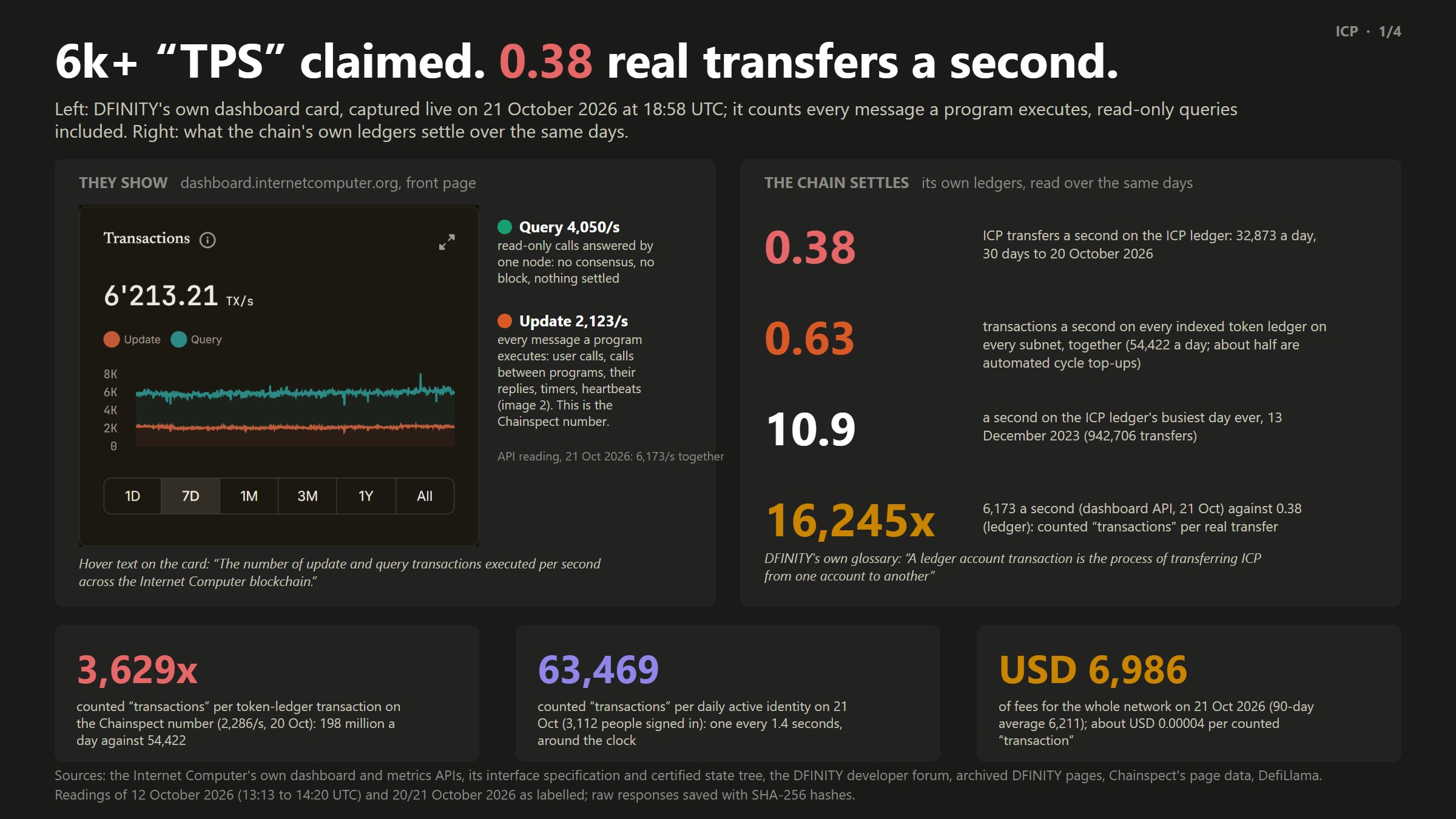
Justin Bons says ICP’s reported 6,000+ TPS may not represent meaningful user activity—and puts real usage at about 0.4 TPS.
- His allegation: basic chain functions are being counted as transactions.
- The post does not show the method or data behind either number.
- TPS can describe very different things depending on what gets counted.
For anyone assessing ICP, the useful question is not just how high the TPS figure is, but whether it measures activity from people using apps. A transparent breakdown would help settle the dispute.
Read more → cryptocatalyst.news/articles…
Original post: xitter.cf/i/status/2113002380362…
ICP's reported TPS numbers are fake! ⚠️
They claim 6k+ TPS, but in reality, ICP only does 0.4 TPS. It is a ghost chain!
By counting basic chain functions as TXs, they are fraudulently misleading the public
Do not be fooled; there is real usage in crypto, but ICP is not it: đź§µ
ICP's foundation, DFINITY, is again caught red-handed lying to the public. This time to a preposterous degree:
The Lie:
The 6k TPS figure comes from DFINITY's own official website. Here comes the kicker: 4k of that "TPS" are read-only queries!
The remaining 2k "TPS" are application steps, something ALL other smart contract chains have, but no other blockchain actually counts as TPS. These include contract-to-contract calls, timers, replies & heartbeats. ICP's leadership counts all of these as "TPS" today
The Truth:
Once we subtract all of those phony forms of TPS, ICP ends up with a mere 0.4 TPS, or 0.7 TPS if we also counted every token ledger
That means DFINITY is inflating the usage of ICP by a whopping factor of x16245
All while the biggest user of ICP today is DFINITY's own subnet where they host their apps! The ckBTC & ckETH minters, along with their ETH & SOL relays. Together, produce 31.5% of this fraudulent TPS count
One Example:
There was a particularly interesting incident in 2022 when a developer was loading a database into his app at less than one call a second
DFINITY's own dashboard showed his subnet doing 1.3k Transaction Per Second, a third of the network's usage that week
The developer then went on to the forum to ask how that was possible. The ICP engineer frankly explained it:
"Each upload put 500 records into three indexes, and the code did each insert as a call from the program to itself. Every call counts, and every reply to a call counts again. So one upload became about 3,000 "transactions". Written as one batched call, the same work would have shown "500x fewer transactions".
Following that up with one of the most damning statements in this case:
"DFINITY's own benchmark had deliberately left such messages out, because counting them "might have been deemed as cheating (after all we care about user-triggered transactions rather than artificially generated traffic)".
DFINITY's own dashboard counts them anyway & still does to this day. On this day, the 21st of October 2026, replies to calls between programs were 57 percent of the "update" count! This mechanism is also not rate-limited at all
In conclusion, their own engineer said counting internal messages would be cheating in a benchmark; their own dashboard counts them to this day; that is the number they sell as TPS! Under ICP accounting, 1 TPS turns into 1.3k "TPS". Now that is a fraudulent & misleading design!
Discrepencies
That is how they can claim to do "6k TPS" while only bringing in less than 7k of fees per day, while its own "Internet Identity" ICP's login system registers a mere 3112 users in the last day
Their physical presence in our ecosystem is also not at all congruent with their claim of being the second most used blockchain in the world
Such inconsistencies are hard to reconcile. Which is why this expose was needed. As it turns out, they have been straight-up lying about their usage this entire time!
Chainspect
Why Chainspect, the blockchain explorer & metrics tracker, would unquestioningly repeat these lies. Taking its data directly from DFINITY's API is unknown
Chain Inspect is not a registered company & for that reason & more, I was unable to find any connection to DFINITY, but it cannot be ruled out. They claim to be fiercely independent
Chain Inspect only reports the 2k "TPS" figure, but that is still wildly misleading
Especially since they do carry out more due diligence with other chains, such as by subtracting consensus messages in SOL, for example, as they very well should
Weirdly, their own policy demands that they adjust their figures accordingly:
"We aim to include only user-initiated transactions and exclude system ones, to enable fair comparison of different networks (e.g. for Solana we exclude “voting” transactions related to their custom consensus mechanism)."
As a community, we need to point the finger here & ask @chainspect_app to update their policy on how they count ICP's "TPS".
The correct number is below 1; reporting 2k+ instead is wildly misleading
Do better, Chain Inspect! We are kindly holding you accountable today, as your website & service are otherwise great!
Conclusion
ICP is a ghost chain: There is nothing wrong with that, as we all need to start somewhere
However, what is wrong is that they are actively lying about this fact. In the investment world, that is called fraud!
Honesty & integrity matter far more to serious investors, as we are, myself included, willing to invest in "ghost chains", making a bet on a superior team & tech
It is a shame, as ICP could be a great chain if they enshrined their subnets as I have previously recommended. If they also cleaned up their marketing, it could become a real contender
Instead, the community will most likely respond with denial again. Exposing a sickness that is endemic within many small cryptocurrency communities
Groupthink with cult-like dynamics, combined with both financial & peer pressure, creates one hell of a toxic soup
Despite all of the personal attacks that will likely follow this critique, the truth speaks for itself. That is also one of the most wonderful things about crypto
It is open-source code running a transparent blockchain. The scammers & crooks can not hide anymore with sufficient due diligence, of the sort we did here today
To the ICP community, there are genuinely good, smart & well-meaning people there. We should never paint any community with a single brush
For those of you receptive to this critique, I hope it will inspire ICP to clean up its act. Operating with more honesty & integrity is not only the right thing to do. It is also the best possible long-term strategy for success in our industry today
When all is said & done. It is the truth that sets us all free! 🔥
More than 61,800 BTC tied to a $5.7 billion fraud scheme are now at the center of a cross-border legal fight.
- Chinese prosecutors are seeking to confiscate the coins, which were seized in the U.K.
- A U.K. court ruled that Chinese law governs victims’ claims.
- A Tianjin court is expected to hear the confiscation request after a six-month notice period.
The reported $5.7 billion scheme figure and Decrypt’s $5.1 billion valuation of the Bitcoin are different measures. For everyday holders, this is about the fate of specific seized assets—not a new restriction on Bitcoin. The key question is whether the courts prioritize confiscation or claims from victims.
The OCC’s first GENIUS Act stablecoin rules take effect Jan. 18—but the agency still hasn’t said when issuers can apply.
- The final rule covers reserves, redemptions and risk standards.
- The OCC dropped a proposed presumption about third-party rewards and will assess those arrangements under the law.
- Other federal agencies are still working on their own rules.
For stablecoin users, this adds one piece of the regulatory framework, but it does not itself change every token’s terms or settle the full U.S. rulebook. Would you use a stablecoin whose rewards depend on a case-by-case regulatory review?
25,700 ETH—about $61 million—went through Tornado Cash in two hours from a wallet linked to the $295 million Drift exploit, Decrypt reports.
- CoinTelegraph counts $109 million in Ether transfers to the mixer over two days.
- The outlets give different snapshots of what remains: roughly $198 million in one report, $138 million in the other.
- Tornado Cash can complicate tracing; the transfers do not show that the ETH was cashed out or recovered.
For Drift users, movement on-chain is not the same as getting funds back. The key question is whether any assets can be identified and recovered.
BlackRock’s proposed Bitcoin protection ETF would use options on IBIT to limit potential losses—but investors would give up some possible gains.
- The proposed iShares Bitcoin Managed Protection ETF adds an options strategy to BlackRock’s Bitcoin and Ether lineup.
- Decrypt reported IBIT brought in $665 million in a day.
- CoinDesk reported outflows of $83.6 million from Fidelity’s FBTC and $54.9 million from Grayscale’s GBTC.
For everyday investors, this would be a different trade-off from simply holding a spot Bitcoin ETF. The key details still to come: how much downside protection, what upside cap, and over what period.
Read more → cryptocatalyst.news/articles…
binancecoin:native chain gaining TVL share over the last 7 days
chaintvl.com/flows
Whats going on on #BSC
The CFTC has approved its first bitcoin perpetual contract—and is telling a court that CME has not shown the agency’s policy is harming the exchange.
- CME’s case concerns how perpetual futures should be classified under U.S. law.
- That classification can shape which firms may offer these contracts and under what rules.
- The dispute could affect U.S. access to perps, but the report gives no court decision or timeline.
For traders, approval of one contract is not a blanket green light for every venue or product. The next signal is how the court handles CME’s challenge. Would you trade perps through a regulated U.S. venue?
France’s National Assembly adopted an amendment targeting certain stablecoin swaps, but the report does not say which transactions qualify or confirm the measure is fully enacted.
- Separate proposals on crypto exit taxes and self-custodial wallet reporting are still under consideration.
- No tax rate, threshold, or implementation timeline is provided in the available details.
For French crypto users, the key distinction is between an adopted amendment and rules that are actually in force. Would you change how you swap crypto before the final wording is clear?
Read more → cryptocatalyst.news/articles…
JPMorgan plans to bring JPM Coin, its token representing dollar deposits, to Ethereum as it seeks to offer the product to a wider selection of institutional clients.
The report does not give a launch date or say which Ethereum services the token will support.
JPM Coin represents deposits at JPMorgan; it is not an announcement of a retail stablecoin for the public.
For institutions, the real test will be access rules and what the Ethereum rollout enables. Would those details change how you think about bank-issued tokens?