

We help systematic & discretionary grain traders quantify the impact of weather on grains to improve trading. Free Trials: https://xitter.cf/t.co/t823t2ZFV1
State College, PA
Joined January 2018
- Tweets2.9K
- Following450
- Followers9.9K
- Likes1.1K


Pinned Tweet
The U.S. corn condition rating declined this week, while the state data show substantially weaker conditions across the western Corn Belt.
The national corn crop rated Good or Excellent fell from 63% to 61%. The latest rating is 3.9% below the historical median and ranks in the 38th percentile.
Western Corn Belt deviations from the historical median:
• North Dakota: −33.3%
• South Dakota: −20.7%
• Nebraska: −18.5%
• Kansas: −13.8%
North Dakota has recorded the sharpest recent decline. Its Good or Excellent rating fell from 71% on July 13 to 37% on August 3, placing the latest reading in the 8th percentile.
The regional difference is clear. Nebraska and South Dakota are well below their historical medians, while Iowa is 10.1% above its median.
Click the link in the comments below to get a risk-free trial of CropProphet. 👇
#OOTT #AgWx #Corn #CornBelt #GrainMarkets


How do today's Argentina corn and soybean precipitation forecasts compare with historical forecasts issued around the same time of year?
Our Point-in-Time Weather Forecast API provides access to 8+ years of archived weather forecasts, allowing users to compare current model forecasts against historical forecasts and conduct backtesting.
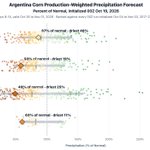
For Argentina's week-two precipitation forecast (Oct 26-Nov 1), AIFS-ENS ranks among the driest 11% of comparable historical forecasts for corn and the driest 6% for soybeans.
The graphics compare today's 00Z ECMWF, GEFS, GFS, and AIFS-ENS forecasts against historical 00Z forecasts initialized within ±15 days of October 19 from 2017-2026.
#OOTT #AgWx #Corn #Soybeans #Argentina #CornBelt #GrainMarkets


ECMWF, AIFS, and GEFS forecast substantially below-normal precipitation across Argentina's corn and soybean production regions in week two (Oct 26–Nov 1).
Argentina's corn production-weighted precipitation forecast for days 8–14:
• ECMWF: 72% of normal
• AIFS: 55% of normal
• GEFS: 54% of normal
Argentina's soybean production-weighted precipitation forecast for days 8–14:
• ECMWF: 58% of normal
• AIFS: 49% of normal
• GEFS: 46% of normal
Get a risk-free trial of CropProphet using the link in the comments below! 👇
#OOTT #AgWx #Corn #Soybeans #Argentina #GrainMarkets


Check out the API here: cropprophet.com/weather-fore…

Request a risk-free trial of the API here: bit.ly/TryCropProphetTwitter
ECMWF, AIFS, and GEFS forecast substantially below-normal precipitation across Argentina's corn and soybean production regions in week two (Oct 26–Nov 1).
Argentina's corn production-weighted precipitation forecast for days 8–14:
• ECMWF: 72% of normal
• AIFS: 55% of normal
• GEFS: 54% of normal
Argentina's soybean production-weighted precipitation forecast for days 8–14:
• ECMWF: 58% of normal
• AIFS: 49% of normal
• GEFS: 46% of normal
Get a risk-free trial of CropProphet using the link in the comments below! 👇
#OOTT #AgWx #Corn #Soybeans #Argentina #GrainMarkets
Get a risk-free trial of CropProphet here: bit.ly/TryCropProphetTwitter
US corn and soybean harvest progress could accelerate over the next seven days, with all three forecast models showing substantially below-normal precipitation before a wetter pattern develops in week two.
US corn/soybeans production-weighted precipitation forecast for days 1-7 (Oct 19-25):
• ECMWF: 46% / 33% of normal
• AIFS: 28% / 19% of normal
• GEFS: 47% / 35% of normal
The forecast shifts toward above-normal precipitation in week two (Oct 26-Nov 1), with the AIFS model showing a substantially wetter outlook than the ECMWF and GEFS.
US corn/soybeans production-weighted precipitation forecast for days 8–14:
• ECMWF: 118% / 103% of normal
• AIFS: 194% / 173% of normal
• GEFS: 122% / 109% of normal
#OOTT #AgWx #Corn #Soybeans #CornBelt #GrainMarkets


Get a risk-free trial of CropProphet here: bit.ly/TryCropProphetTwitter
How has soybean planting shifted across Brazil over the past 50 years, and why does it matter for weather forecasts?
In the 1970s, soybean cultivation was concentrated primarily in southern Brazil. Since then, soybean planting has expanded substantially into central Brazil, particularly Mato Grosso and Goiás, as well as other northern producing regions.
The attached maps and GIF illustrate how soybean cultivation has expanded and shifted geographically across Brazil over time, showing changes in the share of land used for soybeans.
With the ECMWF, GEFS, and AIFS forecasting below-normal precipitation in Mato Grosso over the next two weeks, rainfall across this region is important to monitor as Brazil's 2026/27 soybean planting season progresses.
This geographic shift in soybean cultivation also highlights the value of CropProphet's production-weighted weather indices, such as Brazil soybean production-weighted precipitation. These indices account for where soybean production is concentrated when aggregating weather conditions and forecasts, rather than weighting all geographic areas equally.
#OOTT #AgWx #Soybeans #Brazil #GrainMarkets #Soja

Brazil soybean weather: All three major forecast models indicate below-normal rainfall in Mato Grosso over the next two weeks.
Today's 00z ECMWF forecast has shifted drier for October 16–22, bringing it closer to the GEFS and AIFS forecasts.
Mato Grosso precipitation forecasts (% of normal):
Week 1 (October 16–22)
• ECMWF: 62%
• GEFS: 35%
• AIFS: 40%
Week 2 (October 23–29)
• ECMWF: 73%
• GEFS: 46%
• AIFS: 67%
The ECMWF reduced its Week 1 Mato Grosso precipitation forecast by 13% of normal compared with yesterday's 00z run.
All three models now consistently forecast below-normal rainfall across Mato Grosso during both weeks, although the GEFS remains the driest.
With Brazil's 2026/27 soybean planting underway, rainfall amounts and distribution across Mato Grosso will be important to monitor for soil moisture, planting progress, and crop establishment.
#OOTT #AgWx #Soybeans #Brazil #GrainMarkets #Soja


Get a risk-free trial of CropProphet to access the data and analyze weather and crop production risks: bit.ly/TryCropProphetTwitter
Brazil soybean weather: All three major forecast models indicate below-normal rainfall in Mato Grosso over the next two weeks.
Today's 00z ECMWF forecast has shifted drier for October 16–22, bringing it closer to the GEFS and AIFS forecasts.
Mato Grosso precipitation forecasts (% of normal):
Week 1 (October 16–22)
• ECMWF: 62%
• GEFS: 35%
• AIFS: 40%
Week 2 (October 23–29)
• ECMWF: 73%
• GEFS: 46%
• AIFS: 67%
The ECMWF reduced its Week 1 Mato Grosso precipitation forecast by 13% of normal compared with yesterday's 00z run.
All three models now consistently forecast below-normal rainfall across Mato Grosso during both weeks, although the GEFS remains the driest.
With Brazil's 2026/27 soybean planting underway, rainfall amounts and distribution across Mato Grosso will be important to monitor for soil moisture, planting progress, and crop establishment.
#OOTT #AgWx #Soybeans #Brazil #GrainMarkets #Soja
Grain Traders: Get a risk-free trial of CropProphet today!
bit.ly/TryCropProphetTwitter
"The trade is focused on is not the forecast for El Niño two months out. It's what's going on right now." @StandardGrain
So, let's take a look at the precipitation forecast for Brazil soybean producing regions over the next 2 weeks.
Today's 00z Brazil soybean production-weighted precipitation forecast for week 1 (days 1-7):
• ECMWF: 107% of normal
• GEFS: 80% of normal
• AIFS: 77% of normal
Today's 00z Brazil soybean production-weighted precipitation forecast for week 2 (days 8-14):
• ECMWF: 123% of normal
• GEFS: 105% of normal
• AIFS: 105% of normal
#OOTT #AgWx #Brazil #Soybeans #Soja #GrainMarkets


Get a trial of CropProphet today: bit.ly/TryCropProphetTwitter
Check out the YouTube video here: youtube.com/watch?v=p71ZPhgv…
Brazil’s 2026/27 soybean planting is running nearly in line with its 5-year average nationally, but progress varies considerably across key producing states.
According to CONAB's October 9 report, Brazil soybeans are 15.6% planted, a +0.4% deviation from the 5-year average.
State-level planting progress vs. the 5-year average:
• Bahia: 11% planted | +7% deviation
• Paraná: 36% | +5%
• Mato Grosso do Sul: 25% | +3%
• Minas Gerais: 5% | 0%
• Santa Catarina: 7% | 0%
• Mato Grosso: 25% | -1%
• Goiás: 7% | -2%
While the national planting pace is close to average, Bahia and Paraná are ahead of their historical averages, while Mato Grosso and Goiás are slightly behind.
Will these regional differences persist as Brazil's soybean planting season progresses?
#OOTT #AgWx #Soybeans #Soja #Brazil #GrainMarkets


Brazil’s 2026/27 first-season corn planting is running ahead of its 5-year CONAB average nationally, but progress varies considerably across key producing states, even more so than soybeans.
According to CONAB's October 9 report, Brazil's first-season corn is 34% planted, a +2.5% deviation from the 5-year average.
State-level planting progress vs. the 5-year average:
• Santa Catarina: 80% planted | +7% deviation
• Rio Grande do Sul: 79% | +2%
• Paraná: 78% | -3%
• Minas Gerais: 3% | 0%
• Goiás: 1% | 0%
• Bahia: 1% | +1%
In southern Brazil, Santa Catarina is running ahead of its 5-year average, while neighboring Paraná is behind, despite both states being nearly 80% planted.
How will these regional differences evolve over the coming weeks?
#OOTT #AgWx #Corn #CornBelt #Brazil #GrainMarkets


As @StandardGrain mentions, a SUPER El Niño is coming. So should grain traders care?
Using objective data from the CropProphet SFTP, we analyzed the impact of ENSO on Brazil soybeans.
National yield: no consistent El Niño relationship
• Across 51 seasons (1974-2024), Brazil's national soybean yield shows no consistent relationship with Jan-Feb Niño 3.4.
• The last three super El Niño seasons (DJF Niño 3.4 at or above +2.0°C) finished mixed versus trend: +5.0% in 1982/83, +1.8% in 1997/98 and -4.2% in 2015/16.
Regional yield: north and south move in opposite directions
• In El Niño years, yields have run below trend in the North/Northeast and Center-West and above trend in Rio Grande do Sul.
• Across 173 microregions (1990-2024), 92% of North/Northeast and 98% of Center-West microregions show a negative relationship, while 72% of Rio Grande do Sul microregions show a positive one.
• In El Niño seasons, the typical microregion finished 6.7% above trend in Rio Grande do Sul and 2.0% below trend in the North/Northeast.
• The strongest negative relationships are in Maranhão, Tocantins and Piauí.
• Nationally, the two partly offset.
As of now, traders are focused more on the current conditions. In Brazil soybean production regions, rainfall over the last 30 days has run 112.4% of normal. The Oct 12 00z 15-day forecasts call for 117.4% of normal on the ECMWF ensemble, 97.3% on the GEFS and 89.9% on the AIFS.
#OOTT #AgWx #Brazil #Soybeans #GrainMarkets


Analyze the impact of weather on grains using CropProphet:
bit.ly/TryCropProphetTwitter
Argentina’s corn planting is running 9.9% ahead of the five-year average, with national progress at the 89th percentile.
As of October 8, planting for the 2026/27 season reached 27% nationally, compared with the five-year average of 17%.
How does planting progress compare across individual provinces?
• Buenos Aires: 15% planted | +3% vs. average
• La Pampa: 5% planted | +1%
• Córdoba: 31% planted | +15%
• Santa Fe: 68% planted | +24%
• Entre Ríos: 84% planted | +3%
• Corrientes: 99% planted | +26%
• Misiones: 35% planted | +7%
Santa Fe and Corrientes show the largest positive deviations from their respective five-year averages, while planting progress varies considerably across provinces.
#OOTT #AgWx #GrainMarkets #Argentina #Corn

