

Former HS2 Whistleblower & Project Risk Expert
Joined June 2009
- Tweets44
- Following105
- Followers46
- Likes19


Pinned Tweet
The case for carrying on with #HS2 rests as much on the cost to cancel as on the cost to build.
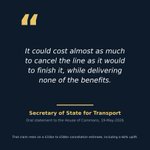
Ministers say cancelling "could cost almost as much" as finishing.
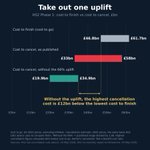
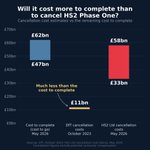
That rests on HS2 Ltd's estimate: £33bn to £58bn to cancel Phase 1. In 2023 the figure was £11bn (2019 prices).

Take off the 66% and cancelling comes to about £20bn to £35bn.
Finishing costs £47bn to £62bn.
Even the highest cancellation cost is about £12bn less than the lowest cost to finish. So does the case for continuing still stand?

With up to £62bn more at stake, these numbers need the independent review @RupertLowe10 proposed at the Public Accounts Committee @HoCcommitteesUK, before the Budget on 28 October.
Full piece, letters and FOI response: stephencresswell.co.uk/hs2-c…
#Budget2026

Can any gun experts identify this weapon seen on site at HS2?
Most likely an air rifle or replica, but still shouldn't be on a work site for a piece of safety critical public infrastructure (if built). Lax security.
#HS2
See this Instagram post by @whistleblower_hs2.scsjv instagram.com/reel/Dc0vMmdKu…
Stephen Cresswell retweeted

Do you feel it?
In late 19th-century Paris, while concert halls demanded massive orchestral sound and technical speed, Erik Satie took a radically different path. They made fun of him. They tried to ignore him.
Working as a pianist in the cabarets of Montmartre, he composed Gymnopédie No. 1 in 1888—a work that stripped Western classical music to its barest essentials.
The piece operates on a deliberate paradox. Though peaceful on the surface, Satie marked it lento e doloroso (slowly and painfully).
That underlying melancholy prevents the music from becoming purely decorative, giving every suspended chord weight and quiet gravity.
Watching it played, you see the thought and weight put into each simple note as it pulls on something inside you.
To many it is not to make you feel good but to feel. And in this is something shared. Perhaps a rainy-day memory.
In this 1966 broadcast, French pianist Jacques Février demonstrates the strict discipline Satie’s music requires. Chosen by Maurice Ravel and Francis Poulenc to premiere their works, he understood that performing Satie demands utter emotional restraint, letting the space between the notes carry the composition’s weight.
By removing resolving harmonies and traditional momentum, Satie laid the groundwork for modern minimalism and ambient music nearly a century before either genre had a name.
In Oct 2023, cancelling HS2 Phase 1 was costed at ~£11bn.
We're now told it would cost £33bn–£58bn — a 3-to-5-fold increase.
And that number now carries the entire case for continuing. 🧵

Most concerning: the justification came AFTER the decision. £25.3bn was already allocated to HS2 in the 2025 Spending Review.
How strong was the pressure to produce a number that worked?
And what happens to anyone inside HS2 who challenges its numbers? I can speak from experience.
All of this points to the need for an independent public inquiry into HS2.
A petition calling for exactly that is open now. If you're concerned, sign and share:
petition.parliament.uk/petit…
#HS2 #PublicSpending
The DfT has published Benefit Cost Ratio 'Transparency Data' supporting the decision to continue HS2 Phase 1.
Their own analysis shows: if current costs were known at Notice to Proceed (2020), the BCR would be 0.3-0.4.
That means 60-70% of taxpayer value invested in HS2 Phase 1 is destroyed.
In my opinion, this is translucence — not transparency.
Adjusting for both current costs AND reduced benefits, my estimate puts the true BCR at 0.1-0.2.
At that level, BCR ceases to be a meaningful metric. The project fails every standard HM Treasury test for public investment.
Full analysis here: linkedin.com/posts/stephenmc…

@CommonsPAC is running an inquiry on HS2 and Euston and requesting evidence.
The question I'd like put to @DfTgovuk and @HSTwo:
What is the BCR based on current costs and current planned benefits?
#HS2