

Gen. info/never medical advice Science-backed insights on energy, performance & longevity. Breaking myths about creatine. 🌐Coming soon:https://xitter.cf/t.co/9hC6xeZVCh
United Kingdom
Joined October 2025
- Tweets2.8K
- Following988
- Followers1.1K
- Likes5.7K





Pinned Tweet
The CreatineLabs Foundations
1. Sleep - Recovery Is the Multiplier
Sleep is where adaptation happens.
Hormones normalize. Memory consolidates. Tissue repairs.
Without sleep, training stress doesn’t build capacity - it just accumulates fatigue.
Creatine doesn’t replace sleep.
It simply helps well-rested cells do more work.
2. Walk - Metabolism’s Default State
Walking is the most underappreciated health intervention we have.
It regulates blood sugar, improves mitochondrial density, supports cognition, and keeps joints and connective tissue resilient.
You don’t need to “optimize” walking.
You need to return to it.
3. Lift - The Signal
Lifting tells the body what to keep.
Muscle, bone, coordination, and strength are not luxuries - they’re survival traits.
Strength training isn’t about aesthetics.
It’s a biological instruction.
4. Fuel - Energy Where It Matters
Fuel doesn’t replace effort.
It determines whether effort can be expressed.
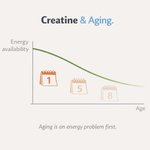
At the cellular level, energy availability governs output - in muscle, brain, and every ATP-dependent system.
Sleep sets the stage.
Walking maintains the system.
Lifting provides the signal.
Fuel enables execution.
Creatine - Supporting Energy Availability
Creatine doesn’t create capacity.
It supports the expression of capacity that already exists.
It works at the cellular level, where energy availability determines output- across movement, recovery, and cognition.
Sleep sets the stage.
Walking maintains the system.
Lifting provides the signal.
Fuel enables execution.
Creatine quietly supports execution.

Small, repeatable actions can meaningfully change how your brain feels.
Just 20 minutes.
Repeated.
That’s a surprisingly good trade.


The best time to train isn’t when your physiology is theoretically optimal.
It’s when your schedule makes it repeatable.
Because 100% consistency beats 20% theoretical advantage every time.

Running is one of the few life upgrades where the instruction manual is just:
- Step 1: Move faster than walking.
- Step 2: Continue.
The first 30 seconds feel like you’ve accidentally auditioned for a nature documentary. 😂

TAKE CREATINE AND HOPE ISN'T THE SMARTEST APPROACH
Here’s the added value:
Creatine is an energy support molecule, not some hack.
Your body uses a system called phosphocreatine to rapidly regenerate ATP the immediate fuel for short bursts of effort: lifting, sprinting, pushing hard reps. Supplementing creatine simply increases the availability of that rapid energy buffer.
What that means for a beginner:
- You may squeeze out an extra rep or two.
- You may recover slightly faster between sets.
- Over weeks and months, that small edge compounds into measurable progress.
But here’s the part most people skip:
If you’re new to training, your biggest returns will come from:
1) Learning good movement patterns
2) Training consistently
3) Sleeping properly
4) Eating enough protein
5) Showing up when motivation dips
Creatine amplifies effort.
It does not replace it.
Think of it like upgrading the battery in your phone.
If you never open any useful apps, the bigger battery doesn’t change much.
But if you’re using the device properly, the extra capacity matters.
Also worth knowing:
- It’s one of the most researched supplements available.
- It’s generally safe for healthy individuals.
- You don’t need complicated loading phases — 3–5g daily is sufficient.
- Drink adequate water.
The smartest approach for a beginner is:
1) Build the habits.
2) Add creatine as support.
3) Let consistency do the heavy lifting.
The supplement should never be the foundation.
It should be the assistant.

39 minutes on a treadmill isn’t automatically a problem.
The real question is: what’s the goal?
Not everyone in the gym is chasing max strength or hypertrophy.
Fitness education is about matching the method to the objective.


Water absolutely hydrates you but water alone isn’t the full hydration story.
Hydration is about fluid and electrolytes (mainly sodium, plus potassium and others).
For most people living normal lives? Water works just fine.
For high output or high sweat? Balance matters. If you drink large amounts of plain water without enough electrolytes, you can dilute sodium levels and actually feel worse (fatigue, headaches, low energy).


It depends on the outcome you care about, but for body composition, that second order is much closer to reality.


It depends far more on you than on the gallon.
For some people - especially larger, active individuals who sweat a lot a gallon (~3.8L) may be completely reasonable. For others, particularly smaller or sedentary people, it can be unnecessary and occasionally excessive.
Should remember that more frequent urination isn’t automatically “detox,” it’s just fluid turnover. Also risk of electrolyte imbalance if you’re not matching fluids with minerals, especially if you sweat heavily.
Hydration is about balance.
Clear to pale-yellow urine, stable energy, and matching intake to activity level is smarter than chasing a round number.

The reason that advice exists is simple: creatine works by saturating your muscle (and brain) stores over time, not by giving you a one-day “boost.”
Taking 3–5g daily keeps phosphocreatine levels topped up, which supports high-intensity performance, strength progression, and potentially cognitive resilience. It’s a consistency supplement, not a pre-workout stimulant.
So yes, if you’re using it, take it on rest days too. But remember: it enhances training. It doesn’t replace it.

They don’t automatically tell you how much you can deadlift, how fast you can run, how mobile your hips are, or what your bloodwork looks like.
They’re a visibility marker, not a full performance report.

It’s not that eating fast directly causes weight gain. It’s that eating fast often leads to eating more before fullness signals kick in, which can increase total calorie intake over time.
So a clearer version would be:
“The faster you eat, the easier it is to overeat.”
It takes roughly 15–20 minutes for your brain to fully catch up with your stomach.
Growth hormone surges during deep sleep, that’s when tissue repairs, muscle rebuilds, and recovery actually happens.
No sleep = no growth.
You don’t level up in the grind. You level up in the dark.

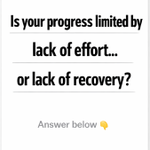
Most people assume progress stalls because they’re “not working hard enough.” But what if the real limiter isn’t effort… it’s recovery?
Training is the stimulus. Recovery is the adaptation.
Think of it like digging a hole and then filling it back in stronger. Every workout digs the hole - you create stress, micro-damage, energy depletion. But sleep, nutrition, and rest are what rebuild the ground higher than it was before. If you keep digging and never refill properly, the hole just gets deeper. You feel flat, sore, tired, unmotivated .... and guess what ... progress slows.
Effort feels productive because it’s visible. Sweat, reps, intensity. Recovery feels passive. Quiet. Almost lazy. But biologically, growth happens when you’re not training - that's when protein synthesis rises, hormones rebalance, and energy stores are restored.
It’s like charging your phone. Using it drains the battery. Charging it is what allows it to perform again. No one blames the phone for dying at 2% but how come we blame ourselves when we’re running on empty.
So if progress has stalled, the smarter question might be:
Are you truly under-working…
Or are you under-recovering?
Sometimes the fastest way forward isn’t more effort.
It’s better rebuilding.

Eat early and you set the clock.
Skip it and you delay the clock.
Neither is magic.
It just depends on what works for your energy, focus, and training.

