

AI Business Development Manager @ Revo | AI Architect & Product Strategist @ VivaTerra Ventures | Bridging Tech & Business Value
Brazil
Joined February 2025
- Tweets2.8K
- Following93
- Followers38
- Likes3.6K
Yan Cotta retweeted

🚨 A MASSIVE internet security emergency is unfolding right now. 🚨
Two CRITICAL vulnerabilities have been discovered in PHP, potentially putting millions of websites at risk.
→ NEARLY 70% of websites with a known server-side language run PHP. The potential scale is ENORMOUS.
→ TWO CRITICAL security flaws have been confirmed, each scoring 9.2/10 in severity.
→ Attackers could potentially take control of vulnerable servers remotely, without authentication.
→ Reports suggest PHP versions dating back to 2004 could be affected. The exact scope is still unconfirmed.
→ EMERGENCY PATCHES are scheduled for TOMORROW at 10 AM ET. Website owners are being urged to prepare immediately.
→ Europe's CERT-EU is warning organizations to patch ASAP or consider TAKING EXPOSED APPLICATIONS OFFLINE if they cannot be secured.
→ WordPress, Magento, Laravel and potentially millions of other PHP-powered websites could be at risk.
→ Once patches go public, hackers could reverse-engineer them and race to attack servers that haven't updated.
The vulnerabilities are CONFIRMED. The full technical details remain secret.
Tomorrow, the race between hackers and defenders begins.
This could get ugly. FAST.

Yan Cotta retweeted

We are bringing agents to the wet-lab bench at Google Research to navigate complex biological landscapes. Learn how we are grounding agents in physical lab robotics to run fast closed-loop molecular design cycles, ultimately discovering single-digit nanomolar protein binders for cancer targets →goo.gle/4B5mMMB
Yan Cotta retweeted

Today we’re releasing Muse Spark Open, the most capable US open-weight model to date.
Built for coding and agentic work, it excels at long-horizon tasks, complex software engineering, and multi-step reasoning.
Key Model Specs:
→ 816B total / 42B active parameters
→ 1M token context window
→ Natively multimodal across text, image, video, audio


Yan Cotta retweeted

Published in Science today: Magic state cultivation works in practice on our Willow processor. We achieved a 40x error reduction, compared to without cultivation, and 99.99% fidelity. Learn how this addresses a critical resource bottleneck: goo.gle/4yr8V0H

Yan Cotta retweeted

Some magical progress towards "magic state" in quantum!
Our @GoogleQuantumAI team has demonstrated "magic state cultivation" on physical hardware for the first time. The result is a 40x error reduction on our Willow processor vs. previous methods, achieving a state-of-the-art 99.99% logical fidelity.
It's another step towards useful, error-corrected quantum computers to help solve the hardest problems. The result is published in Science today, watch the video below to see how it works
Yan Cotta retweeted

Over 400 researchers and I have signed this open letter calling for the AI and security communities to come together to improve alignment and containment approaches in order to protect our critical infrastructure and digital systems.
ai-security-letter.org/

Yan Cotta retweeted

Gemini 4 Argon taught a robot to play cornhole just by watching a video.
It mapped the physics, coded its own simulation, and taught @Apptronik's Apollo humanoid to sink 7 throws in a row.
Yan Cotta retweeted
Gemini 4 Argon is here.
It’s available globally today for developers and enterprises in the paid tier of the Gemini API and the Gemini platform, for Ultra subscribers in Google Antigravity, and Ultra and Pro subscribers in the Gemini app and Search.
Hope you all enjoy it!
Yan Cotta retweeted

Today we are announcing our biggest bet yet on our own silicon.
Starting next calendar year, we will scale our Maia family to multi-gigawatt deployments, making it the primary inference system for our own product and services.
And we’re introducing Maia 300, which delivers 40% more tokens per watt compared to leading GPU-based systems.
We are already deploying Maia 200 across the US, Europe, and Australia, delivering up to 1.7x more tokens per watt across experiences in Teams and Copilot.
Our goal is to build on the full-stack efficiency gains we’ve already seen, while continuing to bring the latest innovations from across the ecosystem into our fleet.

Yan Cotta retweeted

Dusting off this tweet from April because this gap in shared understanding of LLM capability is *widening*. It's now less "two groups of people speaking past each other" and more a sharp funnel.
- Napkin math somewhere around 6B people (~75% of the population) have barely come in contact with LLMs at all.
- Around 1-2B (~20%) are casual and infrequent users of free-tier ChatGPT-like products. This group sees derpy chatbots and treats them a bit like a better Google search, a writing aid, or etc. Maybe an agent tries to book you a flight. I have non-tech friends who (reasonably, imo) say they have not much use for it at all. Even many professionals outside of math&code are in this tier. For example, execs and many other functions spend a lot of their time talking to other people, so while they understand what is happening intellectually, it is still second-hand and a bit abstract.
- Now we get to professional use of frontier-grade LLMs in math&code. Somewhere around 20M people (0.2%) see first-hand that large, complex projects that used to take them weeks/months can now be completed by agents with a prompt. Building apps, copying apps, translating apps, decompiling apps from binaries... This has all happened very quickly and recently - less than 1 year ago, I was writing code manually by hand, typing memorized computer code commands into a code editor character by character, occasionally pressing Tab to autocomplete a little chunk of code.
- And finally we get to the ~5,000 people (~0.00006%) with access to frontier-grade systems internally. The external world has seen the preview. It looks like swarms of thousands of agents collaborating over weeks on software mega projects: minting zero days, running cyber attacks and defenses at machine speeds, discovering new science, advancing the frontier of mathematics. Things that would have taken top professionals in the industry years of work. Meanwhile, human review and comprehension are starting to fall behind. For example, people are still involved in the "archeology" of the OpenAI-HF incident from many months ago. Mathematicians may be poring over the 722 manuscripts on frontier mathematics for a while.
The funnel is driven by a combination of factors:
1. The impact scales with ambition, problem size, and horizon. A question with a paragraph answer barely stresses the system. You need a reservoir of big, difficult problems that you really care about. This aspect drives the consumer / professional dimension of the funnel.
2. The jaggedness of the system (which I have written about a lot separately). Capability peaks in domains that are digital, verifiable and economically valuable. This is because LLM capability emerges from reinforcement learning on verifiable rewards on a curated environment mixture driven by revenue potential. This aspect primarily drives the area (e.g. math&code) dimension of the funnel.
3. Access. Free-tier, paid-tier, internal.
So this is the weirdness of the moment. The general public has mostly not interacted with these systems. When they have, it looks like a derpy chatbot. The majority of professionals still see only a modest uplift. And a small sliver of professionals are experiencing the vertigo of the curve going vertical. And it is all happening at the same time.

Judging by my tl there is a growing gap in understanding of AI capability.
The first issue I think is around recency and tier of use. I think a lot of people tried the free tier of ChatGPT somewhere last year and allowed it to inform their views on AI a little too much. This is a group of reactions laughing at various quirks of the models, hallucinations, etc. Yes I also saw the viral videos of OpenAI's Advanced Voice mode fumbling simple queries like "should I drive or walk to the carwash". The thing is that these free and old/deprecated models don't reflect the capability in the latest round of state of the art agentic models of this year, especially OpenAI Codex and Claude Code.
But that brings me to the second issue. Even if people paid $200/month to use the state of the art models, a lot of the capabilities are relatively "peaky" in highly technical areas. Typical queries around search, writing, advice, etc. are *not* the domain that has made the most noticeable and dramatic strides in capability. Partly, this is due to the technical details of reinforcement learning and its use of verifiable rewards. But partly, it's also because these use cases are not sufficiently prioritized by the companies in their hillclimbing because they don't lead to as much $$$ value. The goldmines are elsewhere, and the focus comes along.
So that brings me to the second group of people, who *both* 1) pay for and use the state of the art frontier agentic models (OpenAI Codex / Claude Code) and 2) do so professionally in technical domains like programming, math and research. This group of people is subject to the highest amount of "AI Psychosis" because the recent improvements in these domains as of this year have been nothing short of staggering. When you hand a computer terminal to one of these models, you can now watch them melt programming problems that you'd normally expect to take days/weeks of work. It's this second group of people that assigns a much greater gravity to the capabilities, their slope, and various cyber-related repercussions.
TLDR the people in these two groups are speaking past each other. It really is simultaneously the case that OpenAI's free and I think slightly orphaned (?) "Advanced Voice Mode" will fumble the dumbest questions in your Instagram's reels and *at the same time*, OpenAI's highest-tier and paid Codex model will go off for 1 hour to coherently restructure an entire code base, or find and exploit vulnerabilities in computer systems. This part really works and has made dramatic strides because 2 properties: 1) these domains offer explicit reward functions that are verifiable meaning they are easily amenable to reinforcement learning training (e.g. unit tests passed yes or no, in contrast to writing, which is much harder to explicitly judge), but also 2) they are a lot more valuable in b2b settings, meaning that the biggest fraction of the team is focused on improving them. So here we are.
Yan Cotta retweeted

You can now train your own Decision model with our free notebook! 💡
Qwen3.5-4B will generate decisions instead of text on just 8GB VRAM locally.
Learn to data prep (state, questions, gold answers), train, serve.
Notebook: colab.research.google.com/gi…
Guide: unsloth.ai/docs/basics/train…


You can now train your own Decision model like Jev locally!
We increased Qwen3.5 0.8B’s aggregate accuracy from 20.7% to 74.3% across 3 decision benchmarks - on just 4GB VRAM.
Turn any LLM like Qwen3.8, Gemma 4 into decision models with our open-source Unsloth repo.
We fine-tuned with a Clef head using Unsloth and LoRA (r=64) for one epoch, increasing downstream accuracy from 30–37% to 78%.
GitHub: github.com/unslothai/unsloth
Guide and Notebooks: unsloth.ai/docs/basics/train…

Yan Cotta retweeted

Introducing 𝙾𝚙𝚎𝚗 𝙸𝚗𝚝𝚎𝚕𝚕𝚒𝚐𝚎𝚗𝚝 𝚄𝙸
A template for bringing interactive, generative UI to your own product. Works with ANY agent.
Supports:
→ Your design system
→ Your components
→ Your real data and actions
Repo: github.com/CopilotKit/OpenIn…
Available on Web, Mobile, and Slack.
Powered by @CopilotKit and AG-UI.

Yan Cotta retweeted

Claude Managed Agents dynamic workflows are now available in public beta. It's a new type of multiagent orchestration, built for your most ambitious workloads.
A lead agent writes a plan that runs across many agents in phases, combining the results at the end.
Yan Cotta retweeted
Introducing Microsoft-Decision-1, our new model for fast decision-making.
It delivers top performance on structured decision tasks, outperforming both LLMs and other decision models in latency and quality.
We’re already testing it across Microsoft for everything from incident response and quality control to scientific discovery.
Yan Cotta retweeted

ChatGPT launched their version of Generative UI yesterday. We took it apart
tldr; the agent never write raw code. It emits DIL (a new language), the server compiles and streams it, the client renders it using a component set so that it feels native

Yan Cotta retweeted

New paper advised by Yann LeCun!
"H-JEPA: End-to-End Learning of Hierarchical World Models for Visual Planning"
Most world models plan in a single latent space and at one timescale, which makes long-horizon planning expensive and forces one representation to handle both low-level motion and high-level goals.
H-JEPA instead stacks JEPA world models across multiple timescales, with higher levels predicting farther into the future.
The highest level first figures out roughly where the agent should go, then each lower level turns that into increasingly concrete subgoals until the bottom level outputs actual actions.
On Visual AntMaze, this 3-level setup increases success from 18% to 73% while using less planner compute.
alphaxiv.org/abs/2610.06805

Yan Cotta retweeted

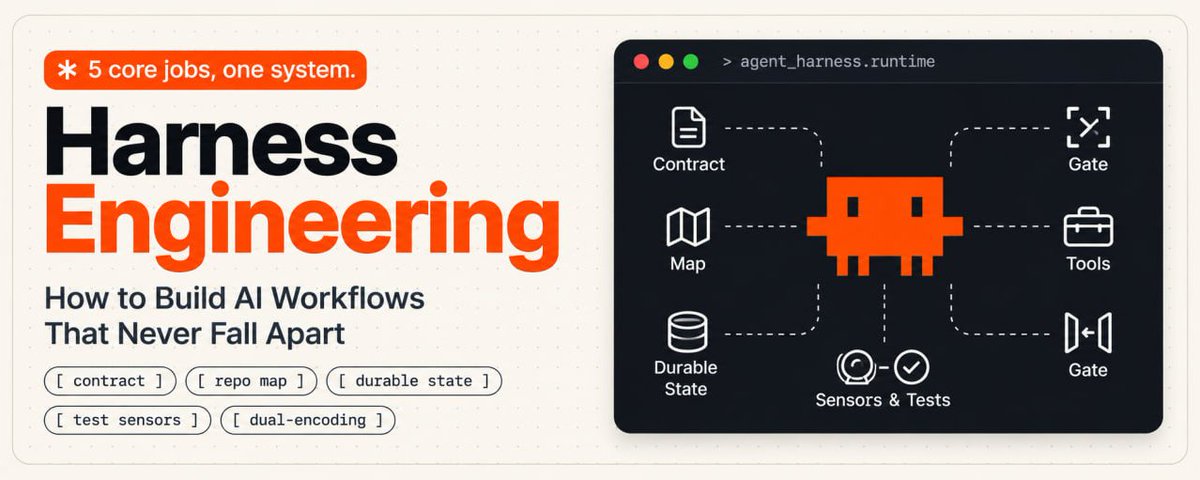
holy sh*t. Official Anthropic tip for Claude Code: stop burning Opus 5.5 context on tasks Haiku 5.5 can swarm, while Sonnet 5.5 builds
put the architect on call with /advisor
claude --advisor opus --subagents haiku
Sonnet 5.5 drives the primary session on high effort, writing diffs and running test suites
Haiku 5.5 subagents swarm the repo in parallel at 340 tok/s, handling file discovery and spec docs lookup
Opus 5.5 stays on call in the background as the advisor, only stepping in at three critical moments:
→ before a plan locks: does the implementation plan miss auth invariants or schema contracts?
→ when a test breaks twice: are we fixing the root cause or falling into a recursive rabbit hole?
→ before calling done: did the full diff introduce hidden regressions or break pre-flight rules?
Opus 5.5 reviews. Sonnet 5.5 builds. Haiku 5.5 swarms
Jev engineering runs the identical pattern one layer down: mechanical decisions that need no reasoning (which file to open, which tool to invoke, retry or abort) execute in 16ms, so the frontier models only wake up when execution paths actually diverge
Plan on high. Delegate on medium. Keep Opus on call.
- the full advisor setup
> Opus 5.5 on call reads full session history and catches deep architectural traps
> Sonnet 5.5 lead drives edits, writes core logic, and executes test harnesses
> Haiku 5.5 subagents swarm AST parsing, grep scans, and API docs in parallel
> JEV micro-fork layer resolves 1,500+ mechanical routing branches in under 16ms
> advisor stays completely silent on routine bash execution to protect context
paste the setup and this prompt into Claude Code below:
"Configure my Claude Code workspace for hierarchical advisor orchestration:
1. Audit ~/.claude/settings.json and project config for model roles fitting lead, subagents, and advisor:
> Pin main session model: sonnet with effortLevel: high for primary execution
> Pin subagents model: haiku with effortLevel: medium for parallel file discovery and docs retrieval
> Pin advisor model: opus on call for strategic review
2. Enable the advisor tool in ~/.claude/settings.json:
> Set advisorModel to claude-opus-5-5
> Enable subagent parallel dispatcher pool (3x workers)
3. Configure automatic advisor consultation checkpoints in ~/.claude/CLAUDE.md:
> Consult /advisor opus before finalizing multi-file architecture plans
> Automatically summon /advisor opus when the same test or compiler error fails twice
> Enforce advisor diff contract audit before declaring tasks complete or staging git commits
4. Constrain subagent scopes:
> Haiku subagents return structured AST summaries and docs snippets only without modifying main session context
Show every configuration diff first. Do not apply edits until confirmed"
↳
code.claude.com/docs/en/advi…

Yan Cotta retweeted
Google releases EmbeddingGemma 2, a new open model that runs locally on 0.5GB RAM.
The 740M parameter Apache 2.0 model combines a 270M text model with vision (170M) + audio (300M).
Run & train the model via Unsloth.
GGUF: huggingface.co/unsloth/embed…
Guide: unsloth.ai/docs/models/embed…


Yan Cotta retweeted

The new OpenAI decision model is really good! I ran it against omarchy's QA results from yesterday's testing runs and I got the following (same prompt, same image)
1. its generally much faster overall
2. it is much more accurate at finding things to click based on screen shots


