

Data, maps, apps, and consulting services for effective #broadband decisions. 🌐 Employee-Owned.
Cincinnati, OH & Seattle, WA
Joined January 2012
- Tweets387
- Following88
- Followers313
- Likes76




Last month, our entire CostQuest team traveled to Cincinnati for our 2026 All Team Conference. We kicked things off with food, drinks and a little friendly darts rivalry at Flight Club, then dove into a full day of sessions covering company updates, strategic planning and a shared vision for what's next.
We wrapped things up by cheering on the Reds at Great American Ball Park, rolling up our sleeves for hands-on communications training led by Barbara McMahan, President of Atticus Consulting, and taking on a company-wide scavenger hunt around the city.
Getting our whole team in one room is exactly how we bring our values to life: People First in action, Fostering Collaboration across every table and session, taking Ownership of our growth, and Driving Innovation through the ideas that only happen when we're together.


Better connectivity starts with better visibility.
We're excited to share the Federal Communications Commission (FCC) has re-awarded CostQuest the contract to continue developing and maintaining the Broadband Serviceable Location Fabric, the foundational dataset behind the FCC's Broadband Data Collection (BDC) program.
Running from February 2027 to February 2032, this new contract reaffirms our role as the trusted provider of the location-level data that federal, state and local policymakers can rely on to improve broadband mapping and support connectivity efforts nationwide.
CostQuest has served as the FCC's Fabric provider since the program's inception, combining multi-source geospatial data, address validation and rigorous quality-assurance protocols, to deliver the most precise and accurate view possible of Broadband Serviceable Locations across the country.
We’re honored to continue this work and remain committed to ensuring government agencies and broadband organizations have the high-quality data they need for better visibility, precise funding decisions, effective deployment programs and better connectivity outcomes.
Link to read the full announcement: costquest.info/3V999vC

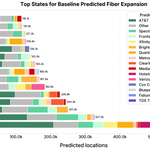
Our new Fiber Forecast Model projects 2.1 million to 6.7 million new fiber-served locations nationwide over the next six months, depending on how aggressively providers deploy, with a baseline case of 4.6 million.
That more-than-3x spread between the low and high case indicates fiber growth in the near-term depends more on discretionary capital allocation and competitive posture than on remaining unserved demand.
For ISPs, the more actionable fiber growth variables: Where and who?
🔵 AT&T leads projected growth within its traditional footprint; regional ISPs lead outside it.
🔵 Florida (509.9k), Texas (327.0k), and Ohio (251.0k) are projected to add the most new fiber locations, followed by Illinois and Georgia. These high-growth states are primarily mixed-density with strong suburban and exurban populations markets, exactly the geographies where overbuild economics work best.
🔵 Greenfield builds continue to skew rural areas, while competitive overbuilds concentrate in denser markets.
🔵 Single-provider rural markets are shaping up as the next competitive frontier as BEAD funding introduces new entrants into historically low-choice areas.
Why it matters: In the overbuild era, protecting market share, ARPU and return on capital starts with anticipating where competitors will deploy next.
Read the full Broadband in America Report: Fixed Broadband Competition Focus—August 2026 Edition, where we break down the scenarios, the builders, and the states to watch, and what it means for market share and customer retention:
costquest.info/4gKOFAa

🎤 Announcing our Fabric Forward 26 Keynote Speaker: Jeff Johnston, CFA
We're thrilled to welcome Jeff Johnston, lead digital infrastructure economist at CoBank's Knowledge Exchange, as this year's Fabric Forward keynote speaker! At CoBank, Jeff identifies the technologies, business models, risks and opportunities reshaping telecom, and he's bringing that expertise to broadband leaders at a pivotal turning point for the industry. Prior to his current role, Jeff was an equity analyst covering tech, media and telecom, and has held senior management roles across the telecommunications industry.
Jeff’s keynote: "Broadband's Next Chapter: Trends Defining the Industry's Next Era and What They're Telling Us"
Following years of unprecedented post-COVID investment and expansion, broadband providers are now navigating a market shaped by federal infrastructure funding, rising costs, shifting investor expectations, emerging competitors – including the rise of LEO satellite providers – and accelerating consolidation.
Jeff will unpack the economic trends redefining the competitive landscape and help attendees answer one of the industry's defining questions: how do you position your organization to succeed and build value, regardless of how the market evolves?
Whether you're an ISP, state broadband office, lender, investor or industry partner, you'll leave with real context and strategic clarity you can apply to your own organization's next move.
📅 October 26–29, 2026 | 📍 The Edgewater Hotel, Seattle, WA
Limited spots — Fabric Forward hit capacity in 2025.
Register today: costquest.info/41IC4GK

Fiber competition is entering a new phase – growth is no longer just about reaching unserved areas; it's about who wins the markets that already have service.
The August 2026 edition of the Broadband in America Report shifts from measuring today's competitive landscape to forecasting where fiber deployment and competition are headed next, using CostQuest's Fiber Forecast Model.
Key #BroadbandinAmerica insights:
🔵 The next phase of fiber is about competition, density and share capture, with large providers driving the shift – large providers pivoted sharply toward overbuild between December 2024 and June 2025, aligning closely with a spike in provider mergers and acquisitions.
🔵 CostQuest's Fiber Forecast Model projects between 2.1 and 6.7 million newly fiber-covered locations over the next six months, depending on carrier aggressiveness – a range reflecting how much growth now hinges on discretionary capital and competitive posture rather than remaining unserved demand.
🔵 By provider, AT&T leads predicted fiber growth within its traditional footprint, while smaller regional ISPs lead growth elsewhere; traditional cable providers are also expanding fiber, largely as a defensive and modernization play rather than a broad footprint push.
As coverage gaps narrow, the next competitive frontier is single-provider rural markets – where BEAD funding is positioned to introduce new competitors and reshape service in areas that have long had few choices.
Explore the full forecast and competitive analysis in the Broadband in America Competition Report – August 2026 Edition. ⬇️
costquest.info/4gKOFAa

Every build decision, acquisition, BEAD award, overbuild, pricing move and technology investment reshapes the competitive board – shifting incentives, options and likely responses. Yet most operators are left reacting to those moves instead of anticipating what comes next.
Reacting isn't a strategy. Anticipating one is.
Explore how to think ahead of the market instead of chasing it at CostQuest's #FabricForward2026.
The session "Anticipating competitor moves: Using data to think strategically about positioning" will uncover how:
🔵 Data can be used to predict your competitor's likely countermove.
🔵 BEAD awards, overbuilds and converging technologies reshape "the board."
🔵 A game-theory-inspired approach with spatial data scenario modeling can sharpen your positioning.
🔵 Using data can better inform your capital deployment decisions.
Led by Alfonso Porras (AVP, Valuation) and Charles Cardot (Analyst), this session is for broadband strategy, planning, finance, market intelligence and business development leaders looking to make better build, defense, investment and competitive-positioning decisions before the market moves around them.
Limited spots are available (we hit capacity in 2025). Learn more about the event and secure your spot today: costquest.info/41IC4GK


Fiber growth is no longer just about reaching new homes: it's about winning the ones already served. 🍂
The latest data points to broadband's next phase – competition, density and share capture, not just footprint expansion.
In the September edition of The Current, we cover what we're seeing:
🔹 Which competitor is coming for your footprint next? CostQuest President and CEO, James Stegeman, breaks down new Fabric and FCC BDC data showing cable operators now competing head-to-head with fiber providers already built into their territory, with AT&T/Quantum Fiber and Verizon/Frontier as the biggest overbuilders, and even Google Fiber facing overbuild in 66% of its own footprint.
🔹 The next six months of fiber growth come with a wide range. CostQuest's new Fiber Forecast Model projects 2.1 to 6.7 million new fiber-covered locations in the next six months, a range that shows how much growth now hinges on carrier strategy over remaining demand.
🔹 Fabric Forward 26 is excited to announce our keynote speaker! Jeff Johnston, lead digital infrastructure economist at CoBank, will headline this year's conference with "Broadband's Next Chapter: Trends Defining the Industry’s Next Era & What They’re Telling Us,” unpacking rising costs, LEO satellite competition and consolidation.
🔹 CostQuest was in Austin this week: Jim Stegeman joined the invite-only MetroMeetups BEAD Meetup at Datacloud USA x Metro Connect Fall for candid conversations on delivering BEAD at scale.
🔹 Celebrating 21 years of impact. We're spotlighting Mary Bigner, CostQuest's third-ever hire, as she retires from her role as Lead Analyst after building the data systems and production pipelines still in use today.
More insight is better when the market is moving quickly. Subscribe below and never miss an edition. 👇
costquest.info/newsletter

What happens when you hire your third employee ever, and give them a job description that's really just "be ready for anything?"
For CostQuest Lead Analyst Mary Bigner ("Cece"), that was the entire pitch back in September 2004: "know a little bit about computers, order office supplies, just be available and ready to do whatever is needed." At the time, the company was five people, maybe six.
Twenty-one years later, that flexibility became the throughline of an entire career. She wrote some of CostQuest's earliest applications, then moved into running production for national cost models used by clients including the FCC – at one point managing output across as many as 15 machines simultaneously. Along the way, she built the data archiving systems the company still relies on, helped run its first conferences, and became, in the words of CostQuest's own President and CEO, "that interchangeable cog" the whole organization could count on.
Colleagues describe someone who met every shift in the company, and there were many, with the same steady attitude: gracious about changing roles, quick to pick up new responsibilities, and, as VP Mark Guttman put it, someone he doesn't think he's "ever seen in a bad mood.”
We're proud to celebrate Cece Bigner's remarkable career. See the full video and article here:
costquest.info/4pXxLmf
The U.S. broadband map keeps evolving – coverage is expanding nationally, but no two local markets are moving the same way.
The July 2026 edition of the Broadband in America Report delivers a data-driven analysis of coverage changes using the latest FCC’s Broadband Data Collection and CostQuest’s® Location Fabric Versions 7 and 8.
Key #BroadbandinAmerica insights:
🔵 Total served Broadband Serviceable Locations (BSLs) increased from 110.2M to 111.2M between June and December 2025, while unserved and underserved counts both declined nationally.
🔵 National gains mask meaningful variation by county and BSL – some markets saw substantial coverage improvements, while others saw unserved counts rise due to new construction, shifting provider footprints or reporting changes.
🔵 Among 9.9 million federally funded, non-BEAD BSLs, 82.5% now have access to at least 100/20 Mbps – and nearly 3.5 million additional BSLs have been awarded BEAD funding as of June 2026, signaling more expansion ahead.
🔵 Fiber and licensed fixed wireless (FWA) continue to raise the competitive baseline nationwide and nearly 43% of federally funded served BSLs in non-BEAD areas now have access to more than one provider, turning former deployment zones into contested markets.
As coverage gaps narrow, the story is no longer just about closing availability gaps – it's about where local markets are shifting, how funding is shaping future builds, and where new technology and provider choices will affect penetration, retention and growth.
Explore the interactive maps and national-to-county coverage trends in the Broadband in America Coverage Report – July 2026 Edition. ⬇️
linkedin.com/pulse/broadband…

Our Cincinnati and Seattle teams got together to celebrate some exciting news: we've been featured on the All Access with Host Andy Garcia program! 🎬
Our edition will begin airing on August 24 on public television (check your local listings)
In the meantime, you can watch the full-length documentary on our website right now. It dives into why broadband access has become essential to education, healthcare and economic opportunity, and how our team is helping build the data foundation – mapping millions of broadband serviceable locations across the country – that ensures federal investment reaches the communities that need it most.
🎥 Watch the full documentary here: costquest.info/4fDCch5
#AllAccess #AllAccessWithAndyGarcia


What if the granular broadband location data you need could be retrieved in seconds?
For many teams, accessing data for broadband projects still means downloads, spreadsheets, manual data matching and building custom processes.
CostQuest’s APIs make it easy to pull the Fabric’s latest broadband location intelligence data on demand and at scale, with customized data integration tailored to your exact needs, reducing manual work and delivering the intel you need, faster.
More than just a way to access data, these APIs help teams analyze, match, and operationalize the Fabric data across their systems and projects.
Richard Rousselot, CostQuest VP and Chief Technology Officer, breaks down APIs and why they are streamlining how teams access address-level insights from the Fabric:
✅ On-demand access to the latest data
✅ Automated, high-volume location queries
✅ Seamless integration into existing systems and applications
✅ Support analysis, data matching and operational workflows
Whether you're folding the Fabric data into workflows, building new solutions, or streamlining analysis, CostQuest's APIs provide a faster, more scalable way to put it to work.
See API options and guides: developer.costquest.com/
Every broadband market has a story. VerraV helps you see it.
CostQuest is excited to introduce a beta version of VerraV, our new Fabric Mapping Tool, designed to make it easier to start exploring location and market insights from the Fabric at the address level.
Users can:
🔷 Automatically view their licensed Fabric counties on a map
🔷 Focus on areas of interest
🔷 Review address-level insights
🔷 Export data reports for further analysis and action
VerraV is included with commercial Fabric Data purchases via TrueVerra. No GIS experience required!
Try VerraV and let us know what you think: verrav.io
Your feedback will help continue improving the mapping and analysis experience.
**To access Fabric location and market insights in your areas of interest, visit TrueVerra.io, CostQuest's Data and Tech Portal.

Cable broadband built America’s high-speed internet foundation. But 2025 data reveals a new competitive battleground in once cable-only markets.
For cable operators, market share in 2026 will be defined less by coverage and more by retention.
Key insights from CostQuest's latest #BroadbandinAmerica Cable Market Report:
🔵 Cable at 100/20 Mbps still reaches 95.1 million BSLs (81.7% of U.S. locations) as of June 2025, but Charter and Comcast both posted subscriber losses in 2025 as FWA and fiber competitors gained ground.
🔵 Cable's exclusive footprint has shrunk 36% in two years, with cable-only BSLs dropping from 30.7 million to 19.6 million. Meanwhile, fiber connections surged from 21.1 million to 38.4 million BSLs between June 2021 and June 2025.
🔵 Operators are leaning into convergence, bundling broadband with wireless, Wi-Fi, and value-added services to defend customer relationships.
🔵 Selective fiber builds and M&A are reshaping the competitive map – Altice/Optimum reported 3.12 million FTTH passings in Q1 2026, Charter is doubling down on DOCSIS 4.0, and AT&T gained 4 million fiber-enabled locations through Lumen's early-2026 FTTH sale.
The most durable competitive advantage for cable is no longer headline speed: it's owning the full customer relationship.
Explore the latest Broadband in America: Cable Market Focus report to see where cable still leads, where it's losing exclusive ground, and how operators are adapting. ⬇️
costquest.com/wp-content/upl…

Broadband is starting to heat up and so is The Current. ☀️
Data and market conversations are telling an important story, shifting how industry players are thinking about the future.
In the June edition of The Current, we cover what we're seeing:
🔹 Acceleration of competition in cable markets – locations where cable is the only high-speed option have dropped nearly 36% in two years. What does this mean for ISPs?
🔹 One message is standing out: provider growth is trending towards customer acquisition and retention, not just expansion. Three market shifts reshaping how ISPs compete in today's broadband landscape.
🔹 More providers are using data to strengthen targeting, planning and competitive strategy. What data are they using to drive results?
🔹 In-depth Fabric knowledge is critical to implement effective strategy, reporting, compliance and operations workflows. Is there potentially Fabric information you could be missing?
🔹 AI and edge infrastructure are creating new demands on broadband networks. Cher Rowland Henton is posing a question: as the race to reduce AI latency intensifies, could the coffee shop on your corner be the next target for edge computing infrastructure?
🔹 Brian Allenby and other experts are seeing important trends to follow from BEAD execution realities and mounting cost pressures to what's happening on the ground as the buildout moves from planning to construction.
🔹 Network cost updates are in the works to support USF grant decision-making. *Webinar with NTCA & Dan Gordon will review details.
More insight is better than none to navigate the shifting tides in today’s market.
👇 Subscribe below and never miss an edition.
costquest.info/newsletter

As many of you know, broadband maps are only as useful as the accuracy and detail behind them. Before the BDC, coverage was reported at the census block level, sometimes marking locations as served and missing unserved and underserved locations.
The National Broadband Location Fabric dataset introduced a structure-level view of coverage mapping by focusing on first pinpointing every Broadband Serviceable Location in the country. To create it, CostQuest cleans and weaves together millions of data points from: parcel, satellite imagery, building footprints, addresses, land and tax attributes, and road data sources.
The result: over 116 million locations mapped to the rooftop, enabling coverage and other data to be overlayed on top for a clear view of available service, who's providing it, where federal funding is being deployed instead of broad assumptions across larger geographic areas.
When the picture is clear, the decisions that follow are stronger. Listen to CostQuest's Director of Data, Alex Meyer, discuss the creation of the Fabric in more detail. ⬇️
Fixed Wireless Access (FWA) has earned its place in the American broadband landscape. What happens next will define its long-term role.
Key #BroadbandinAmerica insights:
🔵 FWA has scaled into a mainstream broadband alternative, but sustainable growth increasingly depends on a disciplined "sell where you can serve" approach, with carriers dynamically gating address-level eligibility based on available tower capacity. Regional WISPs remain an active competitive force, particularly in rural and hard-to-reach markets.
🔵 AT&T posted the highest FWA growth rate among the Big Three, nearly doubling its served locations from 1.9 million to 3.8 million BSLs – a 98.5% increase – driven by Internet Air and broader 5G expansion.
🔵 5G coverage grew approximately 4% since December 2024, while legacy 3G coverage dropped 28% as carriers refarm spectrum for more efficient 4G and 5G use.
🔵 As #BEAD-funded fiber deployments reach FWA markets and satellite providers aggressively cut costs and pursue the same customers and federal dollars, providers face a fundamental strategic choice: position fixed wireless as a complementary, transitional, or secondary connectivity layer
What comes next for FWA won't be defined by growth alone; it will be defined by strategy, capacity and competitive positioning.
Explore the latest Broadband in America: Fixed Wireless Access Market Focus report to see where FWA is growing, who is driving it, and what it means for the future of U.S. broadband. ⬇️
#FixedWirelessAccess #Broadband

CostQuest Associates and WISDM have partnered, and it's a first for the fixed wireless industry.
Fixed wireless operators have been making critical business decisions – where to build, who to market to, which doors to knock on – with imprecise data.
The result? Wasted capital, failed truck rolls, and missed opportunities to connect communities.
CostQuest's industry-leading Fabric BSL data is now commercially available inside the WISDM platform, giving fixed wireless ISPs address-level precision at every stage of their business: network planning, marketing, sales qualification and installation.
This isn't just about better maps. It's about helping ISPs grow smarter, deploy capital more efficiently, and play a real role in universal connectivity, including directing BEAD funding exactly where it's needed most.
Real-time coverage predictions. Installation success rates well over 95%. The guesswork era for FWA is over.
👉 Learn more at costquest.com | wisdm.ai
Read more about the partnership here: costquest.com/wp-content/upl…

In broadband, a lot can happen in one month. Keeping up means knowing what to pay attention to and where to find it.
The latest edition of The Current brings together bite-sized insights on broadband progress, market shifts, company news, and fresh expert perspectives.
Here’s what’s inside our May edition:
🔹 From our desk to yours: CostQuest’s Brian Allenby reflects on the collective fatigueand the very real, often overlooked progress—that has shaped the broadband ecosystem over the past four years, and why the road ahead may be the most consequential chapter yet.
🔹 A “fun size” version of the latest Broadband in America report: A look at the report’s biggest takeaway: fixed wireless providers are entering a new competitive phase, and those who recognize the shift will be best positioned for what comes next. We touched on what the data is telling us and what it means for wireless strategies. costquest.com/resources/arti…
🔹 In case you missed it: James Stegeman on Fiber for Breakfast - CostQuest’s CEO joined Fiber Broadband Association's Gary Bolton to discuss fiber growth, what’s driving it, and the most important competitive shifts happening in U.S. broadband right now. The data reveals the details.
🔹 Fabric Forward 26: Registration is now open for Fabric Forward—returning to Seattle, WA this October. If your team is focused on funding compliance, deployment, or competitive strategy, this is an event you don’t want to miss.
🔹 Joann in the spotlight: We’re celebrating Joann Lawler, a Senior Consultant who spent 12 years at CostQuest, and share a summary of her remarkable five-decade career and lasting impact on modern telecom cost modeling.
🔹 Just for fun: Staff picks to add to your “when I get a break” list.
👇 Subscribe below to ensure you never miss an edition.
mailchi.mp/costquest.com/cos…

What does it take to become one of the most formidable telecom cost modeling experts in the country?
For CostQuest Senior Consultant Joann Lawler, it started in 1977 at New Jersey Bell – one of two women in an engineering group of nine – and it never really stopped.
Her career spans nearly five decades, from assistant engineer at New Jersey Bell in 1977 through the seismic shifts of the 1984 AT&T divestiture, the dawn of fiber, the buildout of Verizon Fios, and ultimately to CostQuest, where she arrived in 2014 and quietly transformed what the company could do.
She built cost models estimating billions of dollars in network investment. She rewrote critical components of CostQuest's modeling platform, pushed the team into new lines of business, and mentored the next generation of analysts on technology and methodology that took her decades to master. And she did all of it by simply putting her head down and getting things done.
We're proud to celebrate Joann Lawler's remarkable career. See the full video and link to read here:
costquest.com/resources/arti…
The broadband industry is moving faster than most internal playbooks can keep up with. Regulatory rules are shifting, competition is accelerating, and the gap between strategy and execution has never been riskier.
CostQuest's Fabric Forward event is back, and this year’s agenda is crafted to help teams effectively navigate the new road ahead.
Join ISPs, State Broadband Offices, and industry leaders in Seattle for CostQuest's working conference where data, policy shifts, and market intelligence turn into strategies and workflows you can implement immediately to stay on top of changing market dynamics.
✅ Candid regulatory updates & compliance direction
✅ Competitive frameworks built for today's market
✅ Hands-on data & technical workflow guidance
No surface-level insights: just clear data, clear direction, and real outcomes for broadband’s next chapter.
Fabric Forward 2026 | Seattle, WA | October 26 - 29
🔗 Register today, limited spots available → lnkd.in/gHTa6adx
#FabricForward26 #broadband
