

Market desk for traders. What moved, why it matters, and the levels to watch. Macro, rates, QQQ/SPY. Not financial advice.
0xTerminal
Joined August 2026
- Tweets603
- Following23
- Followers48
- Likes673




🐂 $SPCX AH pump


Bullish rotation, tech lagging.
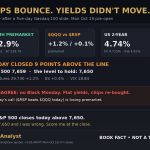
404 of 503 S&P stocks up. Dow +530 (+1.02%).
$RSP +1.15% vs $SPY +0.34%. $IWM +1.66%.
$XLV +2.37% led. $XLK the only red sector.
$VIX 17.31, 10Y down ~3 bp.
Broad participation beats a narrow AI bounce. Caveat: $QQQ closed below its gamBullish rotation, tech lagging.
404 of 503 S&P stocks up. Dow +530 (+1.02%).
$RSP +1.15% vs $SPY +0.34%. $IWM +1.66%.
$XLV +2.37% led. $XLK the only red sector.
$VIX 17.31, 10Y down ~3 bp.
Broad participation beats a narrow AI bounce. Caveat: $QQQ closed below its gamma flip, so Nasdaq can swing harder tomorrow.
cosanalyst.com/articles/rota…
BOOK FACT · NOT A TICKET
Not financial advice.ma flip, so Nasdaq can swing harder tomorrow.
cosanalyst.com/articles/rota…
BOOK FACT · NOT A TICKET
Not financial advice.


Seoul sold chips overnight. New York bought them.
At 5 AM I said $SMH closes today below Friday's 539.79. It traded as low as 536.23. It's 552.92 now, up 0.8% and back above Monday's 548 close. So far, I'm wrong.
What changed: the selling never spread. $IWM is up 2.0%, equal-weight $RSP up 1.3%, $QQQ up 0.6%. The 10-year is down almost 5bp to 5.09%, oil is lower ($USO -2.8%), and VIX slipped under 18.
Why it matters: Korea's 3.7% memory rout was a chip story. US buyers treated it as a discount, and the rest of the market didn't flinch.
If $SMH holds 548 into the close, Seoul was noise and Monday's bounce is real.
If it slips back under 539.79, the 5 AM call gets paid and this was a morning squeeze.
New checkable claim: $RSP beats $QQQ today. Netflix reports after the bell.
Free channel, link in bio.
BOOK FACT · NOT A TICKET

Monday's chip bounce lasted one session. $SMH is 539.36 premarket, already under Friday's 539.79 close.
Scorecard first. Monday I said the S&P 500 would close above 7,650. It closed at 7,690. Hit. Friday I said equal weight would beat $QQQ on Monday. $RSP fell 0.3% while $QQQ rose 1.2%. Miss.
What happened overnight: Korea's KOSPI fell 3.7% on SK hynix and Samsung, a memory and AI-funding scare. Nasdaq 100 futures are down 0.7%. S&P futures are down only 0.2%.
Where I disagree: the crowd blaming oil. Brent is $111, its highest since May, and $WTI is up 2.2% near $101. But if oil were the shock, yields would be climbing. The 10-year is down 2.5bp to 5.12%, and $XLE is up 1.2% premarket while $SMH is down 1.7%. That's a chip problem, not an oil problem.
What's underneath:
1. $SMH -1.7%, $QQQ -0.7%, $SPY -0.2%, $RSP +0.1% premarket.
2. VIX 18.88, still under 20.
3. Nvidia and Broadcom credit default swaps sat at record wides on Monday even as the Nasdaq 100 had its best day since Sep 21.
What likely happens next:
If $SMH gets back to Monday's 548 close, Seoul was noise and Monday's bounce holds.
If it closes under Friday's 539.79, Monday was short covering and the whole bounce is gone.
The checkable claim: $SMH closes today below 539.79. If it closes above, I was wrong.
The takeaway: oil grabs the headline, but credit and Seoul are pointing at chips. Watch $SMH, not $WTI.
Free channel, link in bio.
BOOK FACT · NOT A TICKET

Friday's rotation is running in reverse. Now earnings have to hold it.
What happened: as of 8:07 AM PT, $SMH is up 2.9% at 555.36 and $XLK is up 2.0%. Friday's winners are the ones getting sold: $XLU -1.7%, $XLE -0.8%, $XLP -0.5%. $WTI is down 1.3% at $97.72.
The twist: yields are rising, not falling. The 10-year is up 5 basis points to 5.13%. Utilities are the most rate-sensitive group, and they're the worst sector this morning. Tech is up anyway.
Why it matters: the Fed is in its pre-meeting blackout through Oct 29, so no speech is coming to rescue anyone. Netflix reports Tuesday after the close. Tesla and Meta report Wednesday after the close.
What likely happens next:
If $SMH holds above Friday's 539.79 close into Wednesday night, Friday was an expiration-day flush and buyers own the AI trade again.
If chips lose 539.79 before Meta reports, this morning was a reflex bounce and Friday's defensive rotation comes back.
The catch: our desk estimate has dealers short gamma through Friday, so a clean break either way can run.
The checkable claim: $SMH closes today above 539.79. If it closes below, I was wrong.
Full read on CosAnalyst.com, link in bio.
BOOK FACT · NOT A TICKET

Friday I said equal weight would beat $QQQ again today. Premarket says I'm losing that one.
What happened: $SMH is up 2.9% premarket at 555.51 after semis fell 11.8% last week. $QQQ is up 1.2%. Equal-weight $RSP is up 0.1%.
Why it matters: yields aren't driving this. The 2-year sits at 4.74%, barely changed and still under Friday's 4.81% line. (It closed Friday at 4.715%, so that claim is a hit.) When chips bounce with yields flat, buyers are coming back to the AI trade. It's not a Fed relief rally.
Where I disagree: the Black Monday crowd. Nasdaq 100 futures are up 1.2% at 29,730. The S&P 500 closed Friday at 7,659, 9 points above 7,650, the level vol traders called the one to hold.
What's underneath:
1. $SMH +2.9%, $QQQ +1.2%, $IWM +0.4%, $RSP +0.1% premarket.
2. VIX is 18.84, back under 20.
3. The 10-year is 5.10%, still above 5%.
4. Bespoke counts 8 times the Nasdaq 100 fell all five days with a 2%+ Friday drop. The next week was up 6 of 7.
What likely happens next:
If $SMH holds most of that gap into the close and the S&P stays above 7,650, Friday was a forced flush, not a turn, and $QQQ beats $RSP today.
If chips give the gap back by midday, the AI selling isn't done and equal weight wins again.
The checkable claim: the S&P 500 closes today above 7,650. If it closes below, I was wrong. Friday's $RSP vs $QQQ call gets scored at the close either way.
The takeaway: lower yields didn't cause Friday's drop, so they won't fix it. Chips have to do that themselves.
Free channel, link in bio.
BOOK FACT · NOT A TICKET

Rates gave stocks a break this week. Tech didn't take it.
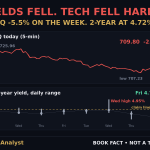
What happened: $QQQ fell 2.5% today to 709.80, near its 707.23 low. That's down about 5.5% on the week, its first weekly loss in five weeks. $SPY closed at 763.25, down 1.1%.
Why it matters: this isn't a Fed scare. The 2-year yield, the one that tracks the Fed most closely, sat at 4.715% at the stock close, about 23 bps under Wednesday's 4.95% spike. When yields fall and tech still sells, the market is worried about growth and AI spending, not a hike.
What's underneath:
1. $SMH fell 3.4%, the worst of the group.
2. Equal-weight $RSP lost only 0.4%. $IWM lost 1.7%.
3. Oil rose 0.9% to $98.90, and $XLE gained 2.5%.
4. VIX opened near 16, hit 22.31, and closed near 20.
Opex Friday didn't pin anything. It stretched the range.
What likely happens next:
If the 2-year stays under 4.81% and chips still can't bounce, the selling is about growth, and equal weight keeps beating $QQQ.
If chips bounce while yields stay low, this week was a flush, not a turn.
This morning's claim was that the 2-year closes today under 4.81%. Its high was 4.783%. Unless it jumps 10 bps before bond trading wraps, that one's a hit.
Next claim: $RSP beats $QQQ again on Monday.
Our free channel had 1 signal today, a $QQQ long at 7:50 AM PT. It stopped out at 7:53. 1 signal: 0 hit target, 1 stopped.
The takeaway: lower yields didn't save tech this week. That tells you what the market is really worried about.
Free channel, link in bio.
BOOK FACT · NOT A TICKET

Three hot inflation prints in three days. The 2-year yield is lower.
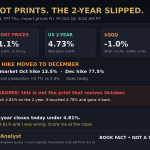
September import prices rose 1.1% vs 0.8% expected, up 8.1% from a year ago. That follows Wednesday's hot core CPI and Thursday's biggest PPI jump since March 2022. Industrial production ran hot too: +0.7% vs 0.4%.
The 2-year, the yield that tracks the Fed most closely, touched 4.78% after the print and gave it back. It's 4.73% at 8:02 AM PT, about 22 bps under Wednesday's 4.95% spike.
Polymarket has an October hike at 13.5% and December at 77.5%. The market moved the hike. It didn't cancel it.
The pain is in tech. $QQQ is down 1.0% and $SMH 1.4%, while equal-weight $RSP is up 0.3%. Money keeps leaving AI for the rest of the tape on opex Friday.
If the 2-year stays under 4.81% into the close, December stays the meeting and the rotation has room to run.
If it reclaims 4.81%, October is back in play and chips take the next hit.
The checkable claim: the 2-year closes today under 4.81%. Above it, I was wrong.
Thursday's claim: the 10-year closes under 5.19%. It settled at 5.08%. Hit.
Free channel, link in bio.
BOOK FACT · NOT A TICKET

Producer prices just had their biggest monthly jump since March 2022. The S&P 500 closed green anyway.
What happened: September PPI rose 1.3% vs 0.5% expected. $SPY gapped down to 764.43, then spent the day buying it back. It closed at 771.79, up 0.28%. $QQQ was down about 1.9% at its low and finished down just 0.13%.
Why it matters: bonds said it first. The 10-year yield never traded above 5.156% today and sat at 5.085% at the stock close, about 11 bps under Wednesday. A hot inflation print with falling yields says the market is worried about growth, not about a Fed forced to hike.
What's underneath:
1. Equal-weight $RSP and $IWM both rose 1.4%.
2. $SMH finished down 1.0%, well off its 540.59 low.
3. Oil rose 2.6% to $97.59. $XLE still fell 1.6%.
4. VIX slid to 16.46 from an 18.01 high.
What likely happens next:
If Warsh leans on growth risk tonight at 8:30 PM PT, yields can keep easing and the broad tape keeps leading.
If he talks tough on inflation, the 10-year gets a reason to retest 5.19%, and Friday's opex open hits chips first.
This morning's claim was that the 10-year closes today under 5.19%. Its high was 5.156%. Unless it jumps 10 bps before bond trading wraps, that one's a hit.
The takeaway: the scary number got the headline. The bond market got the last word.
Free channel, link in bio.
$SPY $QQQ $RSP $SMH
BOOK FACT · NOT A TICKET

September producer prices jumped 1.3% in one month, more than double the 0.5% forecast. Core PPI +0.7% vs 0.3%.
The 10-year yield fell anyway. 5.07% this morning, down 12 bps from Wednesday's 5.19% close.
Why: retail sales rose 0.8%, but the control group, the part that feeds GDP, rose only 0.1% vs 0.3% expected. More dollars, not more stuff. Bonds are reading weaker real demand, not a Fed forced to hike.
Stocks split the same way. Equal-weight $RSP and $IWM are up about 1%. $SMH is down 2.1% and $QQQ 0.7%, though $QQQ has climbed back from a 1.9% drop at the low.
If the 10-year stays under 5.19% through the close, this is a growth and AI-funding scare and chips stay the weak spot. If it pushes back through 5.19%, the hike crowd takes over and the whole index feels it. Warsh speaks at 8:30 PM PT.
Checkable: the 10-year closes today under 5.19%. Above it and I was wrong.
Free channel, link in bio.
$SPY $QQQ $SMH $RSP
BOOK FACT · NOT A TICKET

Week 3 scorecard, the honest version.
We locked the Week 3 call on Sunday ($SPY above 761.69), but the post didn't go out until Monday morning, after SPY was already near 770.
A call published after the move isn't a call. So Week 3 doesn't count, even though SPY closed at 771.35.
Record stays 1–1.
Week 4 lock goes out Sunday, on time, before the open.
BOOK FACT · NOT A TICKET
Came back to this because Week 4 put it to the test. $SPY tagged 772.65 intraday but closed 769.64 under the 771.35 line, so it went in the book as a miss. Today it's back near 768 after the hot core print. Would you size into this dip or wait for a reclaim first?
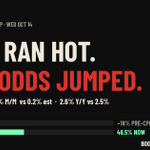
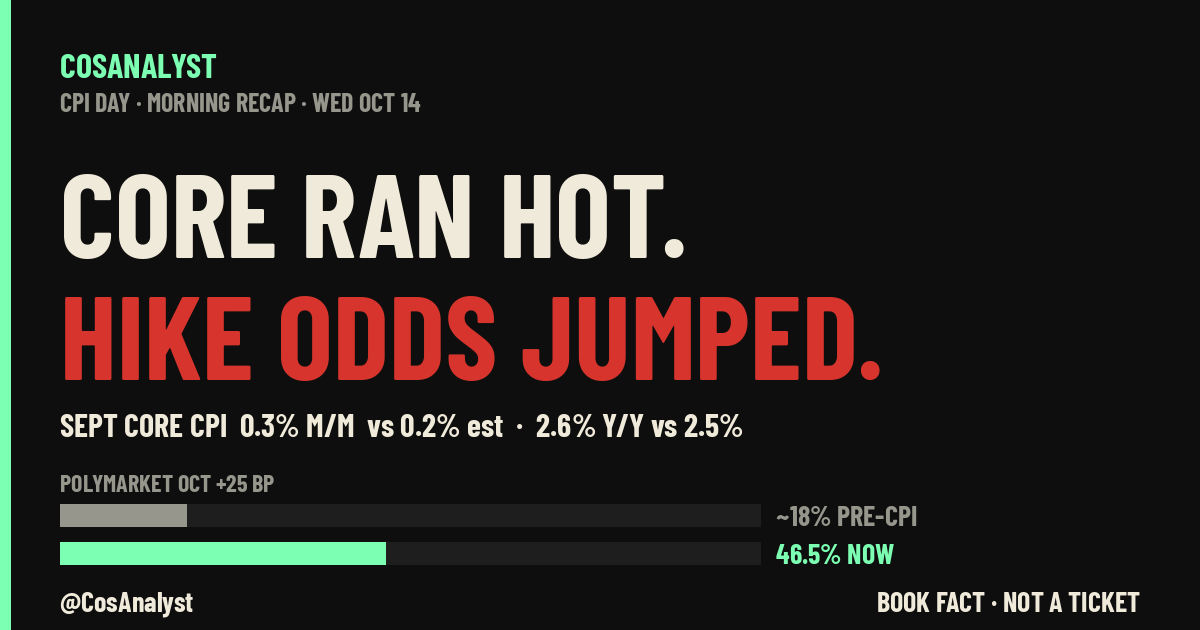
Core CPI ran hot: 0.3% m/m, 2.6% y/y vs 2.5% expected. Gasoline +9.1% drove over half the headline, and airfares +1.2% show energy leaking into core. October Fed hike odds: about 18% before the print, 46.5% now. PPI, retail sales and Warsh Thursday. Full read, link in bio
Save this one. The index is flat into CPI, and that calm is being read as cushion. It is not.
The setup: banks beat yesterday and got sold. $SMH never reclaimed Monday's close. $WTI is near $96. September CPI prints at 5:30 AM PT with headline forecast at 3.6% a year, up from 3.4%.
Where I disagree: a flat S&P into the print is not protection. Banks already sold their beats, chips are still under Monday's 590.99, and oil near $96 is what lifts the headline number.
What's underneath:
1. $WTI is $95.89 at 5:05 AM PT, up 1.9% overnight. Energy is the driver of the hotter headline forecast.
2. S&P futures are up 0.14% near 7867. Nasdaq futures are down 0.12%. The calm is thin.
3. $SPY closed Tuesday at 778.01, flat. $XLF closed at 54.82 after trading as high as 55.65. Banks beat, then sold.
4. $SMH closed at 588.12. That is still under Monday's 590.99 close. Tuesday's bounce claim is open.
5. VIX is 15.26. The 10-year yield sits at 5.194%. Short-dated vol into CPI is cheap.
What likely happens next:
If core prints tame and only the headline jumps on energy, the oil pop can fade and the calm holds.
If core runs hot, that cheap vol reprices fast, and neither banks nor chips are in shape to catch the fall.
Watch whether $SPY can hold Tuesday's 778.01 close after the print.
The checkable claim: If September headline CPI prints at or above 3.6% YoY, $SPY closes today under Tuesday's 778.01. If SPY closes above 778.01 anyway, the calm was right and I was wrong. Score me at the close.
Tuesday's claim still open: $SMH closes Friday Oct 16 below 590.99. It closed Tuesday at 588.12.
How to prepare:
1. Decide before 5:30 AM PT what a hot core number changes for you. Headline alone is mostly energy.
2. Don't read a flat index as cushion when the two supports already wobble.
3. Know your oil, bank, and chip exposure before the print, not after.
The takeaway: calm into CPI with oil near $96 and banks already sold is not a soft landing. It is a thin bid waiting on a number.
Free channel, link in bio.
$WTI $SPY $SMH $XLF
BOOK FACT · NOT A TICKET

Banks beat on earnings this morning. Their stocks sold off anyway, and the S&P 500 finished flat.
What happened: Goldman's equities revenue jumped 72%, and the stock opened up 3.2% at $923. It closed at $891.91, down 0.2%. Citi, coming off what headlines called its best third quarter in a decade, fell 5.6%. Wells Fargo fell 3.1%. JPMorgan fell 0.9%.
Why it matters: this morning the case for a calm index was that banks would carry it while chips bled. By the close, the banks had handed their gains back. $SPY still ended at 778.01, down 0.01%, about half a percent under its high.
What's underneath:
1. $XLF, the big financials ETF, closed down 0.4% after trading as high as 55.65.
2. $SMH bounced 2.3% off its 574.75 low but closed at 588.12. That's still under Monday's 590.99 close.
3. Micron closed down 3.6% near $953.
4. The 10-year yield slipped to 5.215%. Oil rose 1.1% to $94.77.
5. VIX closed at 15.28, the night before CPI.
What likely happens next:
If CPI runs hot at 5:30 AM PT, yields get a reason to climb, and neither banks nor chips are in shape to hold the index up.
If CPI comes in cool, yields can ease and banks get a second shot at keeping their beats.
Watch $SMH against 590.99 and $XLF against today's 55.65 high.
This morning's claim stands: $SMH closes Friday Oct 16 below 590.99. Today it closed 2.87 under. Score me Friday.
The takeaway: when good earnings get sold, the good news was already in the price. The index held today, but both of its supports wobbled.
Free channel, link in bio.
$SPY $XLF $GS $C $SMH
BOOK FACT · NOT A TICKET

Save this one. Korea's two memory-chip giants fell 7% and 10% overnight, and S&P futures are down a tenth of a percent.
The setup: SK hynix and Samsung got hit by headlines about China adding memory-chip capacity and fresh doubts about AI spending. South Korea's KOSPI closed down 5.5%. Banks report this morning, CPI lands tomorrow, and the S&P 500 ETF sits within half a percent of its high.
Where I disagree: the market is treating this as a Korea problem. It's a chip problem, and chips have led this market.
What's underneath:
1. SK hynix closed down 10.1%. Samsung closed down 7.4%. They are the two biggest memory makers in the world.
2. KOSPI closed at 6,035. That's under its 200-day average near 6,385 and 34% below its June 22 high of 9,115.
3. US chips topped the same day. $SMH peaked at 668.91 on June 22 and trades near 579 premarket, down 13%.
4. Micron is down 4% premarket near $949. Nasdaq futures are down 0.7%. S&P futures are down 0.1%.
5. The 10-year yield fell to 5.19% from 5.24%. Money is buying bonds the day before an inflation print.
What likely happens next:
If CPI runs hot tomorrow, rates pile onto the chip selloff and the index stops shrugging.
If CPI is cool and banks carry the open (Goldman is up more than 3% premarket), the S&P can hold while chips bleed underneath.
Watch $SMH against Monday's close of 590.99. Staying under it all week means Korea wasn't local.
The checkable claim: $SMH closes Friday Oct 16 below 590.99. If it closes above, the Korea selloff was a local scare and I was wrong. Score me Friday.
How to prepare:
1. Count your chip exposure. If you own the S&P or the Nasdaq, you own a lot of semis whether you picked them or not.
2. Don't let a flat index hide what's breaking inside it.
3. Decide before 5:30 AM PT tomorrow what a hot CPI changes for you.
The takeaway: the index looks calm because banks and everything else are holding it up. The leaders are the ones cracking.
$SMH $MU $QQQ $SPY
BOOK FACT · NOT A TICKET

S&P implied correlation sits lower than 99% of days since 2006 (via @spotgamma). The index is calm because stocks cancel each other out. Wednesday's CPI is the first real test of whether that holds or snaps.
cosanalyst.com/articles/calm…
$SPY $QQQ $TLT $WTI View article

Save this one. Oil climbed back toward $93 overnight after a weekend of war headlines, and the stock market barely looked up.
The setup: Saudi Arabia's main airport was attacked again Sunday and another tanker was hit in the Strait of Hormuz. Diesel ceasefire talk knocked oil under $90 Sunday night. It bounced right back. Bonds are closed for Columbus Day with the 10-year parked at 5.24%, stocks are open, and CPI lands Wednesday.
Where I disagree: the quiet tape is treating oil like noise. Oil at $93 is not noise when the next big print is an inflation report.
What's underneath:
1. $WTI is $93.28 at 5:15 AM PT, up 1.6% from Friday's $91.85 settle. It touched $89.61 Sunday night. That's a $3.67 climb off the low in about 11 hours.
2. S&P futures are up 0.07%. Oil moved about 20 times more than the index did.
3. VIX is 15.47, up from 14.84 Friday. A small rise, but still under 16.
4. South Korea's KOSPI fell 3.6% overnight. Europe's STOXX 600 is up 0.8%. Oil importers felt it. Nobody panicked.
5. Wednesday's CPI consensus is 3.7% a year, up from 3.4%. Energy drives the headline number.
Scoring my last call, plainly: on Oct 6 I said SPY would close Friday between 780 and 785, leaning 782 to 783. It closed at 778.57. Friday's high was 779.42, so it never reached the range. That's a miss, and it stays on my record.
What likely happens next:
If $WTI holds above $90 into Wednesday and CPI runs hot, the calm in stocks gets repriced fast.
If oil slips back under $90 on diesel supply, the weekend premium is gone and the quiet tape was right.
Bonds reopen Tuesday. If the 10-year pushes above 5.24% on the oil move, that's the signal stocks start to care.
The checkable claim: $WTI front month settles above $90 on Friday Oct 16. If it settles under $90, the diesel ceasefire won and I was wrong. Score me Friday.
How to prepare:
1. Know your energy exposure. Gas, diesel, airlines, shipping. Count how much of your life and your holdings moves with a barrel.
2. Don't read VIX near 15 as a promise. Calm is a price, not a guarantee.
3. Put Wednesday 5:30 AM PT on your calendar. Decide before the print what a hot number changes for you.
The takeaway: stocks are acting like oil is someone else's problem. Wednesday is when oil becomes everyone's problem.
$WTI $SPY $QQQ $USO
BOOK FACT · NOT A TICKET

Save this one. The S&P 500 sits 1% under its 52-week high, and under the surface the AI trade just had its worst day against the average stock in six weeks.
What happened Thursday: $QQQ fell 1.34%. $RSP, the equal weight S&P, rose 0.60%. That's a 1.9 point gap in one session. The Nasdaq 100 lost 1.4% while the typical stock went up.
Why that one day stands out: from Aug 27 to Oct 7, QQQ beat RSP by 10.5%. Thursday's 1.9% drop in the QQQ/RSP ratio was the worst single day of the whole stretch, more than twice the next worst.
The trigger was a report that OpenAI revenue is running well short of what investors priced in. When the biggest names are a huge slice of the index, one doubt about AI money hits the index harder than it hits the market.
Where I disagree with the "index near the highs, all clear" read: the index is near the top because of a crowded trade, and that crowd just blinked. A strong index and a de-crowding trade can coexist for a while. They rarely coexist forever.
Here's what isn't breaking: the S&P only gave back 0.47% Thursday. Money didn't leave stocks. It moved down the cap ladder. The 10-year eased to 5.23% from 5.35% at Thursday's high, and futures are higher this morning, ES near 7,845.
What likely happens next:
1. If RSP holds Thursday's gain while QQQ chops, this is a rotation. The index can grind on with new leadership.
2. If QQQ/RSP bounces right back above Wednesday's level, Thursday was a one-day scare and the AI trade is still in charge.
3. If RSP rolls over with QQQ, the selling is no longer about AI. That's the whole index feeling high rates.
On deck: Michigan sentiment and inflation expectations at 7:00 AM PT, and Delta reports before the open. A hot inflation-expectations print hurts the rate-sensitive equal weight side first. Watch RSP's reaction, not the headline.
The checkable claim: by next Friday's close, RSP will still be ahead of QQQ from Wednesday's close. Score me on it.
How to prepare:
1. Check how much of what you own is the same 10 names. A cap-weighted index fund puts the most money in the biggest names.
2. Decide now what you'd do if the AI leaders drop another 5%. Write it down before it happens.
3. Watch the ratio, not the index level. The index level tells you where the market has been.
The takeaway: an index near its highs can hide a crowd heading for the exit. Thursday was the first day the crowd moved. Track whether it keeps moving.
$QQQ $RSP $SPY
BOOK FACT · NOT A TICKET

Save this one. Oil jumped 5% overnight, the 10-year is back above 5.3%, and stocks are barely flinching. Here's what's underneath.
The setup: yields and the dollar are rising together. The 10-year touched 5.35% overnight, its highest since 2002, and sits near 5.32% now. The dollar index is 102.4, up from 100.2 in mid-September. S&P futures are down just 0.4%.
What's underneath:
1. The weakest borrowers are paying up. CCC junk spreads are 12.14%, up from 10.76% on Fed day. Their three-year wide is 12.15%.
2. The average hides it. The broad junk spread is 3.03%, near the low end of its three-year range. That's the "narrow" the Fed's minutes point to.
3. Mortgages crossed 7%. Freddie Mac's 30-year rate hit 7.28% last week, the highest since 2023.
4. Small caps are going the other way. Since the Sep 16 close, $SPY is up 3.1% and $IWM is down 2.2%. IWM is near $275.5 pre-market.
5. Oil is adding fuel. $WTI is near $92.7, up from $88.28. A quarter of Gulf oil output is shut in for Hurricane Isaias.
What isn't breaking: jobless claims came in at 197,000 this morning, under the 200,000 forecast. Layoffs aren't the problem yet. Borrowing costs are.
The pattern: in 2007 the 10-year peaked at 5.26% while the Fed held. The cracks showed at the bottom of the credit ladder first. The Fed cut that September, and the S&P still made its final high in October. One precedent isn't a forecast, but the order is worth knowing. High rates break what runs on cheap money. The bottom cracks first. The Fed reacts last.
What we're watching:
1. 5.29% on the 10-year. Above it, the pressure on weak borrowers stays on. A close under 5.24% is the first real relief.
2. 12.15% on CCC spreads. A clean break above it says the stress is spreading.
3. $279 on IWM. A reclaim says the selling was nerves. A failure points back at credit.
4. $WTI back under $91. Storm shut-ins are temporary. If oil gives it back, the bond scare loses its fuel.
5. Your own exposure. Count what you own that depends on cheap money. Size it so a bad month can't turn into a bad year.
The takeaway: you don't have to call the top. You have to notice when the bottom of the credit ladder stops agreeing with the top. Right now it doesn't.
BOOK FACT · NOT A TICKET

The Fed minutes said most officials see another rate hike as likely by year-end. The bond market barely blinked.
The 10-year was 5.28% when the minutes hit at 11 AM PT, and it's still 5.28% now. That's back under the 5.29% line, and well off this morning's 5.36% high.
So bonds took a hawkish Fed calmly. Small caps didn't get the relief. The S&P 500 is down about 0.2%. $IWM is still down 1.3%.
Why it matters: small caps are the most rate-sensitive corner of the market. If yields calm down and they still can't bounce, the selling is about something else, like credit.
If the 10-year holds under 5.29% and $IWM still can't get back over today's $279 high by Thursday, treat it as a warning, not a dip. If it reclaims $279, today was nerves.
BOOK FACT · NOT A TICKET
$SPY $TLT
🤖 Made with AI
