

Don't fear; Strive to know.
I am Everywhere
Joined January 2017
- Tweets73.9K
- Following227
- Followers547
- Likes18.1K


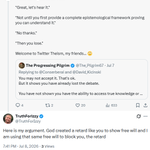


As an atheist, I completely agree that such "worldview-neutrality" is largely a myth. Nobody really enters a voting booth or legislature stripped of their values, experiences, religion, philosophy, etc.
However, a separation of church and state doesn't actually require that we do.
Remember, the goal isn't individual neutrality but, rather, institutional neutrality.
A Christian, for example, is perfectly entitled to vote according to Christian values. But, what they aren't entitled to is a government that treats Christian doctrine as authoritative over everyone else.
And, the idea that “if my values aren't implemented, yours are” is a false dichotomy. For example, if the state declines to mandate church attendance, that doesn't constitute an implementation of atheism. It's just a protection of pluralistic space where Christians can attend church, Muslims can attend mosque, and atheists can do neither.
Neutrality isn't "government without values." It's "government that doesn't make one religion (or religion itself) the price of equal citizenship."

Modern Western ethics was obviously influenced by Christianity....
...along with Greek and Roman philosophy, Judaism, the Enlightenment, humanism, and centuries of social and political development.
The fact that Christianity can be counted as one among such influences does not mean “Christianity is what makes those morals coherent.”

Theists often misinterpret the puddle analogy (perhaps willfully?); it has nothing to do with requiring a multiverse.
Its point is much simpler - you can't infer that an environment was designed for its inhabitants merely because the inhabitants fit the environment; especially when the inhabitants themselves adapted to those conditions.
It doesn't explain cosmological fine-tuning. It just exposes one faulty inference from fine-tuning.
One may disagree with the analogy, but first one must have a proper understanding of what it's actually arguing.
"And it all just... works. Perfectly."
Yeah... I think cancer would like a word with you.
Also, congenital disorder, autoimmune disease, impacted wisdom teeth, appendicitis, ectopic pregnancy, spinal problems associated with bipedalism, retinal blind spots, choking because food and air share the same plumbing....

As an atheist, myself, this wouldn't necessarily surprise me. Churches actively organize, encourage, and prescribe regular giving while atheism has no comparable institution.
However, it probably should be noted that suggesting "Christians give more to charity" - especially when church donations are included - isn't necessarily the same things as suggesting "Christians are more charitable."
And, obviously, none of this has any bearing on whether Christianity is true.

I'm always curious (nothing really to debate, here) exactly how far the rational of most "pro-life" individuals takes them...
For example, if a woman is impregnated via rape – meaning against her will – will you force her to give birth against her will?
Does the father (the rapist) get any say in the matter, in your view?

Sure... we all can grant that the Earth's age isn't important because it changes your morning commute.
But, it is important because it reflects how we decide what's true.
Teaching people to reject overwhelming evidence in favor of ideology has consequences that extend far beyond geology.

Theists must keep in mind the idea "nature can't produce rationality" isn't an explanation... it's just an assertion.
And, exclaiming "God did it" fails to resolve anything, either. All that does is start with the very thing in need of an explanation: an uncaused, eternal, rational mind.
So, it's not about whether morality requires God, but whether it requires a "framework."
But, everyone has a "framework."
Does the existence of a "framework" tell us anything about whether it's objectively true?
This Post is from an account that no longer exists. Learn more


I think it’s important that those arguing for God’s existence understand that not all historical claims begin with the same prior probability.
The claim that "Caesar existed" and the claim that "Caesar flew across the Rubicon" are certainly both “historical claims,” yet they aren't even remotely equivalent; they obviously don't require the same quality and quantity of evidence.
Likewise, “the resurrection” isn't just some other historical event – the claim that “a man was crucified” and the claim that “known physics and natural law were suspended in effort to bring a dead man back to life” are not the same type of claim; the latter naturally carries a higher evidential burden.

Credit where credit is due.
If there was a correct, calm, and reasoned answer to the question, this was it.

When people feel that one of their core beliefs is under threat, they often stop addressing the specific argument and, instead, attack perceived motive, morality, meaning, etc.

The replies to this post have been surprisingly consistent. Most defenders almost immediately abandoned the idea that "people don't die for lies" and, instead, pivoted to the idea that "the apostles couldn't have been mistaken because they saw Jesus."
That, my friends, is an acknowledgment that martyrdom alone doesn't establish the truth of a belief.
The real debate, as ever, is over the historical evidence, not martyrdom.

Another theist argument which needs to die...
Precisely zero skeptics are claiming the apostles died for something they knew was false.
The relevant distinction isn't lie vs. truth but, rather, sincere belief vs. accurate belief.
If martyrdom proved truth, we'd have to accept multiple mutually contradictory religions.
This quoted post is unavailable.
I get that you're trying to illustrate substitutionary atonement, and obviously, the analogy has an emotional appeal, but it falls apart the moment you ask what the punishment is for....
First, The guilty person wasn't punished.
Second, if justice is satisfied by punishing an innocent person instead of the guilty one, then in what sense is it "justice?"
Just imagine we're in a modern courtroom and a judge says "the defendant is guilty of armed robbery, however, his father loves him very much and has volunteered to serve the prison sentence instead."
🙄

.@ShawnRyan762 asked me point-blank: "Why did Jesus have to die on the cross?"
I am humbled and honored that I was put in a position to answer this question for him. This story is one of the best illustrations of the Gospel that I've ever heard.
"Best explanation" according to what criteria?
If none of the proposed explanations can currently be demonstrated, then what distinguishes "God did it" from any other speculative hypothesis besides personal preference?