

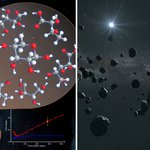






ALT The graphical abstract from the review illustrating the possible steps from an astrophysical origins of the precursor molecules toward self-assembled and homochiral membranes on early Earth.


ALT We identified various sugars in ices simulating the radiation-induced chemistries of the methanol-containing surface of Arrokoth. Arrokoth – a body in the Kuiper Belt – is the most distant object ever explored by a probe from Earth. New Horizons' flyby of Arrokoth revealed its reddish appearance, suggesting a complex chemical composition beneath the surface. The research team of Hawaii simulated the effects of galactic cosmic rays on methanol ices, mimicking the conditions encountered by Arrokoth in the depths of space. The exposed methanol ices reproduced the colors observed on Arrokoth's surface, providing a crucial clue to its chemical composition. Motivated by these results our team in Nice analyzed the organic residue formed and detected a wealth of compounds, including sugars like ribose and glucose - essential molecules for building life on earth. In addition, PAHs played a crucial role in producing the ultra-red slopes observed on Arrokoth's surface.


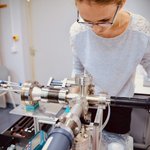
ALT Experimental preparation of analogues mimicking isovaline adsorbed on interstellar dust grains in the laboratory (photo: postdoctoral student Jana Bocková). Thin films of isovaline are needed to first study the interaction between isovaline with circularly polarized photons. This allows to examine the chiroptical properties of isovaline, which refer to its response to circularly polarized light. Furthermore, the researchers aimed to understand the asymmetric photolysis that isovaline would undergo in interstellar environments. By subjecting the thin films to controlled conditions and studying their response to specific wavelengths of circularly polarized light, they sought to simulate the photolysis processes that may occur in space.


