

Connecting Data, People & Ideas since 2016. Using relationships, meaning, context in Data to achieve great things #KnowledgeGraph #GraphDB #AI #SemTech
The World
Joined April 2016
- Tweets6.3K
- Following2.5K
- Followers6.7K
- Likes2.3K



Pinned Tweet
The CDL26 programme is now live!
Two days of real-world deployments, Business Value, Developer Evolution, Scale & Governance, Ontology Engineering & Practice, Rapid Insights.
Clinical trial protocols turned into knowledge graphs, Norway's railway mapped as one, and Siemens using graphs to power its industrial AI agents.
AstraZeneca, Mercedes-Benz, Bloomberg, Google, ServiceNow, and Scania are among those sharing what's working with knowledge graphs, ontologies, and AI right now.
William Tunstall-Pedoe opens with a keynote on neurosymbolic AI, and there are tracks for everyone, from beginners to advanced.
⭐ Take a look at the full programme and book your tickets now: 2026.connected-data.london/p… ⭐
📍11-12 November | London Tower Bridge
Keynotes from distinguished speakers
Presentations with leaders and innovators
Panel discussions exploring diverse views
Masterclasses with expert instructors
Lightning Talks to get you up to speed
#KnowledgeGraph #GraphRAG #Ontology #Graph #AI #DataScience #GraphDB #SemTech

Hands-on knowledge graph sessions usually shut out the people who decide whether a programme goes ahead. Adam Rendek’s masterclass at CDL26 is different, because the only prerequisite is that you can write markdown.
Adam, Data Centre Design Optimisation Manager at AWS, co-invented DOT-LD with Dr Ora Lassila. It’s an open-source syntax that lets domain experts build ontologies directly inside everyday documentation, without Protégé, OWL or an engineer interpreting what they meant.
In two hours you’ll author a working knowledge graph, validate it in VS Code, and see a small language model answer a multi-hop question correctly only once the ontology is behind it. It all runs offline, with no code or database. Directors and engineers complete the same exercises side by side, so practitioners leave able to run the method and decision makers leave able to judge it.
Ontologies Without Ontologists: Shifting Semantics Left into Engineering Documentation
🎤 Adam Rendek, Data Centre Design Optimisation Manager, Amazon Web Services
📅 Wednesday 11 November 2026, 12:30 PM - 02:30 PM, Ontology Engineering & Practice Track (Salisbury Suite)
💻 Bring a laptop with Visual Studio Code installed
📍 Leonardo Royal Hotel London Tower Bridge
⭐ Read more about this masterclass and grab your CDL26 pass: sbee.link/x3k79ebqvm
#CDL26 #KnowledgeGraphs #Ontology #DataLeadership #SemanticWeb #AI

Only three weeks until the graph community takes over Tower Bridge!
Here's everything you need for #CDL26, in one post you can save and come back to.
📅 We're at the Leonardo Royal Hotel Tower Bridge on 11-12 November; doors open at 09:30 on day one and 09:10 on day two.
🌐 Nine tracks run across the two days: Keynotes, Business Value, Developer Evolution, Scale & Governance, Ontology Engineering & Practice, Rapid Insights, Nodes, Edges and the Educational Track. There's room for practitioners at every level and area of interest. View the full programme and plan your event agenda: 2026.connected-data.london/p…
🍽️ The Community Dinner is on the evening of day one, and it's where a lot of the best conversations of the week happen. You can attend this exclusive dinner through the All Access Pass or the Community Dinner pass.
📍Getting there: Leonardo Royal Hotel, Tower Bridge - a short walk from Tower Hill & Aldgate stations. Plan your route and view the event location here: maps.app.goo.gl/QkN227BvwwWx…
⭐ Haven't signed up yet? Now is the time. Register today and join us for our tenth edition: 2026.connected-data.london/c…
#TechEvents #KnowledgeGraphs #GraphRAG #Ontologies #SemanticWeb

Which version controls? Context graphs give legal agents the answer 📄
A single credit agreement can come with several drafts, amendments and side letters. Before an AI agent can answer a question about it, it has to establish which version governs.
Piecing that structure together from raw files is hard. Context graphs are a promising way to improve agent quality and efficiency, so the Harvey team tested the impact on Legal Agent Bench.
The setup:
For each task, the agent first reviewed every document in the client matter
It built a graph of relevant entities and relationships: parties, dates, draft vs. executed status, and which versions belong to the same contract
The same agent was then graded with and without the graph, using LAB’s standard setup
The results:
Up to 30% higher rubric pass rate
Up to about 50% lower task cost
Some cases showed much larger gains. In one firm-knowledge task, the agent had to find the firm’s most recent secured financing and retrieve the executed credit and security agreements as precedents for a new facility.
Without the graph, it searched files one at a time across many matters and chose the wrong precedent: 0% of rubric criteria.
With the graph, it located the relevant matter and its executed agreements immediately: 75%.
Questions worth considering: is the cost of building the graph counted within task cost, and how do graph costs change as people interact with the matter over time?
By Niko Grupen
Harvey Graph sbee.link/ajkpnvwmf7
#ContextGraph #LegalTech #AIAgents #AgentEvaluation #LegalAI
--
Connected Data London 2026 | 11–12 November | Leonardo Royal Hotel London Tower Bridge
🎟 Tickets on sale now - 🔔 Full programme announced
sbee.link/wj8xdfayg6
📺 Sponsorship opportunities available. Contact [email protected] for details.
#KnowledgeGraph #GraphRAG #Ontology #Graph #AI #DataScience #GraphDB #SemTech
Data engineers and knowledge graph experts have spent years working on the same problem while barely acknowledging each other. Joe Reis has been on the data side for most of his career, and he’s come to CDL26 to explain why that’s changing.
Joe is the best-selling co-author of Fundamentals of Data Engineering, author of Mixed Model Arts, and creator of Practical Data. Lately he’s been spending more time with the ontology and semantics crowd. His conclusion is that they’ve been onto something all along. Knowledge people obsessed over meaning, identity, relationships and context, while data engineers concentrated on moving, storing and querying information at scale. Now AI is forcing the two groups together, and both need what the other has.
Joe will open the Nodes Track by tracing how the two camps got here: the inflexion points, the misunderstandings, and what each side has to learn to get working systems into production. Expect underpants gnomes, wrestlers, goths and a very pedantic argument about definitions, plus a refreshingly blunt take on what happens when data scale meets semantic rigour.
If you sit in either group, or you’re the person stuck translating between them, this is the one to make sure you’re in the room for on Day 2.
Respect My Ontology: Why Data Engineering and Knowledge Graphs are Doing a “W.T.F.”
🎤 Joe Reis Creator & Author, Practical Data
📅 Thursday 12 November 2026, 11:00 AM - 11:30 AM, Nodes Track (Warwick Suite)
📍 Leonardo Royal Hotel London Tower Bridge
⭐ Discover more about this session and secure your pass: 2026.connected-data.london/t…
#CDL26 #DataEngineering #KnowledgeGraphs #Ontology #DataModelling #AI

Connected Data retweeted

Context Is King: Knowledge Graph Identifiers and Ontology as the Shared Layer Beneath Every Agent
Ask three agents for the on-time delivery rate and get three answers. One reads a BI model, one its own prompt, one a vendor application. Each definition is reasonable alone. Together they form a hydra: fix one inconsistency and two more grow back in the next agent.
The terms are often used interchangeably. They are different things, and confusing them leads teams to build the wrong one.
* Context engineering is a chef choosing ingredients for one dish.
Scope: a single agent and its prompt
* Context layer is the pantry, labelled and stocked.
Scope: the shared definitions of meaning and identity
Five shared elements, with the ontology as the spine. Every other component either references it or is typed by it
* Context fabric is the labelling standard and inventory system.
Scope: any chef in any kitchen finds the same ingredient by the same name
Federated ownership of context, with centralised meaning and access
Not a product. Fix the shared contracts and the tools underneath can change without breaking agents
* Where knowledge graphs come in:
The ontology defines what “delivery risk” or “strategic supplier” means, once
Every entity gets one enterprise IRI. Source-system IDs from the ERP, the procurement system and contract PDFs map to it through a key crosswalk
That is linked data principles applied directly: globally unique identifiers, shared by every source, that embed no vendor or system
The shared IRI, not a shared store, joins live status, lakehouse history and a contract clause into one answer
When a source system is replaced, only the mappings are re-pointed. Agents, prompts and dashboards stay as they are
The same logic reaches the edges:
NER label sets derived from the ontology, so entities found in documents link to the same IRIs as the data
Vendor agents kept inside the fabric: A2A for actions, MCP for shared meaning
Corrections routed to the owner of the context item, so every agent using it improves
Past a point, more context lowers answer quality. The aim is the right context, described by metadata on what each item means and how fresh it is.
One body, many owners. Part 1 of 3.
By Suman Banerjee
medium.com/data-science-coll…
#Ontology #LinkedData #ContextEngineering #ContextFabric #AgenticAI
--
📩 The Year of the Graph Autumn 2026 newsletter issue is out!
Meaning, Traversal, Reasoning, Action: The Graph Stack for Agentic AI. 👇
yearofthegraph.xyz/newslette…
All things #KnowledgeGraph, #GraphDB, Graph #Analytics / #DataScience / #AI and #SemTech.
Subscribe and follow to be in the know. Reach out if you’d like to be featured

Most of the knowledge organisations rely on still lives in PDFs and text documents. Generative AI can pull data out of them easily enough, but it struggles to connect that data into something coherent that people and other AI agents can trust.
Doug Beeson, Ontologist at Semantic Arts, thinks the missing piece is patterns. Doug developed Sparql Patterns earlier this year for a notoriously difficult job: turning clinical trial protocol PDFs into RDF. The technique encodes the connections between data points in pure RDF, so they can be managed by the same machinery as the data itself. The result is AI that works as a fact generator for knowledge graphs, producing neuro-symbolic data that other agents can consume without ambiguity.
The approach has since proven useful well beyond clinical trials, as a set of templates for building structured data conversion pipelines.
This session is a good fit if you’re:
- Sitting on large volumes of unstructured or semi-structured documents
- Using LLMs for extraction but finding the output hard to connect or trust
- Building knowledge graphs and looking for a repeatable way to populate them
Doug keeps the technical slides to a minimum, so it’s accessible to a broad audience. Some familiarity with RDF will help you get the most from it.
Sparql Patterns for Connected Data
🎤 Doug Beeson, Ontologist, Semantic Arts
📅 11 November 2026, 05:10 PM - 05:30 PM, Rapid Insights Track (Ludgate Suite)
📍 Leonardo Royal Hotel London Tower Bridge
⭐ Book your CDL26 pass and discover more about this session: sbee.link/whguxrmvyb
#CDL26 #KnowledgeGraphs #RDF #SPARQL #NeuroSymbolicAI #GenerativeAI

On a two-hour train journey through the Norwegian countryside, Veronika Heimsbakk stopped scrolling and started wondering how fast her RDF tools really were, in real numbers against real alternatives.
She turned that question into a “trainmark” of eleven RDF frameworks across five programming languages and three dataset scales, all running the same six SPARQL queries. Some of the results are hard to ignore. A purpose-built SPARQL engine answered an aggregation over 10 million triples in 2.2 milliseconds, while a pure-Python library needed 43 seconds for the same job.
In this Rapid Insights session, Veronika will share her findings, with the caveats up front. She’ll also cover why converting RDF into a property graph strips out the semantics that make RDF valuable, and how to choose the right tool for the workload you actually have.
The methodology is fully disclosed, and the code is reproducible so that you can test her findings against your own stack.
Mind the Gap: 11 RDF Frameworks, Honestly Benchmarked
🎤 Veronika Heimsbakk, Knowledge Graph Specialist, Data Treehouse
📅 11 November 2026, 04:45 PM - 05:05 PM, Rapid Insights Track (Ludgate Suite)
📍 Leonardo Royal Hotel London Tower Bridge
⭐ Find out more about this session and book your CDL26 pass today: sbee.link/qtkepryhmu
#CDL26 #KnowledgeGraphs #RDF #SPARQL #SemanticWeb #GraphDatabases
LLM agents tend to fail at the edge of a knowledge graph in one of two ways. Either they have no clear scope-to-query, or they have full access and hallucinate beyond what the graph actually knows.
Kurt Cagle, Editor-in-Chief of The Cagle Report, argues that both come from the same gap: no formal idea of where a graph’s boundary is. At CDL26, he will propose a fix, with three words worth learning:
Holon: Arthur Koestler’s 1967 idea of something that’s both a whole in itself and part of something larger, applied here to graphs
Boundary: where one graph’s knowledge, permissions and responsibilities end
Interface: how a graph exposes what it knows to callers, agents included, without exposing raw SPARQL
From there, Kurt shows how RDF 1.2 and SHACL can handle validation, projection and interface definition, with a worked SHACL example. He’ll also cover DataBooks, the Model Context Protocol as the connection layer, the new W3C Holon Community Group and his reference implementation, HolonBridge.
He’s upfront that this is “early-stage, deliberately so”, which gives you a chance to engage with an idea while it’s still taking shape. Best suited to practitioners comfortable with SPARQL who are building agent-facing systems on a graph. No prior knowledge of holonic theory needed.
Towards Holonic Data: Holons, DataBooks, and the Boundary Problem in Distributed Graphs
🎤 Kurt Cagle, Editor-in-Chief, The Cagle Report
📅 11 November 2026, 03:30 PM - 03:50 PM, Rapid Insights Track (Ludgate Suite)
📍 Leonardo Royal Hotel London Tower Bridge
⭐ Read more about this session and book your pass: sbee.link/-custom-by-source-…
#CDL26 #KnowledgeGraphs #RDF #SHACL #AgenticAI #W3C

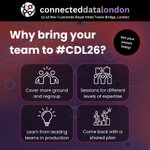
Connected Data London is better as a team.
With up to five sessions running at once, one person can only see part of the programme. Bring your team, and you can split up across the tracks, then compare notes over lunch.
Why bring your colleagues to #CDL26 ?:
1. Cover more ground - send your engineers to the Developer Evolution masterclasses and your architects to Scale & Governance, then bring the best of each back to the office.
2. Leaders and builders in the same room - day one runs a Business Value track for decision-makers alongside the hands-on technical masterclasses, so the people who approve projects and the people who build them hear the same ideas.
3. Learn from teams already in production - Siemens, Bloomberg, AstraZeneca and Google share what worked, what didn’t and what they’d do differently.
4. Come back with a shared plan - leave with a common language for knowledge graphs, ontologies and AI, and fewer internal debates about where to start.
Join us on 11-12 November at the Leonardo Royal Hotel in Tower Bridge!
⭐ Book for you and your team today: 2026.connected-data.london/c…
#KnowledgeGraphs #Ontology #DataTeams #AgenticAI #DataStrategy

Ten business models for monetizing a knowledge graph
Not every graph is meant to be sold. But the architecture and data investment behind many of them hold value beyond the organization that built them. The same models also work internally, as chargeback structures that connect a graph team’s work to what it enables elsewhere.
From least to most commercial:
1. Open source: the core graph stays free, while updates, customization and hosting carry the charges. It is the pattern used by Neo4j, and it fits the sharing ethos of the semantic web.
2. SaaS: access to the graph and its updates is the product, as Diffbot has done.
3. Perpetual license: the whole graph is sold at a premium. It is rare, and suits a graph built years ago in a field that has since grown crowded.
4. Marketplace: AWS, Databricks and Snowflake host data sets, MCPs and apps. Any model on this list can be offered there.
5. Packaging by discipline, domain, named graph, time or version: a modular alternative to selling everything.
6. Query access: the most common model. The product is the service built on query patterns, such as verification, entity resolution or network analysis. Gates via API or MCP prevent a full copy of the graph.
7. Co-op membership: members contribute to the graph. It can be as small as covering server costs, or as large as a consortium building a clinical studies graph.
8. Claim a node: organizations claim and maintain their own entries, much as on Wikidata. It requires incentives and strong governance.
9. Corrections and enhancements to graphs you do not own: resolving open nodes to Wikidata or Getty identifiers, for example in the Six Degrees of Francis Bacon graph. Creative Commons terms apply.
10. Extensions: adding proprietary layers to an existing ontology, such as historical context for FIBO, while staying connected to it.
Revenue traced back to a knowledge graph also strengthens the case for headcount and resources, and gives data teams a way into business conversations. 💡
The next video in the series covers access patterns, security and rights.
By Ashleigh Faith
sbee.link/jghrmnyqtc
#DataMonetization #DataProducts #OpenSource #SemanticWeb #Wikidata
--
Connected Data London 2026 | 11–12 November | Leonardo Royal Hotel London Tower Bridge
🎟 Tickets on sale now - 🔔 Full programme announced
2026.connected-data.london
📺 Sponsorship opportunities available. Contact [email protected] for details.
#KnowledgeGraph #GraphRAG #Ontology #Graph #AI #DataScience #GraphDB #SemTech

“Which capabilities would be affected by retiring this platform?”
Most enterprise architects can’t answer that quickly, because the answer is spread across models, catalogues and documents that don’t talk to each other. In this two-hour masterclass at CDL26, Kalin Maldzhanski, Enterprise Architect at TUI, shows how to build a pipeline that can.
Working from a travel-industry scenario, you’ll build it step by step:
Build: convert architecture models and catalogue data to RDF, reconcile duplicate elements and align everything to an organisational ontology, while source teams keep ownership of their data.
Validate: apply SHACL rules, inspect how relationships are derived, and check provenance and freshness.
Ask: query the graph through an AI assistant in your IDE, guided by ontologies and reusable agent skills, to produce a dependency graph, a capability impact heatmap and a solution proposal.
You’ll leave this masterclass with a repeatable workflow and reusable examples you can apply to your own architecture estate. Basic familiarity with architecture models or knowledge graphs is recommended.
Build Your Own Enterprise Architecture Intelligence Pipeline with Ontology-Guided Conversational AI
🎤 Kalin Maldzhanski, Enterprise Architect, TUI
📅 11 November 2026, 03:30 PM - 05:30 PM, Scale & Governance Track (Warwick Suite)
📍 Leonardo Royal Hotel London Tower Bridge
⭐ Learn more about this session and book your pass now: sbee.link/3jpw6htf4n
#CDL26 #EnterpriseArchitecture #KnowledgeGraphs #ArchiMate #Ontology #AgenticAI

Connected Data retweeted
Teaching agents to walk the graph: Wikidata Search Traces 🕸️
The semantic web was the original web of agents. Agentic LLMs have barely touched it.
A new paper from PleIAs, in collaboration with AI-BRIDGES and Wikimedia Deutschland, tests a convergence between two kinds of depth: graph traversal in a knowledge graph, and recursion in Recursive Language Models (RLMs).
In an RLM, the model works in a persistent Python environment, keeps intermediate results in state, and delegates selected evidence to sub-calls.
What they built:
A method for growing multi-hop questions over a frozen Wikidata snapshot (about 48M entities, 262M facts). Named entities are replaced with nested conditions, and each expansion is certified so the target stays unique and every condition is necessary
10,235 solving traces over single-entity and multi-hop questions
An open RLM harness with 13 graph functions
What the first evaluation shows, on 100 questions:
The harness improved both models tested, compared with direct tool calling over the same functions
gpt-6-luna went from 49 to 61 correct answers, doubling multi-hop accuracy (9 to 19 out of 50)
Qwen3.8-27B, open-weight and served on a single H100, went from 60 to 74, the top score of the evaluation
The gain comes from carrying the search further along the chain of conditions: models reach the target entity more often
The traces are meant for training. The next step is fine-tuning a smaller model, around 12B parameters, on them. The authors see wider potential here: recursively exploring graphs and texts may be a skill in itself, one that can be learned with far fewer parameters. Is that a path to a cognitive core for search?
Beyond Wikidata, they plan to study RLMs as a general approach to semantic data search across sources and ontologies.
By Mohamed Chenene, Carlos Rosas-Hinostroza, Anastasia Stasenko, Shani Evenstein Sigalov and Pierre-Carl Langlais
arxiv.org/abs/2610.06650
#Wikidata #RecursiveLanguageModels #AIAgents #OpenSourceAI #SemanticWeb
--
📩 The Year of the Graph Autumn 2026 newsletter issue is out!
Meaning, Traversal, Reasoning, Action: The Graph Stack for Agentic AI. 👇
yearofthegraph.xyz/newslette…
All things #KnowledgeGraph, #GraphDB, Graph #Analytics / #DataScience / #AI and #SemTech.
Subscribe and follow to be in the know. Reach out if you’d like to be featured

We’re excited to welcome Value from Data & AI as a partner of Connected Data London 2026.
Founded as a London meetup in 2023, Value from Data & AI now brings together data and AI practitioners and leaders in London, Barcelona and Paris, and through a global online hub. Its focus is the product and commercial skills that turn data and AI work into real business value.
Knowledge graph projects often succeed technically but struggle to prove their worth. This partnership brings that business perspective into CDL26, connecting our technical community with people who build the business case, and giving you a community to share your insights with.
Founder Nick Zervoudis is leading the session Prove the Value Before You Build the Graph at this year's tenth edition, a two-hour masterclass on testing the commercial case before you commit to the build.
⭐ Join the Value from Data & AI community for free: valuefromdata.ai/?utm_source…
⭐ Book your CDL26 pass and attend Nick Zervoudis' session at CDL: 2026.connected-data.london/c…
#CDL26 #DataStrategy #KnowledgeGraphs #AI #BusinessValue

Question Answering Systems Powered by Ontologies, Knowledge Graphs and Large Language Models
In this presentation Dan Selman will teach you how to define an ontology for a business domain and then to use the ontology to extract entities from text, store them in a knowledge graph, and use Large Language Models to transform natural language queries into structured graph queries.
Enterprises are awash with structured and unstructured data, and unlocking that data, and making it available to knowledge workers asking questions, will drive productivity improvements over the coming decades.
The presentation is targeted at architects, data scientists and engineers working in the ontology, data modelling and knowledge graph space. Some knowledge of large language models is beneficial, but not a requirement.
Running Open Source code will be used to illustrate many of the concepts.
sbee.link/d9vfxyhq7t
--
Dan Selman. Distinguished Engineer, Docusign
My expertise in knowledge representation and reasoning and software development is driving the evolution of Intelligent Agreement Management. At the intersection of AI innovation and practical application, my work contributes to Docusign's leadership in the digital agreement space
--
Welcome to Connected Data London's #ThrowbackThursday
Every Thursday at 3pm GMT, we are releasing gems from our vault on #YouTube
Tune in and learn from leaders and innovators; subscribe to our channel and watch premieres as they are released!
#knowledgegraph #graphdatabase #graph #AI #datascience #analytics #semtech #ontology

Open Ontologies
Plan a change to a production ontology. See every consequence before you apply it. Then give the reviewer a proof that they can check without trust in you.
SHACL says conforms. The property doesn’t exist. 🔍
A generated triple uses priceBracket. The ontology declares priceRange. Plain SHACL reports a pass, because it only inspects the triples a shape targets.
That gap sits at the centre of Open Ontologies:
Open-world SHACL checks well-formedness, not completeness
Zero focus nodes checks nothing, yet reports success
Closed-world vocabulary checking is the primitive most knowledge-augmented validation stacks lack
Open-world semantics cannot catch fabrication. A GraphRAG pipeline that validates LLM-extracted triples with SHACL alone leaves invented class and property names unchecked.
The vocabulary gate (vocab_check) closes it. Class and property names in generated data are compared against what the ontology declares, and invented ones are flagged before they enter the store.
Around the gate sits a full engine: a Rust MCP server with 70+ onto_ tools to build, validate, query, diff, lint, version, reason over, align and govern RDF/OWL ontologies. In-memory Oxigraph triple store, native OWL2-DL tableaux reasoner, SPARQL, SHACL. Single binary, no JVM. MIT licensed. 🦀
The repo’s benchmarks place the value somewhere other than F1. On OntoAxiom (9 ontologies, 3,042 axioms), SPARQL extraction through the MCP tools and an LLM reading the raw OWL file land at parity. The difference is auditability: every extracted pair traces to a query against real triples.
Whether LLMs belong in ontology creation is a question for evidence, budget, team expertise and timeline rather than ideology.
By Fabio Rovai
sbee.link/gkdn7w6y4q
#SHACL #MCP #OWL #RDF #LLMs
--
Connected Data London 2026 | 11–12 November | Leonardo Royal Hotel London Tower Bridge
🎟 Tickets on sale now - 🔔 Full programme announced
sbee.link/defqrv47hm?utm_sou…
📺 Sponsorship opportunities available. Contact [email protected] for details.
#KnowledgeGraph #GraphRAG #Ontology #Graph #AI #DataScience #GraphDB #SemTech
“Stop moving your data and start connecting it.”
That’s the case Google’s Vinay Balasubramaniam and Bei Li will make at CDL26. Vinay leads product management for BigQuery, and Bei is the founder of Spanner Graph and BigQuery Graph, so you’ll hear it directly from the people building the products.
Their session shows how Google Data Cloud combines native graph capabilities, enterprise ontologies and semantics into an active intelligence layer across the lakehouse, turning static tables into connected, executable business knowledge without redundant ETL.
In 30 minutes, they’ll cover:
- Fusing graph topology with semantic models over data held in multiple engines
- Bridging structured metrics and relational graphs for multi-hop reasoning and real-time observability
- Grounding enterprise AI agents in verified business data through shared semantic context
You’ll leave with architectural patterns for turning raw analytical data into an operational knowledge engine for agentic AI
.
Borderless Context Engine: Unifying Knowledge Graphs, Semantics, and AI Agents on Google Data Cloud
🎤 Vinay Balasubramaniam, Director of Product Management, BigQuery, Google
🎤 Bei Li, Founder, Google Spanner Graph and BigQuery Graph, Google
📅 12 November 2026, 02:50 PM - 03:20 PM, Nodes Track (Warwick Suite)
⭐ Take a deeper look into this session and book your pass today: sbee.link/rgk8xcyewv
#CDL26 #KnowledgeGraphs #BigQuery #GoogleCloud #AgenticAI #Semantics

Connected Data retweeted
How Enterprise Information Architecture unlocks reliable Graph AI
Data silos, compliance risks, and AI hallucinations costing enterprises millions annually are not inevitable. You can fix your architecture without replacing existing systems.
An Enterprise Information Architecture anchored by a semantic knowledge layer connects disparate databases into an interconnected, machine-actionable fabric—powering trustworthy Graph AI and natural language querying.
Rather than complex “rip-and-replace” projects, it unlocks siloed data into AI-ready enterprise knowledge with strict governance built in.
Discover how semantic knowledge graphs bridge enterprise data and trustworthy AI in metaphacts’ free white paper.
#InformationArchitecture #AI #EnterpriseKnowledge #KnowledgeGraph #TrustworthyAI
Get the whitepaper 👇
go.linkeddataorchestration.c…
By Metaphacts - helping bring Year of the Graph to life

Enterprise knowledge graphs tend to fail for organisational reasons long before technical ones. The benefits span the whole business, budgets sit with individual teams, few people understand the technology, and everyone wants results now.
At CDL26, Timi Scoop-Alcala of IKEA and Noz Urbina of Urbina Consulting share an honest account of keeping an enterprise knowledge graph initiative alive while that work is still in progress.
They’ll answer the questions that keep coming back:
“Why semantics?”
“How do RDF, property graphs and vector approaches fit together?”
“Can’t generative AI just do this now?”
They’ll also cover the tension between starting small and planning for scale, making shared capabilities matter to teams with immediate priorities, and explaining technical decisions through their impact on the business and its customers.
You’ll leave with practical ways to explain your initiative, bring different stakeholders with you and keep momentum while the long-term value is still taking shape. For business and technical leads of all backgrounds.
Surviving Long Enough for Your Knowledge Graph Initiative to Make a Difference
🎤 Timi Scoop-Alcala, Senior Product Owner, Knowledge Management, IKEA
🎤 Noz Urbina, Consultant & Founder, Urbina Consulting
⭐ Take a deeper dive into this session and book your pass: sbee.link/f8dey9qk4t
#CDL26 #KnowledgeGraphs #KnowledgeManagement #StakeholderEngagement #EnterpriseAI #Semantics

Who is CDL26 for? These are only four of the communities within our ecosystem, each with sessions built around the problems they’re solving right now. Swipe through to find yours!
🏭 Industry, Manufacturing & Operations
Knowledge Graphs and Agentic AI at Siemens: From Semantic Assets to Industrial Agents | 12 Nov, 14:15
What Do Robots Do Without Data? Why Assembly Graphs May Be the Missing Layer Between CAD and Vision-Language-Action Robots (Mercedes-Benz) | 12 Nov, 15:50
The Keyhole Effect: When LLM-Generated Ontologies Look Complete and Aren’t (Scania) | 12 Nov, 16:25
🏦 Finance, Public Sector & Regulated
When Knowledge Starts to Act: Agents, Knowledge Graphs, and the Evolution of the Human Blueprint (Bloomberg) | 12 Nov, 12:10
Building Evidence-First Knowledge Graphs with Dynamic Ontology and Just-in-Time Entity Resolution (JPMorganChase) | 11 Nov, 15:30
Prove it or remove it: How to build a knowledge graph that lawyers can’t take down (OpenSanctions) | 11 Nov, 13:20
💻 Tech, Consulting & Software
Build your own knowledge graph powered MCP server (Neo4j) | 11 Nov, 09:30
Borderless Context Engine: Unifying Knowledge Graphs, Semantics, and AI Agents on Google Data Cloud (Google) | 12 Nov, 14:50
Scar Tissue: 20 Lessons from 20 Years of Building Ontologies and Knowledge Graphs (ServiceNow) | 12 Nov, 13:40
📈 Investors
Prove the Value Before You Build the Graph (Value from Data & AI) | 11 Nov, 09:30
Mapping the Graph Technology Landscape: How State of the Graph Built a Vendor-Neutral Ecosystem Catalog | 11 Nov, 12:30
Founder-led talks from Ontology Pipeline (12 Nov, 11:00) and The Knowledge Graph Guys (12 Nov, 11:35)
Discover more sessions & book your pass today: 2026.connected-data.london/p…
#CDL26 #KnowledgeGraphs #Ontology #AgenticAI #DataStrategy


Semantics for the Emerging Enterprise Agent Ecosystem
Enterprise agents tend to fail on context, not reasoning. 🧭
The knowledge they need sits across systems of record, SOPs, policies, tickets, emails, code and operator judgment. The same term carries different meanings in different functions. Token limits rule out loading everything at once, and every token now carries a cost.
So the question shifts from “how much context can an agent hold” to “what is the right context for this step.”
Semantic silos show the problem clearly.
Team 1 defines “Active Customer” as a purchase in the last 30 days. Team 2 defines it as a subscription in the last 6 months. Each definition lives inside its own dataset. An agent asked about Active Customers has no basis for choosing between them.
The proposed answer is to separate semantics management from data management. Meaning is defined once, and tables, files and APIs refer to it.
That layer is the Agentic Knowledge Fabric (AKF):
Ingest: structured systems, SOPs, source code, audio and video, tickets and emails, plus tacit knowledge captured through expert interviews and operator walkthroughs. All of it is compiled into versioned concept/entity cards and policy cards.
Store: a metagraph holding references and bindings to the data layer rather than instance-level data, so objects number in the thousands instead of billions. Knowledge graphs carry typed relationships, while indices and metadata support filtering and vector search.
Serve: a request is parsed, disambiguated through the vocabulary, resolved through bindings and assembled into a Minimum Viable Context package. Policy comes first, then facts, then supporting evidence, all within an explicit token budget.
Three principles hold it together: relevant and semantically correct data, delivered in a token aware way, through one consistent method for ingesting, compiling, storing and serving meaning across data, documents and media.
For teams building agents today, the starting point is a question about definitions: which ones are we relying on, and are they consistent across the systems that matter? The cost of fixing a semantic inconsistency grows with every agent built on top of it.
By Eric Broda and Juha Korpela
sbee.link/49ftpnhbwq
#SemanticLayer #AIAgents #ContextEngineering #EnterpriseAI #AgenticAI
--
Connected Data London 2026 | 11–12 November | Leonardo Royal Hotel London Tower Bridge
🎟 Tickets on sale now - 🔔 Full programme announced
sbee.link/dhefk3jv98
📺 Sponsorship opportunities available. Contact [email protected] for details.
#KnowledgeGraph #GraphRAG #Ontology #Graph #AI #DataScience #GraphDB #SemTech
