

#Research lab led by Prof. @MerleFairhurst. We explore the cognitive and neurophysiological correlates of social affective touch and interpersonal coordination
Technische Universität Dresden
Joined September 2023
- Tweets190
- Following367
- Followers114
- Likes17








Pinned Tweet
Call for Contributions for a NeuroImage Special Issue led by @MerleFairhurst (@TactileInternet/@tudresden_de) and @nico_hinrichs (@MPI_CBS)
Focus: hyperscanning, inter-brain coupling, multimodal neuroimaging, VR/AR/haptics and computational models.
Issue starts 01.26

Wanna join our team? We have exciting new open projects on social touch, comfort, health, virtual reality, thermal feedback, and human connection.
Explore the opportunities: tu-dresden.de/ing/elektrotec…

We’re investigating whether touch from a social robot can comfort people experiencing low-arousal, low-valence emotions. This NWO-funded collaboration between @TilburgU and @tudresden_de explores how affective haptic feedback shapes emotional experience and social perception.

With Dr. Merel Jung, Dr. @jeanne_hecquard & Prof. @MerleFairhurst
Learn more: tu-dresden.de/ing/elektrotec…

How are physical touch and trust connected?
Our research began with a systematic review of the two-way relationship between touch and trust in human and technology-mediated interactions.
Read more: sciencedirect.com/science/ar…

Welcome to our new PhD candidate, Fatih! 👋
Fatih previously completed an internship for his Master’s thesis with us at @TactileInternet investigating virtual self-touch in immersive VR, emotion regulation, mindfulness, stress, and psychophysiological responses to acute stress.

New paper from our team: How do preferences for touch from friends change from adolescence to adulthood?
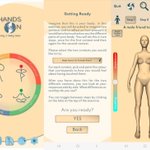
Using the HandsOn app, we found that age, gender, body area, and relationship context all shape how touch is experienced.

The study opens up important questions for socio-emotional learning and wellbeing.
Read more: onlinelibrary.wiley.com/doi/…

Our Chair, Prof. @MerleFairhurst, features in the latest 6G-life video, exploring how touch shapes human–machine interaction, emotional connection, and more intuitive technology.
Watch here: youtube.com/watch?v=bukDiPW8…

Virtual reality’s greatest potential may be connection.
From social inclusion in Cyberball to trust-building with a virtual robot and shared musical experiences, VR can create meaningful bonds through presence, attention, and interaction.

Read the article in our blog: tu-dresden.de/ing/elektrotec…
Which functions of clinical touch can be technologically mediated?
Our chapter in the forthcoming book Berührungsmedizin introduces the DSH classification of diagnostic, social, and salutary touch, and explores how wearables, robotics, and haptic systems could support

clinical touch when direct contact is not feasible. Their effects, however, depend on context, social meaning, individual expectations, and consent.
Find out more about the book here: shop.kohlhammer.de/beruhrung…

A new systematic review examines physical, human-to-human touch across healthcare professions, looking beyond its diagnostic and clinical functions to its communicative, social, and affective dimensions.

The review challenges the simple distinction between “instrumental” and “expressive” touch, highlighting the socio-affective matrix that may be present across healthcare touch.
pmc.ncbi.nlm.nih.gov/article…

A new review explores how physical touch shapes emotional engagement, presence, and immersion across theme parks, immersive theatre, performance art, VR, gaming, and film.
Can technology really reproduce the warmth and social meaning of human touch?
journals.sagepub.com/doi/ful…

A new reference work on touch medicine is coming!
Berührungsmedizin explores therapeutic touch from its neurobiological foundations and embodiment to clinical applications, ethics, training, and implementation.
Looking forward to seeing our research referenced in this book.

Expected Q4 2026 from Kohlhammer Verlag.
linkedin.com/posts/beraeshru…

Our manuscript “Disentangling touch aversion” has been accepted by the Journal of Nonverbal Behavior!
The study examines how touch aversion varies across people and relationships, and highlights the roles of sensory sensitivity, threat sensitivity, and relationship context.

Preprint: researchsquare.com/article/r…