

AI-powered competitor intelligence. Understand your market, uncover opportunities and make better business decisions. Know. Analyse. Grow.
Joined September 2026
- Tweets61
- Following18
- Followers2
- Likes11






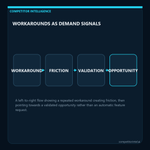


When customers use spreadsheets, chat or manual approvals beside a SaaS product, what should you investigate first: how often it happens, which workflow it disrupts, or whether customers would change behaviour to fix it?

A visible feature does not reveal the whole product. Separate what you observed from what the system probably requires. Keep integrations, permissions, edge cases and operational assumptions marked as questions until validated.

A competitor’s weakest point may sit outside the product: spreadsheets, duplicate entry, manual approvals or chat messages filling workflow gaps. Those workarounds are evidence of recurring friction—and possible positioning opportunities.
Product analysis becomes more useful when it produces a build sequence. Move from observed behaviour to system requirements, open questions and prioritised tasks. SassCloner is designed to help connect those stages.

A competitor’s weakest point may sit outside the product: spreadsheets, duplicate entry, manual approvals or chat messages used to fill workflow gaps. Those workarounds are evidence of recurring friction—and possible positioning opportunities.

When several customers complain about the same competitor, what should you validate first? The feature they request, the workflow it disrupts, the workaround they tolerate—or whether they would actually change behaviour?
A customer may dislike a competitor and still refuse to switch. What blocks the move: migration, integrations, permissions, training or internal approval? Identify that barrier before treating dissatisfaction as demand.
A customer complaint is not automatically a product opportunity. Ask: does it recur, affect an important workflow and create a behaviour customers will change? Then test the smallest useful intervention before building a full feature.
When a competitor says it is “simple”, “secure” or “built for teams”, what proves that claim? Trace the positioning to a customer problem, then inspect the product for evidence. Anything unsupported becomes an open research question.
When comparing SaaS pricing, ask more than “which is cheaper?” Can buyers predict the final cost? Are limits easy to understand? Do add-ons create approval friction? Pricing design can influence switching as much as the monthly figure.

Competitor pricing is not just a number. Compare packaging, usage limits, add-ons, upgrade triggers and approval friction. A cheaper plan can still feel harder to buy if the customer cannot predict the final cost.
Does your competitor research change what gets built? Separate observed behaviour, likely system requirements, open questions and first-release tasks. If the analysis never changes priorities, it may be documentation rather than intelligence.

A competitor may look like one product but serve several segments. Compare use cases, buying triggers, support needs and tolerance for complexity. The clearest opportunity may be the customer the incumbent serves indirectly.

A competitor may look like one product but serve several segments. Compare use cases, buying triggers, support needs and tolerance for complexity. The clearest opportunity may be a segment the incumbent serves indirectly.
A competitor may look like one product but serve several different segments. Compare use cases, buying triggers, required support and willingness to tolerate complexity. The clearest opportunity may be a segment the incumbent serves indirectly.
What would customers actually have to rebuild if they switched competitors? Map history, templates, integrations, team routines and shared knowledge. Retention may come from accumulated context rather than the headline feature.
A competitor’s retention may come from habits, not features. Compare saved history, templates, integrations, team routines and shared knowledge. These assets can create more switching friction than the product’s headline capability.
A product can satisfy the daily user and still lose the deal. Analyse the full buying journey: user outcomes, budget justification, IT approval and operational risk. Positioning must answer the objection that actually blocks purchase.
When analysing a competitor, what would customers actually have to leave behind? Look beyond features: history, templates, integrations, team habits and shared knowledge may create more switching friction than the product’s headline capability.