

Make connections. Tech 4 educators & genealogists + Created by @ErikaBsumek. Collaborate, Cite, Map Networks, Present, Export. #twitterstorians #dhtoolkit #edu
Austin, TX
Joined January 2018
- Tweets12.2K
- Following820
- Followers1.1K
- Likes2.1K
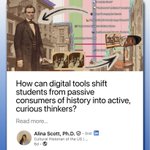


"How can digital tools shift students from passive consumers of history into active, curious thinkers?"
One of Dr. Alina Scott's ideas: making ClioVis 'Teaching Timelines' where students draw analytical connections between course material using ClioVis.


We are excited to announce that ClioVis—our non-AI timeline and mindmapping tool—has a new website!
The website highlights the impact ClioVis is making in classrooms across the country, features testimonials from students and professors, and includes a tutorial page to help you, or your students, use the platform with ease.
Check out the new page at cliovis.com.


What's missing from current conversations about the US-Mexico border? Its history!
Mary E. Mendoza's 'The Deadly Divide' examines how the United States constructed its first southern border fences in response to the spread of 'Texas fever,' a livestock disease spread through cattle ticks. Mendoza explores how this connection to disease control shaped border expansion, and the rhetoric used to justify it.
Interested in learning more?
Get a copy of Mendoza's book, published by @UNC_Press, here: bit.ly/deadly-divide
Or, check out our ClioVis timeline: bit.ly/cvdeadly-divide
Rereading your notes isn't good studying. What actually works is forcing your brain to do something with the information.
Here's a better strategy: summarize new ideas in your own words, then connect it to what you already know.
ClioVis makes that process easy, and even lets you visualize it. Enter new content as a new 'event node,' draw a connection back to a concept you've learned before, and explain how the two ideas relate. Building this web throughout your coursework will help you integrate the new information in your brain, which is exactly what you need to easily retrieve it on a test.
If you're ready to stop cramming the night before tests, comment 'STUDY' and we will send the first twenty students a code for a free individual subscription.
Researchers are using ClioVis to bring the past to life. We are so proud to support this digital scholarship!
'ClioVis: Visualizing Modernity Across the Americas in the 19th Century for Students' highlights archival documents relating to modernity in Latin America for high school and undergraduates.
Marcus Golding, Colton De Los Santos, Antonio Argüelles, and Ori Wade Parks developed the resource as a reference for students and teachers, and will be presenting their project this Friday.
Register to attend the event: bit.ly/LLILASshowcase26
Check out the timeline: bit.ly/bensoncv26

A recently published article highlights ClioVis’s pedagogical power amid the AI era.
Historians Erika Bsumek and Kristina Neumann describe ClioVis as “offer[ing] a model for digital pedagogy that slows student cognition, foregrounds evidence-based reasoning, and reinforces the interpretive practices at the heart of historical inquiry.”
They emphasize that the technology’s scaffolding of higher-order thinking makes ClioVis stand out among other digital tools.
Read the publication at bit.ly/pedagogy25cv


If “memory is a web of interconnected ideas,” why are we still building linear timelines?
@DrJustinSung talks about the significance of thinking through how different concepts connect, arguing that such analytical thinking is the key to learning retention. This learning science is the core of ClioVis, which pushes students to make connections between the concepts that they’re learning.
Ready to get started? We’re looking for a select group of educators to use ClioVis in their classrooms at no cost this fall. Sign up for a free demo at try.cliovis.com
Have you recently published a book? Let us help promote it for free!
We are looking for scholarly books to feature in our Mapping New Books Series. Our interns will work with you and deliver fully fleshed out timelines of your book, which can be used in book talks, etc.
To start working together, DM us or comment below!
Check out our new Mapping New Books series at the link in our bio.


What does the process of building tangible skills look like? Can tech play a role in that?
As part of our new ‘Reclaiming Tech Tools’ series, we highlight how tech built on cognitive science—like ClioVis—prioritizes student thinking over AI through its design. Future videos will examine this idea by breaking down learning science like schema theory and its relation to ClioVis features.
🔔Follow us for more
🔗Sign up for a free demo with a human intern—not AI—today at try.cliovis.com
There’s a lot of backlash against ed-tech right now, and some of it is warranted in this age of AI, but not all Ed-Tech is created equal.
ClioVis was made by an educator, rooted in pedagogy and learning science, for educators. The digital timeline tool mirrors the steps of what educational psychologists call 'meaningful learning.' In the age of AI, this learning science makes all the difference.
We're looking for a select group of educators to use the software in their classroom for free. If you're interested, email admin@cliovis.com
President Trump cut the size of Bears Ears, again. What's the monument's unique history?
As this news broke, a ClioVis Intern was reading historian Erika Bsumek's The Foundations of Glen Canyon Dam in preparation for a new episode of our Mapping New Books series. The books tells the unique history of how the monument came about.
What have you always wanted to know about our national monuments?
Purchase a copy of Bsumek's book, now in paperback from University of Texas Press: bit.ly/foundations-of-glen-c…
Did you know that the first US-Mexico border wall was constructed to prevent the spread of Texas Fever?
In this edition of our Mapping New Book series, ClioVis Intern Blaze introduces Dr. Mary E. Mendoza's new book 'Deadly Divide: How Insects, Pathogens, and People Defied the US-Mexico Border,' which provides a new, environmental angle for understanding US-Mexico borderlands.
Learn more by getting a copy of Dr. Mendoza's new book here: bit.ly/deadly-divide
@UNC_Press
At UT-Austin, professors are having students build timelines and mind maps to master course content and lock in learning.
ClioVis is the ultimate tool for brainstorming, planning, and presenting ideas that pushes students to prioritize thinking over AI shortcuts.
Get started with the platform today at cliovis.com.

If you want to remember what you're learning, cognitive science shows it's easier when you create something with the content you're studying.
Last week, one of our interns talked about this phenomenon—which researchers have dubbed "the generation effect." In this video, he shares how working in ClioVis produces that effect and can improve how you study.
Get started today at cliovis.com
Do you ever notice that you remember content better when you make something with it? That's what cognitive scientists call 'the generation effect.'
In this study tip video, ClioVis intern Aidan discusses why it is important to actively engage with content as you review it.
What do you do while studying to make the content stick?
ClioVis is proud to support student research at universities across the globe.
This April, students in Dr. John Haberstroh's Ancient Greek history course at University of Nevada, Las Vegas presented their ClioVis timelines at UNLV's Lied Library.
Over the semester, students researched the social, political, and economic histories of 5th century BCE Greece and collaborated to build timelines of major battles, speeches, and figures.
Interested in using ClioVis with your students? Get started with a Free ClioVis Exam Copy (an initial free semester) at ClioVis.com

The Smithsonian Castle reopened to the public last week in celebration of the 250th anniversary of the American Revolution.
ClioVis intern Evelyn covers the history of the Smithsonian Institute, from its original creation to the opening of future museums.
Want to learn more? Check out the link to her timeline: bit.ly/smithsoniancv
Over the past semester at UT-Austin, students in Professor Isabelle Headrick's American Jewish History course used ClioVis to support their research projects.
The platform pushes students to draw analytical connections between ideas, visualize their reasoning, and strengthen their critical thinking skills.
Interested in using ClioVis in your own classroom? Get started at cliovis.com.


