
I'm telling the huge story of the American Civil War X by X and tidbit by tidbit. Learning about the Civil War is enjoyable and rewarding. - Jonathan R. Allen
Village of Pinehurst, NC
Joined June 2009
- Tweets13.1K
- Following4.2K
- Followers27.5K
- Likes1.8K





Pinned Tweet
All of my Civil War books (501 Civil War Quotes and Notes, 305 Civil War Words and Terms, and 125 Civil War Stories and Facts) are now available in audio format. Slack back in your easy chair and listen to learn Civil War History. More links in comments. amazon.com/dp/B0F2GPH9PC

“You will, however, learn before this reaches you that our success at Gettysburg was not so great as reported-in fact, that we failed to drive the enemy from his position, and that our army withdrew to the Potomac" - Robert E. Lee, writing to his family after Gettysburg.
President Abraham Lincoln wanted the Army of Northern Virginia destroyed and was unhappy Lee’s army escaped back to Virginia after Gettysburg. Lincoln said Meade’s chase after Lee and the Army of Northern Virginia was like: “an old woman trying to shoo her geese across a creek.”
Both Gen. George G. Meade's and Lee’s armies were exhausted and spent after the three-day battle at Gettysburg. Meade cautiously pursued Lee’s retreating Army of Northern Virginia, but the Confederates crossed the Potomac River and escaped.
Gen. George G. Meade and the Army of the Potomac won a major victory at Gettysburg in July 1863. General Lee’s invasion of the North was both incomplete and unsuccessful, and it was finished.
At Gettysburg on July 3, 1863, about two or three hundred Confederates from Virginia and Tennessee were able to break through the Union line during Pickett's Charge.
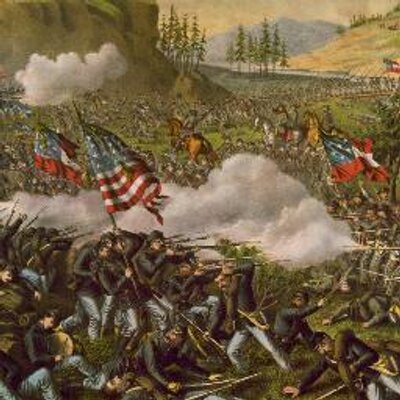
At Gettysburg on July 3, 1863, canister and infantry fire rained down hard on General Pickett’s charging men but they bravely held their lines. Death spread like wildfire and Pickett’s division lost 75% of its men.
“This has been a sad day for us, Colonel, a sad day; but we can’t always expect to gain victories.” - General Robert E. Lee, to Colonel A. J. Lyon Fremantle of the British Army, at the end of fighting at Gettysburg on July 3, 1863.
“It’s all my fault, it is I who have lost this fight, and you must help me out of it the best way you can. All good men must rally.” - Robert E. Lee to the men of Pickett’s Charge as they return to their lines after being repulsed by the Yankees. July 3, 1863 at Gettysburg.
“It ain’t so hard to get to that ridge – The hell of it is to stay there.“ - The thoughts of a Confederate soldier, just prior to Pickett’s Charge on July 3, 1863 at Gettysburg.
“Up, men, and to your posts! Don’t forget today that you are from Old Virginia!“ - General George E. Pickett, to his men just before Pickett’s Charge on July 3, 1863 at Gettysburg. Many of these men never returned to Old Virginia.
"Pickett said, ‘General, shall I advance?’‘ - General James Longstreet, describing events just before Pickett’s Charge on July 3, 1863 at Gettysburg.
On July 3, 1863 at Gettysburg during Pickett's Charge, Union artillery tore into the advancing Rebels. However, the men in gray bravely continued on toward the Union line.
On July 3, 1863 at Gettysburg during Pickett's Charge the Union artillery used canister. The deadly horror of the shotgun-like fire tore Confederate men apart into bits and pieces.
On July 3, 1863 at Gettysburg during Pickett's Charge a small clump of trees, a copse of trees, near an angle of a stone wall became the aim of the Confederate’s advance.
On July 3, 1863 at Gettysburg during Pickett's Charge, the Confederates paused a few hundred feet from the Union line to somewhat reorganize themselves for their final assault on the Billy Yanks.
On July 3, 1863 at Gettysburg during Pickett's Charge, Union infantry waited patiently and nervously for the men wearing gray to come closer into better range.
On July 3, 1863 at Gettysburg during Pickett's Charge, Union artillery opened fire upon the advancing Confederates quickly mowing many of them down. Protected behind breastworks, Union infantrymen held their fire.
At 1:45 in the afternoon on July 3, 1863 at Gettysburg, General James Longstreet ordered the attack on the Union center. Confederate infantry began to move across a half mile of open ground. Pickett’s Charge had begun.
There can be no doubt that on July 3, 1863 at Gettysburg across the space of the great open field and pasture that separated the men in blue from their enemy, the men in gray performed some common tasks and made prayers to God to pass their own nervous time before the fight.