





Pinned Tweet
In a fully automated factory, you wouldn't have machinists, you would have application engineers. You wouldn't have maintenance, you would have service engineers. Every position there would be more technical than what is demanded to operate a factory. Fewer overall people, but the ones that are there have a deep skill set. Finding these people isn't impossible if you're willing to throw a lot of money at them. Making them from scratch is almost easier, but it takes time. With the way things are moving, we don't have time. Unfortunately, we only have deadlines.


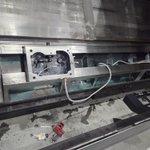
So I had to rebuild a tool changer arm, adjust the cam timing, and align it. Looks like I am very close, but when I watch it in slow motion, I'm slightly off. I will have to return with an alignment kit for a CAT50. It's not easy getting this perfect. It weighs 67 lbs and it's held on with a compression fitting. You have maybe a tolerance of .005" on the height to match the knockout. If both sides aren't perfect, you start dropping tools. These are 10" face mills and they weigh 40 lbs. They will destroy the way covers if they fall on them from that height.


Check out Steve's progress. For doing this in his spare time, this is amazing. @10_X_eng is top notch.

STEVE CAN CONTROL MACHINE TOOLS. I made an AI that can control my Syil X7.
Not hobby tools, machine tools. Ones that you can buy from @titangilroy or from Dynamic @ChipHaze
What a time to be alive. Github repo so you can build your own connectors below.
Chip Haze retweeted

Ok, what makes Steve so interesting. This little box is what. If there is a technical path that will work, Steve just writes them on his own. I am not driving the technical direction of Steve... You are. It's the only platform where customers get what they ask for as close as technically possible.
(Steve is a small project, so it can't do everything sry)

Chip Haze retweeted

It was my absolute pleasure to interview Bartosz Naskrecki @nasqret and I'm now very excited to share the interview with you.
He's possibly the most knowledgeable person I know about the current capabilities of AI in math and I just learned *a lot* in this conversation (and during an amazing talk he gave at the conference we were both at). Thanks Bartosz!
Plus, look at that location!! 🤩
youtu.be/jKcRLlCn2Mg?is=AZYb…

Toolpath'S (CAM kernel) licensing is the remaining proprietary choke point.

NVIDIA just dropped an open source Apache-2.0 licensed CAD kernel HAHAHAHAHAHAHAHAHAHAHA
i honestly feel bad for the prop CAD bros. this week has been nonstop L's and it isn't getting better from here
github.com/NVIDIA-Omniverse/…


Rue definitely needs more eyes on what he does. He has a lot of followers but the algorithm doesn't do him any justice.

Whenever I see a new video or somebody interviewed about the utilization of AI for mathematics, I always ask myself, why the hell aren't they interviewing Thomas? He seems so straightforward and pragmatic. Thomas runs the website Erdos problems and dealt with both side of this argument. @nasqret also works within academia while being a heavy contributor to AI and mathematics.

Keep Steve free
You all funded $267.71 for Steve Studio to keep it free for everybody.
The more you share my content, the more resources Steve Studio has.

Check out my friends at Neuramill. Their software just keeps developing into something pretty cool. If I lived on the west coast I would join this team.

🎙️ A new episode of Bits and Bolts is out today! You can automate a thousand clicks in CAM software. The harder problem is understanding why a machinist makes them ⚙️
Before the first cut, someone has to choose the tools, decide how to hold the part, interpret tolerances, and plan the order of operations. Much of that judgment lives in an experienced machinist’s head.
So I sat down with Nistha Mitra, co-founder and CEO of Neuramill, for the latest episode of Bits & Bolts.
Neuramill is building an AI co-pilot for high-precision manufacturing, with the goal of helping one machinist do 10x more by capturing the reasoning behind those decisions.
We talk about the missing data behind physical AI, preserving knowledge as experienced machinists retire, and why human judgment remains essential when you’re making mission-critical parts.
📌 Chapters:
00:00 An AI co-pilot to make a machinist 10x
00:27 Meet Nistha Mitra and Neuramill
01:38 Foundation models, explained
03:43 How data and robotics are changing manufacturing
06:44 Why trust matters in manufacturing AI
09:05 The missing data behind physical AI
12:31 Is a complete physical AI model decades away?
14:18 Neuramill and the knowledge machinists carry
17:14 From a drawing to machining decisions
20:03 Milling, setups, and micron-level precision
22:39 Where Neuramill fits between CAD and CAM
25:09 What early machine-shop deployments revealed
27:53 Why space manufacturing needs this
29:07 Additive versus subtractive manufacturing
31:38 Can dark factories make mission-critical parts?
32:59 Bringing the next generation into machining
35:16 The vision for an AI-native factory floor
36:42 Thanks, outro, and bloopers


Yes

I just want to remind all of you that amazing shit is built in places other than SF, LA, Austin, etc.
Real Americans are build amazing shit with no background at famous companies in places you have never heard of.
Midwest builders need their own thing somewhere semi-rural without all the same BS as the startup capitals.
There is so much untapped potential in the Midwest in people that will never move to the big cities and they all have a top notch work ethic.