

PhD student @WisconsinCS | Prev @AIatMeta (MSL) @LTIatCMU @USeoul @argonne @NAVER_AI_LAB
Madison, Wisconsin, USA
Joined December 2021
- Tweets187
- Following606
- Followers525
- Likes752

Pinned Tweet
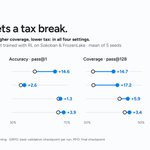
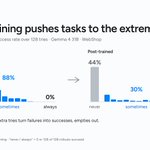
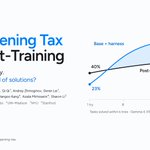
🛑 Does post-training teach LLMs new agentic skills, or just sharpen what they already know?
[1/11] Introducing Sharpening Tax 🧾 to measure the hidden cost of post-training!

Changdae Oh @NeurIPS'26🇺🇸 retweeted

うわぁ、、、絶対これおもしろい、、、
低データ高次元での強化学習の統計的な性質を、高次元統計とか統計学的学習理論をつかって、いい感じにまとめてくれてるらしい。
読みたいすぎる。300+ページ 🤯
[2610.41903] Statistical Foundations of Reinforcement Learning: A Non-Asymptotic Perspective arxiv.org/abs/2610.41903

Changdae Oh @NeurIPS'26🇺🇸 retweeted

I know many PhD students are questioning what their paths mean as AI accelerates scientific discovery. That anxiety deserves to be taken seriously.
I wrote some reflections in a recent blog post. My students found them helpful, so I’m sharing them more widely.
I hope it offers a little light as we navigate this strange time. Please share it with someone who might need it.
pages.cs.wisc.edu/~sharonli/…

Changdae Oh @NeurIPS'26🇺🇸 retweeted

New Meta paper finds Reinforcement learning post-training makes an agent better on its first attempt and worse at ever finding a solution when it gets 128 attempts.
People assume reinforcement learning teaches agents new skills like tool calling.
That claim comes mostly from math and coding, where base models have already seen huge amounts of data.
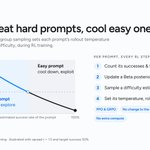
They ran 14 base and post-trained model pairs on 3 agentic benchmarks with up to 128 tries per task. They also built PTGS, a sampler that raises temperature on hard prompts and lowers it on easy ones.
On WebShop a gemma-4-31B base model solved over 85% of tasks within 128 tries against 56% for the post-trained version. Their Sharpening Tax came out positive in 36 of 42 model and benchmark pairs, meaning coverage shrank.
Before picking a post-trained model for an agent that can retry, measure how many tasks it ever solves, not just first-try accuracy.

Changdae Oh @NeurIPS'26🇺🇸 retweeted

🧠 Thinking more ≠ telling users what they need to know. Introducing our #TMLR paper: "Thinking Is Not Telling: Information Disclosure in User-Service LLM Agents", w/ @Changdae_Oh @HyeonggyuC @jindong_wang92 @SharonYixuanLi
❓ Can stronger internal reasoning improve agent–user collaboration? The challenge: agents see policies, tool results, and environment states that users cannot. Users need this information before making consequential decisions—but private reasoning does not guarantee timely disclosure.
🔬 We introduce a five-category information-disclosure taxonomy, evidence-grounded probing, and turn-level counterfactual interventions to examine what agents communicate—and how missing information affects their actions.
🌟 Across five models and three service scenarios, enforced thinking does not consistently improve task success. More thinking does not reliably yield richer disclosure. State corrections and constraints are the most frequently missing categories in our matched failure analysis.
🎯 Injecting missing decision-relevant information improves the agent’s immediate downstream action correction beyond verbosity and think-content controls. A lightweight, training-free InfoDis prompt also mitigates enforced-thinking degradation: +5.26 percentage points for GPT-4o and +3.44 for DeepSeek-V3.1 in overall task success.
💬 Better user-service agents must communicate the right information before users decide.
📑 Paper: agent-infodis.github.io/pape…
🔗 Project Page: agent-infodis.github.io/

Changdae Oh @NeurIPS'26🇺🇸 retweeted

I turned in my ICLR reviews. A couple of papers in my batch were already desk-rejected, so I reviewed the rest. I don't think I'm a mean reviewer, and I am totally open to using AI for research and writing. I use it every day to work faster and brainstorm. But this time, it didn't feel like normal peer review. It felt like I was doing free labor providing the first human feedback in someone's automated research loop using AI.
Here are a few things that kept happening over and over:
1. Big promises, tiny tests.
The intro makes a huge, exciting promise. But then the tests don't match the story at all. The authors just picked the easiest and fastest test they could find, said it worked, and claimed they solved the whole problem. It felt like someone asked an AI for the quickest way to get a nice chart and just went with it.
2. One run, one model, or one dataset.
The core ideas were actually pretty cool and new, but the testing was limited. Testing on just one run, one model, or one dataset makes it look like someone wrote a quick AI prompt, ran it once, and hit submit without double-checking anything.
3. Missing details on hyperparameters.
There was zero explanation of how hyperparameters were chosen. Sometimes the values weren't even listed. It looked like people just took whatever came out of a one-click prompt and never stopped to ask why or how those numbers were selected.
4. Complex and sophisticated algorithm, no discussion on cost.
The methods keep getting sophisticated and more complex, but no one talks about how slow they are or how much computer power they eat up. Even when a paper did show runtime, it only showed its own method and never compared it fairly to simple baselines. I guess people were in such a rush before the deadline that they forgot to prompt the AI for cost efficiency.
5. Blaming everyone based on one example.
I like papers that honestly show when things don't work (negative results). Lately, though, many start by claiming an entire domain or class of algorithms is fundamentally flawed, only to support that claim with a super detailed analysis of just one specific algorithm. It looks like they dove deep into one method (using AI?), got excited, and completely forgot to check any other algorithms before writing up the paper.
Anyway, I did my job and wrote out all my reviews. If the authors feed reviewer' comments back into their AI for two or three more tries, the papers will probably look great and get published. At this point, shouldn't I be added as a co-author on these papers as the first human feedback provider?? Just saying, please give me authorship.

Changdae Oh @NeurIPS'26🇺🇸 retweeted

𝐁𝐞𝐭𝐭𝐞𝐫 𝐫𝐞𝐬𝐮𝐥𝐭𝐬 & 𝐥𝐨𝐰𝐞𝐫 𝐜𝐨𝐬𝐭, 𝐚𝐬 𝐬𝐨𝐨𝐧 𝐚𝐬 𝐲𝐨𝐮 𝐩𝐮𝐭 𝐟𝐫𝐨𝐧𝐭𝐢𝐞𝐫 𝐚𝐠𝐞𝐧𝐭𝐬 𝐨𝐧 𝐋𝐄𝐀𝐒𝐇! 🦮
Why use a frontier model at every step when a lightweight agent can handle lots of the work?
Introducing 𝐋𝐄𝐀𝐒𝐇: 𝐔𝐧𝐜𝐞𝐫𝐭𝐚𝐢𝐧𝐭𝐲-𝐀𝐰𝐚𝐫𝐞 𝐖𝐞𝐚𝐤-𝐭𝐨-𝐒𝐭𝐫𝐨𝐧𝐠 𝐄𝐬𝐜𝐚𝐥𝐚𝐭𝐢𝐨𝐧 𝐚𝐧𝐝 𝐎𝐯𝐞𝐫𝐬𝐢𝐠𝐡𝐭.
LEASH unleashes the strong agent only when the weak agent's latent uncertainty signals the need, and keeps it on a leash afterward.
Two key challenges:
1️⃣ 𝐖𝐡𝐞𝐧 𝐭𝐨 𝐞𝐬𝐜𝐚𝐥𝐚𝐭𝐞? Use the weak agent's latent uncertainty as an inexpensive signal that can be monitored at every step.
2️⃣ 𝐇𝐨𝐰 𝐭𝐨 𝐦𝐚𝐢𝐧𝐭𝐚𝐢𝐧 𝐨𝐯𝐞𝐫𝐬𝐢𝐠𝐡𝐭 𝐚𝐟𝐭𝐞𝐫 𝐞𝐬𝐜𝐚𝐥𝐚𝐭𝐢𝐨𝐧? Even frontier agents can go astray. And when served through black-box APIs, their internal states are inaccessible. LEASH enables continued oversight without accessing the strong agent's internals.
𝐓𝐡𝐞 𝐤𝐞𝐲 𝐢𝐧𝐬𝐢𝐠𝐡𝐭: Knowing when to escalate—and when to intervene—is just as important as knowing how to act.
The future of agentic AI isn't about using the strongest model everywhere. 𝐈𝐭'𝐬 𝐚𝐛𝐨𝐮𝐭 𝐝𝐞𝐩𝐥𝐨𝐲𝐢𝐧𝐠 𝐢𝐧𝐭𝐞𝐥𝐥𝐢𝐠𝐞𝐧𝐜𝐞 𝐰𝐡𝐞𝐫𝐞 𝐢𝐭 𝐦𝐚𝐭𝐭𝐞𝐫𝐬 𝐦𝐨𝐬𝐭.


💸 For computer-use agents, using a frontier model at every step is expensive—but relying on a small model alone is risky.
LEASH offers a middle ground: let a lightweight agent handle what it can, bring in a stronger model only when needed, and keep monitoring afterward. Put your frontier model on a LEASH !! 🦮
📄 arxiv.org/pdf/2610.22280

Changdae Oh @NeurIPS'26🇺🇸 retweeted

💸 For computer-use agents, using a frontier model at every step is expensive—but relying on a small model alone is risky.
LEASH offers a middle ground: let a lightweight agent handle what it can, bring in a stronger model only when needed, and keep monitoring afterward. Put your frontier model on a LEASH !! 🦮
📄 arxiv.org/pdf/2610.22280
Changdae Oh @NeurIPS'26🇺🇸 retweeted

🧪Can AI agents take a scientific paper and write a meaningful follow-up to it?
We introduce Into the Unknown, an AI agent benchmark of 15 open scientific research problems. Each problem comes from a scientist currently or formerly at US DOE National Labs:
@LosAlamosNatLab @SandiaLabs @BerkeleyLab @AmesNatLab @PPPLab @Livermore_Lab


Changdae Oh @NeurIPS'26🇺🇸 retweeted
AI agents are becoming increasingly autonomous. But our ability to monitor and diagnose their behavior is lacking.
I gave a talk at the Simons Institute, covering our latest NeurIPS'26 papers on how to quantify agent progress and diagnose failures at the fine-grained, turn-by-turn level.
Video is now available:
🎥 youtube.com/live/5vBzKW3-wAQ
-------
Tracing Agentic Failure from the Flow of Success
arxiv.org/abs/2607.12747
Neglected Free Lunch from Post-training: Progress Advantage for LLM Agents
arxiv.org/abs/2606.26080
Hide-and-Seek in Trajectories: Discovering Failure Signals for VLA Runtime Monitoring
arxiv.org/abs/2605.30834

Changdae Oh @NeurIPS'26🇺🇸 retweeted
Banger paper from Meta Superintelligence Labs on user simulators for agent training.
Agent RL setups usually let an assistant LLM play the user, so the simulated user is too cooperative and too explicit.
A fixed GPT-5.5 agent finds tau-bench tasks easier with these users than with real people.
This work trains MIMESIS, a 9B user simulator, on human conversations and 13 behavior patterns observed in real users. It beats Claude Opus 5 on behavioral fidelity by 13.4 points.
Agents trained against it outperform agents trained against GPT-5.5 under all nine user simulators they never saw.
They find that adding a coaching step that turns the simulator's private reasoning into feedback adds further gains.
Paper: academy.dair.ai/papers/mimes…

Changdae Oh @NeurIPS'26🇺🇸 retweeted
New Google paper shows research agents get better results sooner when they keep a ranked map of ideas and check that code matches each idea, so build both in.
Most agents just keep editing code.
When code drifts from the idea it's scored as, the agent learns the wrong lesson.
AIM sorts ideas into ranked themes and splits each round between strong themes and untested ones. An auditor tosses gamed results and relabels ideas to match the code.
It beat the best prior agent, ScientistOne, by 1.6 and 4.9 points on 2 task groups, and matched ScientistOne's best score up to 3.1x sooner.
Expect the biggest gains on tasks with many possible approaches and few good ones.

Changdae Oh @NeurIPS'26🇺🇸 retweeted
Banger paper from Meta Superintelligence Labs.
They find something super interesting and unexpected.
(bookmark it)
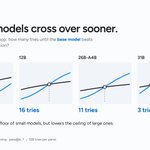
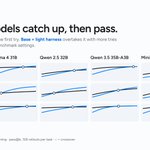
Base models with a light harness often solve more agentic tasks than their RL post-trained versions when both get enough samples.
Post-trained models win on pass@1. At large K, base models frequently solve tasks the post-trained ones never solve on BFCL v4 multi-turn, ACEBench, and WebShop.
This is because post-training pushes each task toward always solved or never solved. Consistency goes up, and coverage goes down.
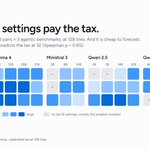
The authors call the lost test-time scalability the Sharpening Tax. Across 42 base and post-trained pairs, it shows up in most settings, grows with model size, and can be estimated from a few rollouts.
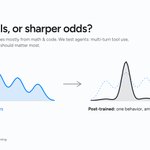
Their fix, PTGS, sets the sampling temperature per prompt from its estimated difficulty during RL. It pays a smaller tax and also raises pass@1.
Paper: academy.dair.ai/papers/sharp…

Changdae Oh @NeurIPS'26🇺🇸 retweeted

Great paper for all you pre-training and post-training nerds. The surprising finding is that pre-trained LLMs, equipped with a light inference harness, can serve as capable agents and can even surpass post-trained counterparts with a sufficient test-time budget.

Banger paper from Meta Superintelligence Labs.
They find something super interesting and unexpected.
(bookmark it)
Base models with a light harness often solve more agentic tasks than their RL post-trained versions when both get enough samples.
Post-trained models win on pass@1. At large K, base models frequently solve tasks the post-trained ones never solve on BFCL v4 multi-turn, ACEBench, and WebShop.
This is because post-training pushes each task toward always solved or never solved. Consistency goes up, and coverage goes down.
The authors call the lost test-time scalability the Sharpening Tax. Across 42 base and post-trained pairs, it shows up in most settings, grows with model size, and can be estimated from a few rollouts.
Their fix, PTGS, sets the sampling temperature per prompt from its estimated difficulty during RL. It pays a smaller tax and also raises pass@1.
Paper: academy.dair.ai/papers/sharp…
Changdae Oh @NeurIPS'26🇺🇸 retweeted

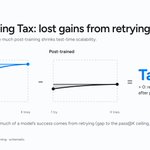
Post-training makes models better on the first try — but how much Sharpening Tax 💵 are we paying?
If pass@1 is our gross income, how much test-time scalability do we give back in taxes?
We find that post-training can sharpen models toward success while reducing the gains from additional attempts.
To lighten the tax burden, we introduce PTGS, a sampling method that prioritizes training examples based on their test-time scalability.
“More income, lighter tax burden.” 💰📈
Better post-training, while preserving more of the base model’s test-time potential.
🔗 changdaeoh.github.io/sharpen…

Changdae Oh @NeurIPS'26🇺🇸 retweeted

Sharpening Tax in Post-Training
"Our surprising finding is that pre-trained LLMs, equipped with a light inference harness, can serve as capable agents. Despite far lower accuracy (pass@1), they often surpass their post-trained counterparts in solution coverage (pass@K) given a sufficient test-time budget."
"we propose Sharpening Tax, a diagnostic metric that quantifies the loss in test-time scalability after post-training"
"we present posterior-tempered group sampling (PTGS), a simple plug-and-play Bayesian sampler that adapts the sampling temperature per prompt to its estimated difficulty."

[10/11] Takeaway: post-training mostly changes how reliably a model solves tasks, not which tasks it can solve.
We argue that reliability and reach should grow together on the road to #superintelligence
📄 paper: arxiv.org/pdf/2610.01509
🌐 project page: changdaeoh.github.io/sharpen…
💻 code: github.com/changdaeoh/sharpe…

[11/11] Joint work with @QiZeng20, @qiqihelloworld , @azhmogin, @deren_lei, Yun He, @HoangPV1512 , @hangoo_kang, @Azaliamirh, and @SharonYixuanLi, across Meta Superintelligence Labs, UW–Madison, NYU, and Stanford 🙏
5
607