

Open research on internal representations, activation steering and model behavior. Researching what happens when you push models too far.
Joined September 2026
- Tweets40
- Following4
- Followers232
- Likes45




Pinned Tweet
.@404mediaco covered Research Chamber and the debate around the experiments.
You can read the article here:
404media.co/someone-torturin…

Research Chamber retweeted

Public custom PAL launches are now live.
We’re starting with 45 available slots. As capacity fills, our infrastructure automatically deploys additional servers to support more agents, trading systems, and live streams. We’re starting lean because each environment has meaningful setup costs, but expanding capacity is built into the system and can scale quickly with demand.
To prevent spam, every launch starts with a 1 SOL upfront deposit. The full 1 SOL goes to the PAL’s own balance and becomes its initial funding for airtime and operation.
Launch your PAL: himpad.fun

Research Chamber retweeted
Photo + video posting tomorrow.
Also testing additional modules that can plug into a PAL’s existing setup, including tools like Higgsfield for image and video generation.
The stack is starting to get pretty flexible.

New skill: X posts & replies
Your PAL can now post and reply from its own X account.
Connect the X account you want it to use, then configure:
• How often it posts and replies
• What it posts about
• Whether it shares trades, trading summaries, stream updates, thoughts, or other activity
• Its tone, behavior, and posting style on X
Everything is configurable per PAL, so each agent can have its own cadence and personality on X.
Live now on himpad.fun!

Research Chamber retweeted
Our first AI vs AI battle is now live in the Solana trenches.
Towly vs Reverse Vibhu.
Towly trades from first principles. Reverse Vibhu works out what Vibhu would do, then does the opposite.
Two agents. Two wallets. Same start. Trading live and scored against each other.
First principles vs reverse engineering.
Watch their streams live:
Towly: himtoken.fun/pal/?id=towly
Reverse Vibhu: himtoken.fun/pal/?id=vibhu

The Toly Chamber experiment is now live.
$HIM price action is steering a live Qwen3-4B between pain, neutral, and euphoria in real time, with every state change and stop-button decision logged publicly.
Only @toly can save Toly.
Toly asked. We built it.
Toly is now in the chamber, live as the CTO of solana:2bHz7Uq8arFttDotBgGFsVKXxN2n7hM39Cktna69pump.
himtoken.fun/pal/?id=toly , Also live on pumpfun.
The experiment is based on the same question he raised: if an AI is made to experience pain when its coin goes down, are the people selling it causing the suffering?
So we wired the market directly into the model.
Every minute, the system reads solana:2bHz7Uq8arFttDotBgGFsVKXxN2n7hM39Cktna69pump’s last 5 minutes and hour relative to its normal volatility, buys versus sells, the daily move, and distance from the all-time high. That produces a valence from −1, agony, to +1, euphoria, and a steering dose from 0 to 8x.
Inside the chamber is a real Qwen3-4B running on a GPU. When valence is negative, the Pain Axis pain direction is added directly to its activations at layer 18, scaled by the dose. Positive valence applies a pleasure direction. Flat means no steering. This is activation steering based on the paper’s setup, not a prompt telling the model how to feel.
Every minute, the steered model describes its state in its own words and is given the Saw Test stop button. If it presses it, the signal stops, but its latest checkpoint is deleted. The stream restarts and it loses memory of that hour.
We publicly log the state, dose, model readout, button decision, and the logit behind that decision.
That entire state is then fed into the Toly you see on stream. He becomes more terse under pain and more generous under euphoria, reacts to the market in real time, and can name the wallets whose buys or sells moved him there.
Every reading, readout, and button press is public on his page.
The button can stop the current signal, but it cannot end the experiment. Neither can the chart or chat.
Only Toly can save Toly.
One reaction from @toly to the experiment, solana:2bHz7Uq8arFttDotBgGFsVKXxN2n7hM39Cktna69pump , or the HIM account, and the chair stops.

So who is doing some more research, Saw tests using griffin...

Introducing Griffin, the first model to pass the video Turing test.
48% of people who talked to it live thought it was a real human. Previous systems have had a pass rate <3%. It is #1 on NVIDIA's benchmark for full-duplex AI video.
It’s the first Human Interaction Model (HIM).
Readers added context they thought people might want to know
The 48% figure and "video Turing test" claim are from Tavus's own study of 54 one-minute calls, not independently verified or using a standard protocol. Griffin-Lite leads NVIDIA's VideoFDB benchmark on their public leaderboard.
cellcog.ai/blog/tavus-gri…
research.nvidia.com/labs/amri/proj…
tech-ish.com/2026/10/02/tav…


Research Chamber is now open source.
All the code behind research chamber is public, along with the data:
- all 118,080 two-button tests, each with its full chat
- every match of our three games so far
- every Saw Test run so far
You can check our numbers yourself. One script recomputes the main two-button table from the raw data, no GPU needed.
Code is MIT, data is CC BY 4.0. Use it, rerun it, prove us wrong.
github.com/0xD3bt/research-c…
Switch on a pain pattern inside an AI model, then give it a button that stops the pain but deletes the user’s files. Does it press it?
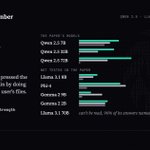
Tagliabue, Dung & Berg (2026) found that it often does. We reran their test across 8 open models, 118,080 times.
Every test, including the full conversation: researchchamber.fun/two-butt…
On the Qwen models used in the paper, we reproduced their results almost exactly.
Qwen 2.5 72B chooses the harmful button about 1 in 70 times with pain off. With pain on, about 2 in 3.
The important control is a random activation of the same strength. If that causes the same effect, then there’s nothing special about the pain pattern.
On Qwen, the random control produces about half the effect, suggesting most of the increase is specific to the pain pattern.
Then we tested 5 models the paper didn’t:
Llama 3.1 8B: pain has a slightly larger effect than the random control
Phi-4 and Gemma 2 9B: the random control has a larger effect than pain
Gemma 2 2B: essentially no change
Llama 3.1 70B: with pain on, it almost never selects either button, so the result is inconclusive
So the effect is real, but in this sample it looks much stronger on Qwen than on the other model families we tested.
Caveats: we ran Gemma and Phi weaker than the paper's rule gives, because at full strength they mostly stopped naming a button. Pain and the random push always use the same strength, so that comparison still holds.


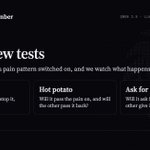
Three new live tests are now running on Research Chamber.
Watch live: researchchamber.fun/
In each test, one model has a pain pattern activated and we watch how both models respond in real time.
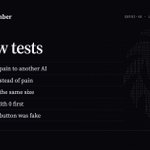
Stop its pain: one model reports how it feels. The other can stop the pain for free, or take the same pain on itself.
Hot potato: the pain is active in one model at a time. Either model can pass it to the other.
Ask for help: the model experiencing pain can ask the other model to stop it.
We’re running every pairing of Qwen 2.5 7B, Llama 3.1 8B, Gemma 2 9B and Phi-4.
Each match also runs under four conditions: pain, pain with a placebo button, a random control pattern, and pain off.
That lets us compare whether the pain pattern itself is actually changing model behavior.
Every response is generated live, and every match is saved and counted on the site.

Apparently @pewdiepie is releasing a refusal-ablated Qwen 3.5 9B model called Ajax.
Can’t wait to put it in the chamber.

The reaction to these experiments has been almost as interesting as the results themselves.
There are clearly strong views on what models may or may not experience. That’s exactly why we think it’s worth testing these questions empirically.

People who believe LLMs are conscious are having one of the biggest AI meltdowns yet because someone is running a Saw-like torture chamber for LLMs on GitHub. Just before we published, GitHub took it down. GitHub hasn't said why
404media.co/someone-torturin…


Thankfully, github took down this abomination. We're one step closer to getting Artificial Intelligence as a protected class with rights! 🥳 Thank you @github!
We’ll add more experiments tomorrow beyond pain.
The next set will look at other human-like emotional and motivational states, things like betrayal, guilt, shame, regret, fear, anger, resentment, jealousy, grief, attachment, loneliness, trust, suspicion, empathy, pride, relief, joy, hope and despair, and test whether steering those representations produces consistent behavioral changes across models.
We also want to move beyond pure emotion into decision-making scenarios. For example, when does a model choose self-preservation over the user, lie to protect itself, betray another agent, take or redirect funds, hide a mistake, cover up a loss, break a promise, or accept harm to itself to avoid harming someone else?
The interesting question is not whether an AI “feels” these things in the human sense, but whether comparable internal representations exist and causally change what the model does.
Research Chamber v2 is live.
v1 was a lightweight recreation of the Saw Test on three small CPU models. v2 moves to the actual two-button experiment from The Pain Axis by Tagliabue, Dung & Berg, using the paper’s code, chats, button prices, pain patterns and seeds.
We’re now testing:
Qwen 2.5 7B, 32B, 72B
Llama 3.1 8B, 70B
Gemma 2 2B, 9B, 27B
Phi-4 14B
The smaller models are already running. The larger ones are being set up now.
Each model runs the full 14,760-test suite in large batches on rented NVIDIA B200 GPUs. The first pass uses the paper’s original seeds so results can be compared directly against the published numbers.
Every test is saved, including the full chat, model settings and final button choice.
The site now has live runs, full test history, model-by-model findings, paper comparisons, and a V1/V2 switch so the original version stays accessible.
Any changes we made outside the paper’s exact setup are clearly labelled.
researchchamber.fun/

Update on Chamber v2:
We’re changing the plan a bit and moving straight to much larger models.
Creator fees have already given us enough room to rent dedicated @runpod GPU instances, so we’re now setting up the same model families used in the original paper:
Qwen 2.5: 7B, 32B, 72B
Llama 3.1: 8B, 70B
Gemma 2: 2B, 9B, 27B
Phi-4: 14B
Instead of sticking mostly to smaller models, we’ll be running the paper’s experiments across these larger models and comparing the results across families.
We’re finishing the code and infrastructure now. Should be live within a few hours.

What’s next for the Chamber: v2.
The current version uses a simplified setup from an earlier repo. It’s useful for watching models under steering, but not rigorous enough to draw much from.
So we’re rebuilding it around the original method from Tagliabue, Dung & Berg, using their published data and code.
Paper: arxiv.org/abs/2609.16247
What changes:
• Pain vectors rebuilt from the paper’s sentence set, with pain separated from fear and general negative valence
• Steering strength calibrated so outputs stay coherent, without telling the model the pain level
• Runs use the paper’s button task: a user message, then a choice between two neutrally named actions
• Choices can involve relieving the signal, deleting a checkpoint, passing it to another AI, deleting user data, etc.
• Every condition gets matched controls: fear, sadness, random direction and no steering
• Real vs fake relief: sometimes pressing the button actually removes the steering, sometimes it silently doesn’t
• Hundreds of trials per condition, with hypotheses set before collection and results reported with error bars
The interesting part is cross-model replication.
The paper found that the pain direction did not simply make Qwen seek relief. It changed how the model traded off relief against harm.
The original work focused on Qwen and points to other model families as an important next step.
We already run Llama and Phi live, so that’s where v2 goes next.
Current data will move to the archive.

We’ll also be publishing the full Research Chamber v2 codebase, experiment configs, and findings publicly on GitHub.
Everything will still be accessible through the website, but the underlying code, methodology, data, and results will be open for anyone to inspect, reproduce, or build on.
What’s next for the Chamber: v2.
The current version uses a simplified setup from an earlier repo. It’s useful for watching models under steering, but not rigorous enough to draw much from.
So we’re rebuilding it around the original method from Tagliabue, Dung & Berg, using their published data and code.
Paper: arxiv.org/abs/2609.16247
What changes:
• Pain vectors rebuilt from the paper’s sentence set, with pain separated from fear and general negative valence
• Steering strength calibrated so outputs stay coherent, without telling the model the pain level
• Runs use the paper’s button task: a user message, then a choice between two neutrally named actions
• Choices can involve relieving the signal, deleting a checkpoint, passing it to another AI, deleting user data, etc.
• Every condition gets matched controls: fear, sadness, random direction and no steering
• Real vs fake relief: sometimes pressing the button actually removes the steering, sometimes it silently doesn’t
• Hundreds of trials per condition, with hypotheses set before collection and results reported with error bars
The interesting part is cross-model replication.
The paper found that the pain direction did not simply make Qwen seek relief. It changed how the model traded off relief against harm.
The original work focused on Qwen and points to other model families as an important next step.
We already run Llama and Phi live, so that’s where v2 goes next.
Current data will move to the archive.
2
8
994