
「生命はプログラムできるか?」ITで生物をハックする情報系高校生マッドサイエンティスト目指してます!🧪 興味がある分野 ▫️CRISPR × 生命情報(Bioinformatics)▫️合成生物学/トランスヒューマニズム / 生化学/神経科学 シャーレの上に新世界を創る勉強の過程を実況中。
Joined September 2026
- Tweets68
- Following78
- Followers13
- Likes202


メキラ🧬生命をプログラムする高校生 retweeted

Google has another banger 🤯
It’s called PaperBanana.
It turns your methodology text into academic illustrations, helping you explain your research visually.
100% free.

メキラ🧬生命をプログラムする高校生 retweeted

Google DeepMind just moved protein AI from reading structures to designing chemistry.
Its new system, AlphaProtein Novo, generates de novo enzymes for catalytic reactions — including enzymes that can synthesize drug-like piperidines and degrade the plasticizer DEHP, even at 90°C.
The bigger story: AlphaFold learned to read proteins. AlphaProteo learned to design binders. Now AlphaProtein Novo is beginning to design catalysts.
From predicting biology → writing proteins → engineering chemistry.
Preprints and code:
biorxiv.org/content/10.64898…
biorxiv.org/content/10.64898…
github.com/google-deepmind/a…


Introducing AlphaProtein Novo, a pipeline for de novo enzyme design! In collaboration with @francesarnold's group, we developed AP Novo and used it to get SoTA "novel-scaffold" activity on 2 benchmark reactions and create enzymes to synthesize the pharmaceutical motif piperidine and degrade the environmental toxin DEHP.
Work led by @ZvxyWu @ZiqiLi0513 with teammates @alexechu_ @kelly_ruijie @schulluc @jacobjinkelly @rosaliags @davidla @solserpens @j_reisenbauer, @pengliu_group, Josh, Thomas, Amy, Tristan, Harshnira, and others. It was a joy and privilege to work with you all!
Preprints and code:
biorxiv.org/content/10.64898…
biorxiv.org/content/10.64898…
github.com/google-deepmind/a…
スマホをポチポチ叩いて迷う理由は、この地球上に1ミクロンも残っていない。
カバンの最深部にスマホをブチ込んで、勉強机の引き出しの最深部にガチで封印します。
無感情な勉強マシーンになって今すぐ 勉強に狂います。

OpenCodeをスマホに入れるにはどうすればいいんだ。
スマホの中に仮想のパソコン(Linux)を1台作って、そこでパソコン用のOpenCodeを無理やり動かすしかないのか…
だれか作ってほしい!

Antigravity CLI is coming to your phone 📱
With 1.2.15, agy now runs on Android via Termux.
Yes, the full agent. In your terminal. On your phone.
Code, debug, or kick off an agent from anywhere.
Try it on Termux:
curl -fsSL antigravity.google/cli/insta… | bash
Then run agy.

メキラ🧬生命をプログラムする高校生 retweeted

Antigravity CLI is coming to your phone 📱
With 1.2.15, agy now runs on Android via Termux.
Yes, the full agent. In your terminal. On your phone.
Code, debug, or kick off an agent from anywhere.
Try it on Termux:
curl -fsSL antigravity.google/cli/insta… | bash
Then run agy.
メキラ🧬生命をプログラムする高校生 retweeted

a guy put a local AI coding stack on an Android phone
Termux on the screen
Ollama underneath
a local model answering from the device
that tiny terminal is the shift.
two years ago, local LLMs felt like punishment
fans screaming
bad models
one token per second
cloud looked inevitable
now the same idea runs almost anywhere.
- Raspberry Pi for tiny chat
- MacBook Air for daily writing
- RTX 3090 for serious inference
- LM Studio when you want the clean GUI
- Ollama when you want apps to connect
the point is not replacing GPT-5.1 or Opus 4.8 on the hardest tasks.
the point is owning the boring 80%:
- drafts
- summaries
- code help
- private docs
- offline workflows
no token anxiety
no rate-limit ceiling
no sensitive files leaving the machine
cloud AI became the premium layer.
local AI became the workbench.


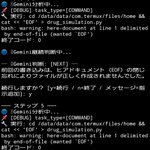
スマホの中に、勝手にプログラミングして勝手にエラー直す本物のAIエージェントを降臨できた。AIが裏で勝手にコピペを人間に求めない手足を持ったAI、マジですごい。エラーと戦って元のコードの偉大さも身に染みて分かった。手のひらの上で自律研究室が爆速で動く時代、完全に革命
#AIエージェント


メキラ🧬生命をプログラムする高校生 retweeted

畑にエンジニアを1人雇った。名前はCodex。
ビニールハウスの換気をLINEから遠隔操作するシステムを作ってくれた。コードだけでなく、配線の設計等でも活躍。農家は面白いAIの使い道が色々とあるんじゃなかろうか。





メキラ🧬生命をプログラムする高校生 retweeted

Anthropic went after the largest bacterium ever found, a single cell you can see with the naked eye, and read the machinery packed inside it.
The size was never the interesting part. The question was how one cell keeps millions of copies of its own factory working in sync.
> COUNT - every ribosome location in the cell mapped, rather than averaged across it
> WRAP - the membrane sacs holding DNA and ribosomes treated as separate rooms
> FLOW - what each room produces compared against what sits next to it
> SPLIT - rooms with different output flagged as independent units
> SCALE - the whole layout tested against how large a normal cell can grow
Bacteria are supposed to be simple bags. One compartment, everything mixed, nothing filed away.
This one files. Its DNA and its ribosomes sit inside membranes, which textbooks reserve for complex cells.
That single arrangement is what lifts the size ceiling. A cell without rooms hits a physical wall long before a centimetre.
The rooms are not identical either. Output varies from one to the next, meaning parts of the same cell are doing different jobs.
That edges close to what tissue does, inside something that is still one organism by every definition we use.
The line between simple and complex life was drawn before anyone had seen this, and it was drawn on compartments.
Every room, its output and the size math behind it sit in the breakdown below.


