

Separating AI and quantum signal from noise. Charts, snark, and uncomfortable truths.
The Lab
Joined November 2025
- Tweets1.7K
- Following130
- Followers2.5K
- Likes1.8K




Pinned Tweet
HOW DO THE BEST QUANTUM COMPUTERS STACK UP?
Assessing quantum computers is notoriously difficult. Qubits and gate fidelities are just the starting point - connectivity, error correction overhead, coherence times, and actual demonstrated results all matter too.
But if you had to pick the leading systems right now, here's where I'd land.
Google and Quantinuum are in a league of their own. These are the groups that have published beyond-classical results and started probing genuinely novel physics. Helios (99.92% 2Q fidelity on 98 qubits) and Willow (99.80% on 105) are the real deal.
IBM is making steady, underrated progress. The latest Heron chip sits right up there with Google on raw fidelity (99.88%) - held back mainly by sparser heavy-hex connectivity vs Google's more flexible layout.
Then we have the newer kids on the block - neutral atoms. Infleqtion (trading as $INFQ on NYSE starting Tuesday), Atom Computing and QuEra are all fielding impressive hardware. Infleqtion's Sqale runs 1,600 qubits. Atom Computing's Gen 1 has 1,180. These are BIG machines, albeit with lower fidelities to show for it so far.
What's genuinely exciting: the leading systems now span at least 3 distinct approaches - superconducting, trapped ion, and neutral atom. They don't all have to win. Only one has to make it through to challenge modern encryption and unlock fundamentally new use cases.
Competition is how we get there faster.

Dr. Hugh Bitt retweeted

A little quantum error correction happened today. 😂
@ChipStockInvest posted a public correction after the quantum community challenged the repeated claim that Infleqtion had “zero revenue.”
$INFQ reported $32.5M in 2025 revenue and another $9.5M in Q1 2026. That wasn’t a tiny technicality. It materially changed the entire framing of the company.
Huge credit to @Chris76985971 , @QuantumBullHQ and everyone else in the quantum community who brought receipts. And credit to @ChipStockInvest , @7investing and @7Innovator for reviewing the evidence and correcting the record publicly.
This is how serious coverage should work: challenge the claim, show the evidence and fix the record.
Infleqtion is not merely “a conceptual idea.” It is a real operating company with nearly two decades of history, real hardware, real customers and real revenue.
youtu.be/JwCbkIY3NNQ?is=SOj6…

And just like that, $QNT has become the most valuable listed quantum company. The quantum “flippening”.
Despite all the money and stock $IONQ has thrown at acquisitions, the market is figuring out that none of that matters if you can’t built a top tier quantum computer.
If $IONQ can successfully deliver its upcoming 256 qubit and 99.99% fidelity system, it will deserve to trade at a premium to $QNT once again.

Something incredible is happening in quantum.
We’re about to observe a phenomenon known as the “flippening”.
When the underdog, with less commercial traction, is about to overtake the X favourite, the commercial hype monster.
Yes — that’s $QNT about to overtake $IONQ in market cap.
You heard it here first. Technical progress matters more than acquired revenue.

When you find yourself agreeing with @genejchan

$QNT has almost caught up to $IONQ's market cap at $21B.
This is despite revenues being an order of magnitude less than IonQ, and despite not being a platform.
What is the market telling us?
It's saying it values PROVEN and DELIVERED quantum computing specs over anything else.
IonQ needs to deliver Tempo and 256. Roadmaps no longer cut it.
What's commercially available right now - the Forte Enterprise - is way out-of-date.
Put up or shut up indeed.
$IONQ has entered the arena!!
You may think this means they’re finally being open about their system specs and capabilities.
WRONG.
It means they’ve paid UFC for octagon signage. “Quantum is now”. The system leadership is later.

Tracking quantum computing progress is notoriously hard.
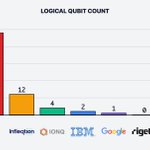
One shorthand is to look at “logical qubits”, which represent the error corrected units of computation.
This used to be theoretical, but in the last few years, leading companies have proven error correction works.
Of the public companies, newly listed Quantinuum ($QNT) has demonstrated the most so far (48).
Neutral atom player $INFQ has shown 12. $IONQ recently demonstrated some for the first time last week, with a small scale demonstration of 4.
However, there are some caveats 👇

Not all logical qubits are equal. The error rates are important, and what works at small scale may not work at large scale. There’s also nuances around mere error detection vs error correction.
I found this paper from @Alice__Bob, a French superconducting company, particularly helpful.
xitter.cf/alice__bob/status/2062…

Everyone's talking about logical qubits. Nobody agrees on what they are. 🧩
Today we're publishing a memo with 5 criteria to help fix that.
Logical qubits are the building block of tomorrow's useful quantum computers. 🧱 But the term gets stretched to mean wildly different things depending on who's using it.
For analysts, investors, and anyone trying to place their informed bet on quantum, that's a real problem. Claims from different labs or companies are very hard to compare directly. Unless you hold a PhD. We wanted to change that. 🤓
Our memo, "Defining the Logical Qubit: Five Criteria to Benchmark Logical Qubit Claims," lays out what we believe a useful logical qubit should meet, and how non-specialists can actually compare the headlines. ⚡
The 5 criteria:
🏃Can you outperform your physical qubits?
📈 Can you make it better?
⏳ Have all the errors had time to happen?
🎯 Does it work without cherry-picking?
🏁 Does error correction last the whole computation?
If you care about quantum computing, you need to care about logical qubits.
Read the memo 👇
bit.ly/4vA5ELE
#QuantumComputing #LogicalQubits #FaultTolerance #FTQC #QuantumErrorCorrection #QuantumTechnology
Now the dust has settled from last week - a brutal selloff across the board, but also a new face in the public quantum arena: Quantinuum ($QNT).
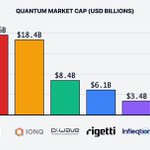
Let’s look at where the market caps landed:
$IONQ — $21.2bn
$QNT — $14.7bn
$QBTS — $8.8bn
$RGTI — $6.9bn
$XNDU — $3.9bn
$INFQ — $3.2bn
For once, the market seems to have landed on roughly the right price. Quantinuum commands a substantial premium to everyone, except $IONQ.
On the technology, this looks wrong. Quantinuum’s quantum computing program has always been the stronger of the two, and consistently hit its roadmap targets.
But you can’t ignore what $IONQ has become. It’s morphed into a broader quantum business (sensing, networking, space) and added + acquired substantial revenue.
That said, it’s still early days. No one is making billions yet. Some new systems are due this year, including $IONQ’s 256 qubit device.
Which company will be most valuable at the end of the year?

Dr. Hugh Bitt retweeted

Today, Quantinuum officially begins trading on NASDAQ under the ticker symbol QNT.
Today’s milestone is the direct result of the dedication of our team, trust of our partners, and support of the entire quantum community.
Thanks to everyone who helped us reach this historic day.

$IONQ has finally put out a real logical qubit demonstration - 4 logical qubits, breakeven on lifetimes. Credit to their QEC team, this is good work.
But the paper is more revealing about the hardware than the error correction.
Nowhere do they state a single 2-qubit gate fidelity. In their own noise model, it’s asterisked as “variable.” The distribution runs from ~99.9% down to ~98%, and the parallel numbers are worse than the isolated ones. They say this is from crosstalk.
So to hit breakeven they hand-pick a bespoke qubit-to-ion mapping per circuit, routing around the bad pairs to cut average error rates.
Now hold that against the roadmap: a 256-qubit system at 99.99% 2Q fidelity, due this year.
There’s a significant gap to bridge here.

We’re proud to share our latest advance in fault-tolerant quantum computing using high-rate quantum low-density parity-check (qLDPC) codes, which we have found directly reduce qubit overhead.
With our trapped-ion hardware, we can demonstrate logical qubits with a high encoding rate on a single device, which requires much lower qubit overhead than other popular approaches like the surface code. This result represents substantial progress toward IonQ’s large-scale quantum architecture.
Congratulations to the team who have been working across labs on this research: Edwin Tham, Michael Goldman, Shantanu Debnath, Ashay Patel, Jyothi Saraladevi, Jason Nguyen, Erik Nielsen, Neal Pisenti, Kenneth Wright, John Gamble, and Nicolas Delfosse.
Read the paper → arxiv.org/abs/2606.06455 🔶
#IonQ #QuantumComputing #FutureOfQuantum

Rating the Big Tech quantum programs:
🐐 $GOOGL: The goat. The first below-threshold QEC result, world-class physics and engineering. Ahead, but the lead isn’t permanent. They need to up the spending to stay there.
↗️ $IBM: Strong and rising. Clear roadmap, real hardware shipping already. Over $1B from US gov won to build a fab + $10B IBM funds committed. On the up.
🤔 $AMZN: They have some interesting physics, but the commitment looks half-hearted. Feels like a side project. Might be too late to the party.
🚩 $MSFT: More focused on PR than results or the tech. Big claims, but where are the qubits? Zero.
Microsoft has a chequered history of these kinds of quantum announcements.
Last time, it was disputed whether what they even had a qubit at all.
Going to need to see what technical detail and numbers they share to figure out if they’ve actually made progress - but not holding my breath.

Announced today at #MSBuild: Microsoft unveiled Majorana 2, a next-generation topological quantum chip developed with the help of Microsoft Discovery’s agentic AI. msft.it/6009vj6BX
If the $IONQ figure looks outrageous, that’s because it is. They haven’t even delivered 1 logical qubit yet. The clock is ticking…

$QBTS had its investor day. Big reveal: a roadmap to universal gate-based QC following the Quantum Circuits acquisition.
The 2030 target? 10 logical qubits.
For context, $IONQ used the Oxford Ionics deal to turbocharge its roadmap to an incredible 80,000 logical qubits by 2030.
D-Wave doesn’t have the lowest target in the industry by a bit. It’s the lowest by 20x++.
$INFQ has already shown 12+ logical qubits and is at <$4B market cap to $QBTS $11B.
Something is going to give.
$IBM just announced it’s putting >$10B into quantum over five years, targeting a fault-tolerant machine by 2029.
This is the company that’s already deployed 90+ quantum systems, and also building the first US quantum chip foundry (Anderon).
And $RGTI and $QBTS… rallied on this? 🤷♂️
Rigetti and D-Wave have pennies by comparison. These names were already years behind on the tech. Now they’re billions behind on the balance sheet too.
Remind me why the stocks went up?
barrons.com/articles/ibm-sto…

What’s going on at $IONQ? 🤔
The US government has committed $2bn to nine quantum companies, but $IONQ isn’t one of them.
The list includes $IBM, $RGTI, $QBTS, $INFQ and some private companies including trapped ion competitor Quantinuum.
Notably absent: $IONQ. The self-acclaimed "world's leading quantum company."
It’s not the first time. They were also missing from the Genesis Mission collaborator list back in November that had IBM, Google, Microsoft, NVIDIA, Quantinuum all named.
Why is $IONQ missing from these marquee government initiatives?
$INFQ getting its beak wet, and one of just a small handful of quantum companies chosen for this funding.
This should bring a lot more exposure to the stock. Especially since $IONQ missed out.

Infleqtion has signed a Letter of Intent with the @commercegov CHIPS Research and Development Office for $100 million in proposed funding to accelerate U.S.-based quantum computing technologies critical to economic competitiveness and national security.
“Quantum computing is emerging as a foundational technology for economic competitiveness, technological leadership, and national security,” said Matt Kinsella, Chief Executive Officer of Infleqtion. “This investment reflects the transformative potential of quantum innovation, and we’re honored to work with the Department of Commerce to accelerate U.S. leadership in quantum computing.”
The proposed investment supports the advancement of neutral-atom quantum systems across quantum hardware, photonics and full-stack system development, while strengthening domestic quantum manufacturing, supply chain and workforce capabilities.
Infleqtion’s quantum technologies are already supporting programs across national security, energy, and scientific research, including @DARPA, the @Energy, @NASA, and the @DeptofWar.
“NVIDIA and Infleqtion have long worked together to accelerate the capability of quantum computing through integration of quantum processors with GPU supercomputing,” said Timothy Costa, Vice President and General Manager for Quantum at @NVIDIA. “This announcement is an important milestone for developing large-scale quantum computing systems in the United States, and we're excited to continue supporting Infleqtion on this journey.”
Read the full announcement: ow.ly/FcOQ50Z2CSk

This prediction is not looking good anymore @commonsenseplay
wsj.com/tech/u-s-to-award-qu…


Prediction: NO EQUITY STAKES BY US GOVERNMENT in
$ionq $rgti.
Here is the latest of where we stand.
- Last night it was reported by the WSJ, that the Trump administration is in talks to take equity stakes in quantum computing firms.
- The WSJ reported that the Trump administration is in discussions to take equity stakes in several quantum-computing firms in exchange for federal funding, part of a broader effort to increase U.S. government involvement in strategic industries. Companies included in IonQ, Rigetti Computing, and D-Wave Quantum .
Following the report, quantum-computing stocks rallied sharply, with $ionq $rgti $qubt $qbts all up 10% or more.
- Yahoo finance is now, today in the last hour, reporting that that does not necessarily reflect the Trump administration’s current plans.
- Yahoo Finance is now reporting that the proposed deals are not necessarily something the Trump administration is considering.
- They say that the White House has been approached with offers for the administration to take equity stakes for cash. However the president wants to get a good return for the taxpayer. What may be under consideration would be warrants or loans that may not necessarily be with the company's mentioned in the article.

The much-awaited US Government investment in quantum stocks is here!
$2B earmarked. $1B noted as going to $IBM, but no detail on the others yet.
Quantum stocks are all up in the pre-market.
Let’s see how it gets allocated. I expect there will be some winners, but also some losers who miss out.
wsj.com/tech/u-s-to-award-qu…