

Our Mission: To credibly report on carbon, clean energy, emission reduction and climate related business practices.
Worldwide
Joined June 2017
- Tweets5.2K
- Following411
- Followers9.3K
- Likes1.7K






Pinned Tweet
Most people can't explain how carbon credits actually work. That window won't stay open.
A $900B+ compliance market. A voluntary market projected to grow up to 100× by 2050.
The free 25-page briefing, in one sitting: lp.carboncredits.com/strateg…

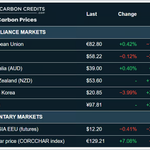
Here is where carbon prices closed this week. Get carbon prices in your inbox >> lp.carboncredits.com/the-car…

Q3 CBAM Price Climbs Nearly 10%
The new €82.32/tCO₂ price marks a clear increase during 2026.
The Q3 price is important because it applies to CBAM-covered emissions from goods imported into the EU during that quarter.
Read more: carboncredits.com/eu-cbam-ce…


Smart.
America took one of the cheapest commodities on earth.
Removed it
And turned the empty space into the cheapest way to store the most important one - oil.

Meet America’s 714-Million-Barrel Underground VAULT
👇
The United States doesn’t store its emergency oil in giant steel tanks.
▪️It stores most of it inside salt.
Along the Gulf Coast, the Strategic Petroleum Reserve contains 60 enormous underground salt caverns spread across four sites in Texas and Louisiana.
Together, they can hold 714 MILLION barrels of crude oil.
The typical cavern is roughly 200 feet across and 2,500 feet tall and holds around 10 million barrels.
▪️That's tall enough to swallow Chicago’s Willis Tower with room left over.
And salt happens to be unusually good bottle material.
At these depths, rock salt has extremely low porosity and permeability.
It also deforms slowly under pressure.
Most interesting of all, small cracks squeeze themselves shut.
Salt heals its own cracks, like a superhero.
That combination is why the Department of Energy says salt-cavern storage can cost:
▪️ Up to 10 times less than above-ground tanks and
▪️ 20 times less than caverns mined from hard rock.
The U.S. government took one of the cheapest commodities on earth…
Removed it…
And turned the empty space into infrastructure capable of holding hundreds of millions of barrels of the world’s most important commodity.

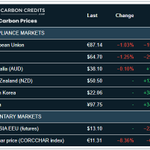
Here is where carbon prices closed this week. Your source for live carbon prices is here >> carboncredits.com/carbon-pri…


$C’s $1T sustainable finance target includes environmental AND social finance, so it should not be treated as $1T of climate finance.
The real test: can capital mobilization translate into measurable emissions reductions across the real economy?
Full breakdown: carboncredits.com/citi-susta…

Lithium prices rose 0.13%, settling at $22.75/kg globally.
This mild upside is primarily driven by the stalled restart of CATL’s Jianxiawo mine, which continues to cap domestic supply and introduce volatility.
Additionally, resilient demand from China’s expanding battery energy storage systems and robust EV infrastructure buildout is reinforcing price floors. Barring macroeconomic shifts, these supply bottlenecks and strong storage fundamentals will likely sustain near-term pricing momentum.
Live Lithium Prices >> carboncredits.com/lithium-pr…


AI is creating a new sustainability challenge: water.
$GOOGL consumed 10.9B gallons of water in 2025, up 34% YoY, as data center demand surged.
Now, Google is committing $60M to water projects and targeting 120% replenishment by 2030.
But is “water positive” enough?

Google replenished ~78% of its 2025 water use, up from 63% in 2024.
The bigger issue: AI-driven data center growth is pushing water demand higher.
$MSFT, $META, and $AMZN face similar pressures.
The key isn’t just replacing water—it’s reducing consumption, using reclaimed water, and investing where local watersheds actually need it.
Water could become a competitive advantage for AI infrastructure.
Data centers need electricity, land, cooling—and increasingly, access to water.
Companies that manage these resources responsibly may have an edge with regulators, investors, and local communities.
We break down @Google’s $60M investment, its 2030 target, and the growing water footprint of AI:
carboncredits.com/google-com…


Walmart $WMT is still growing, but its latest results reveal a bigger story.
Q2 revenue hit $187.9B, up 5.9%, while global e-commerce surged 23%.
At the same time, Walmart cut Scope 1 & 2 emissions 7.5% YoY.
Can growth and decarbonization scale together?

The sustainability numbers are notable.
Renewables supplied 53.3% of Walmart’s global electricity in FY2026, above its 50% target.
Walmart is targeting zero Scope 1 & 2 emissions by 2040 without relying on carbon offsets.
But the harder problem is Scope 3.

$WMT’s estimated Scope 3 footprint reached 635M tonnes of CO2e in FY2026.
That’s where its enormous supplier network matters.
Project Gigaton has reported 1.37B+ tonnes of cumulative expected reductions, removals and avoided emissions.
carboncredits.com/walmart-wm…

Vietnam and Singapore are moving closer to cross-border carbon trading under Article 6 of the Paris Agreement.
Vietnam has approved its Implementation Agreement with Singapore, creating a framework for eligible Vietnamese projects to generate and transfer ITMOs.

Why it matters:
Singapore allows eligible international carbon credits to cover up to 5% of taxable emissions.
Vietnam could become a new source of high-integrity credits while attracting international climate finance to emissions-reduction projects.
But projects still need authorization, verification and buyers.
The bigger story is Southeast Asia’s emerging Article 6 carbon market network.
Singapore had signed 11 Implementation Agreements by June 2026.
Vietnam’s approval could turn another bilateral framework into a functioning channel for carbon trading and climate finance.
carboncredits.com/vietnam-ap…
