

Machine Learning Systems lab (https://xitter.cf/t.co/jcp3fc4JEp) at the University of Cambridge lead by Prof. Nic Lane (@niclane)
Joined July 2020
- Tweets127
- Following23
- Followers722
- Likes321




We're featured in the latest @stateofai by @nathanbenaich. 😎

Research from @CaMLSys and @flwrlabs featured by @nathanbenaich in his @stateofai report.
Slide 13 covers our recursive improvement agent work -- Red Queen Gödel Machine led by @Alex__Iacob, @itsmaddox_j, @williamfshen.
Slide 45 includes AI safety benchmark: AIReg-Bench led by @billymarino and @Rosco_Hunter_
Catch this podcast with @niclane7 of CaMLSys, especially watch out for the discussion of large-scale decentralized training of LLMs pioneered in our lab with the Photon system -- jointly developed with @flwrlabs.
buzzsprout.com/2417792/episo…

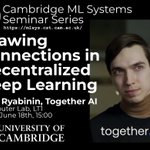
This week, we are delighted to host Max Ryabinin (@m_ryabinin) of @togethercompute who will be speaking at the Cambridge ML Systems Seminar Series. His talk is at 3pm June 18th, LT1 @Cambridge_CL

Photon: A New SOTA for Decentralized LLM pre-training at @MLSysConf 2025. Poster today; talk on Thursday. @lorenzosani97 converting one person at a time to the merits of federated everywhere for everything.
Paper: arxiv.org/abs/2411.02908


Thanks to everyone who joined online and in person for the fantastic talk by @Jamie_Shotton from @wayve_ai!


Join us for the next Cambridge ML Systems Seminar: @Jamie_Shotton, Chief Scientist at @wayve_ai who give his talk: "Frontiers in Embodied AI for Autonomous Driving" on Friday May 2nd at the @Cambridge_CL in LT1. See you all then!

Lots of interest in SparsyFed @iclr_conf. Big step forward in practical use of sparsity for federated training. High sparsity w/out heavy hyperparameter tuning
arxiv.org/abs/2504.05153
Fantastic team: @AdrianoGuastel1, @lorenzosani97, @Alex__Iacob, Alessio Mora, Paolo Bellavista


Join us for the next Cambridge ML Systems Seminar:
Alexander Hägele (@EPFL) on "Learning Rate Schedules, Scaling Laws, and Techniques for Pretraining LLMs"
📍 @Cambridge_CL, FW26
🕒 Tue 08 April, 14:00–15:00
Featuring new results from his recent NeurIPS spotlight.

New paper from @CaMLSys: Can machine unlearning enable AI Act compliance? We map applications and technical gaps, providing the first catalogue of use cases. @billymarino, @meghdadkurmanji & @niclane7 w/ @GoogleAI GARA support: arxiv.org/abs/2502.12430
Amazing talk by Dongqi Cai yesterday on his efforts to enable LLM training on mobile devices. Federated? On-device? It's all possible with DQ's research.


Congrats @Alex__Iacob and his co-authors. Over the weekend @NeurIPSConf they won the "Outstanding Paper Award" at the FL@FM-NeurIPS'24 Workshop!
Paper link: arxiv.org/abs/2405.14446


Our Photon paper w/ @flwrlabs has dropped: arxiv.org/abs/2411.02908 -- featured in the @AcmSensys keynote below.
"The first AGI will be Federated" -- come hear my keynote at the @AcmSensys conference this Wednesday morning. I'll explain why when we finally achieve AGI, and flick the switch to bring it online, it will have been trained using some variety of federated AI. And not the training methods of today, DDP and the like, that are limited to being deployed in single data centers -- which are themselves fast reaching the limits of their own scalability as we struggle to co-locate and power north of 100k GPUs in one physical place.
In support of my talk, here is a preview of a few results coming in hot from a new arxiv paper produced by @flwrlabs and @CaMLSys (@Cambridge_Uni) that will go live also Wednesday. We show our unique approach and system (aka Photon built on Flower) produces LLMs that are both better (by perplexity) and faster to train than DDP (when network speeds are equal, as measured up to 7B). Furthermore, we show this can scale effectively as we add more weakly connected GPUs -- while also being more efficient (eg better wall clock training times) than any existing known methods for training under decentralized/widely-distributed settings.
Folks, it's time to train different. Larger and more complex LLM settings are underway. Link to arxiv Wednesday.


Great new LLM challenge by @flwrlabs is out. We've started our submission already!👏

🤟I’m so happy to see such a big response to the launch of the FlowerTune LLM Leaderboard!
➡️Complete launch details: flower.ai/blog/2024-10-16-fl…
🦙Visit the leaderboard and participate now: flower.ai/benchmarks/llm-lea…
Catch @billymarino today giving a talk @CodeXStanford and @Stanford on "compliance cards". A brand new way of thinking about how AI can become compatible with regulation like the EU AI Act and other regulation the is evolving globally.
law.stanford.edu/2024/09/09/…

On Sunday at #KDD2024 (@kdd_news) our own Bill Shen (@williamfshen) presented PISTOL at the KDD workshop on Evaluation and Trustworthiness of Generative AI Models: genai-evaluation-kdd2024.git…. One of only a few papers selected for oral presentation 👏 arxiv.org/abs/2406.16810

We are delighted to announce the 8th PhD student to graduate from @CaMLSys: Yan Gao (@yangao381)! 🎆 Yan's PhD is one of the first to comprehensively study how SSL can federated (incl. video, speech, single-image). Yan was jointly supervised by @niclane7 and @parcolletT. 👏👏

Slightly👀 belated congrats to 🌟PhD student, Edgar Liberis who defended in April 2023 -- but never got a shout-out. 🚀 His thesis: "Taming TinyML: Deep Learning Inference at Computational Extremes" set a new standard in MCU ML inference. 7th PhD student to graduate from @CaMLSys

In Cambridge tmr? Come hear Wanru (@Renee42581826) present @Microsoft Cambridge (MSR) AI & Pizza talk series.
The Small Lecture Theatre, 21 Station Rd
June 13th - 5pm start
Talk: Decentralised Collaborative Large Language Model: Multilingual Applications & Data Quality Control

Harvard Kennedy School's @MisinfoReview features new research by a team that includes @CaMLSys lab member ➕ PhD student @billymarino. It assesses the spread of AI-generated media on X (formerly Twitter) by looking at data from X's Community Notes platform misinforeview.hks.harvard.ed…
