

We are dedicated to starting conversations about #SoilScience and supporting a Canadian community of experts and enthusiasts.
- Tweets1.1K
- Following229
- Followers2.8K
- Likes1.3K

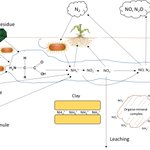




ALT This diagram shows part of a nutrient cycle. From the right: Organic residues, soil organic matter and dead microbial life undergo decomposition through biological and chemical processes. Nutrients like ammonium (NH4+) or nitrates (NO3– ) are available for uptake by plants and microorganisms. The NH4+ and NO3– used by microorganisms for protein synthesis and other metabolic functions will be released by microbial cells at the end of their lifespan. Plants will take up the nutrients through their root hairs. © Joann Whalen is licensed under a CC BY (Attribution) license.

ALT Lactarius rubrilacteus mushrooms are sexual fruiting structures of the fungus, evident on the soil surface. Most of a fungus’ body lies below the surface, unseen. © T. Trofymow.


ALT a petri dish under a black light, which shows streaks of glowing bacteria

ALT An illustration of living things in soil. Along the top are headers, and in the columns are examples of large and small soil organisms. For example: Primary producers include plants and organic substrates. Herbivores and decomposers include root-feeding nematodes, mycorrhizal fungi, saprophytic fungi and bacteria. Microbial grazers include collembolans, mites, fungivorous and bacteriophagous nematodes and flagellates. Tertiary consumers include predacious and nematode-feeding mites, predaceous and omnivorous nematodes and amoeba.

ALT Image description: two hands placing time-release fertilizer pellets beside a plant shoot.

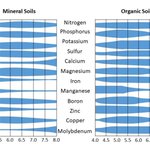
ALT Soil pH influences whether nutrients are available to plants. Shown here are nutrient availabilities in mineral and organic soils influenced by soil pH. Adapted from Munroe (2018) by Lewis Fausak and licensed under a CC BY (Attribution) license.

ALT Soil pH influences whether nutrients are available to plants. Shown here are nutrient availabilities in mineral and organic soils influenced by soil pH. Adapted from Munroe (2018) by Lewis Fausak and licensed under a CC BY (Attribution) license. ALT A graphic showing how much mineral availability there is at various pH levels. The graphic illustrates that different minerals are affected by different pH levels.

ALT A diagram showing water molecules bonded to each other and clay particles in soil. Underneath are the words cohesion: the attraction of water molecules to each other, and adhesion: the attraction of water molecules to a solid.

ALT Soil has three phases – solid, liquid and gaseous. This diagram shows all three phases interacting with a plant root. The space between solid particles is called a pore, which holds liquids or gases. When it rains, soil air is displaced by water. In this way, the phases of soil are dynamic. © Jean Caron is licensed under a CC BY (Attribution) license.

ALT tractor in field with rows of crops

ALT The white film on the surface is formed by salt crystals that have precipitated on the surface. Grass growth is suppressed on the saline soil and instead salt-tolerant Salicornia rubra dominates the vegetation cover. © Darwin Anderson (Saskatchewan Center of Soil Research); licensed under a CC BY (Attribution) license.

ALT Micrographs of nematodes. It is fairly easy to determine what soil mesofauna feed on based on their feeding structures or ‘mouths’. (A) a root lesion nematode (Pratylenchus penetrans) that is a plant-parasitic nematode with a ‘pin-like’ spear structure called a stylet (arrow) is protruded into root cells for feeding. (B) The head area of a bacterial-feeding nematode of the genus Acrobeles. Bacterial-feeders have small mouth cavities called a stoma where bacteria are ingested. The arrow points to cool appendages called probole of uncertain purpose. They may aid in scraping bacteria biofilms for feeding. (C) The head area of a predatory nematode that preys on other nematodes and mesofauna. The arrow points to a large mouth cavity called a buccal cavity. Within the cavity is a spur called a ‘stationary tooth’ that helps rip the surface of prey allowing their contents to be ingested. © Mario Tenuta, University of Manitoba is licensed under a CC BY (Attribution) license.

ALT A man standing near a bridge wearing a tan jacket and jeans

ALT Image caption: Adding compost to your garden soil is one way you can increase soil carbon. Shown here – healthy garden soil with a section of fungi showing in white, called hyphae. It’s a sign of healthy soil! Description: Dark soil with a few plant roots showing as lighter brown and yellow. There are white filaments covering some roots.

ALT Micrograph of a single nematode: Caenorhabditis elegans is the most famous type of nematode. It can be dried or frozen for decades and still be revived. C. elegans has been to space on many missions by NASA! Research involving C. elegans has even been the subject of many breakthroughs in recent science history, including research leading to three Nobel Prizes, 2002 and 2006 in Physiology or Medicine, and 2008 in Chemistry © B. Goldstein; licensed under a CC BY-SA (Attribution ShareAlike) license.

ALT infographic showing the major sources of soil organic matter: leaves, needles and wood; bacteria & fungi; arthropods & earthworms; roots (coarse and fine)

ALT This shallow rill (left) was formed by running water on flatter land, while the larger gully formed on a steeper slope (right.) Both are caused by human changes to grassland and forests. Images courtesy of Maja Krzic, Univ. of British Columbia, images licensed under a CC BY (Attribution) license.

ALT wheat stubble left in field, with some chopped stalks in between rows. Far off is the horizon.