Common Sense Institute Oregon (CSI) is a non-partisan research organization dedicated to the protection and promotion of Oregon’s economy.

Oregon, USA
Joined November 2023
Today, we officially welcome CSI Oregon to our family! Get ready for groundbreaking research and unbiased policy analysis in the Beaver State. #CSI_OR
6
3
13
5,122
Oregon added 5,800 jobs in September, a welcome sign of improvement for the state's labor market. CSI's analysis of the latest BLS data finds job growth was led by: 🏗️ Construction: +2,000 jobs 🏥 Health Care and Social Assistance: +1,700 jobs 🍽️ Leisure and Hospitality: +1,300 jobs While September brought encouraging gains, Oregon's longer-term employment recovery remains uneven. Learn more: bit.ly/4k6WC67
22
Oregon's manufacturing workforce is still nearly 11% smaller than before the pandemic. New CSI analysis of the latest BLS employment data finds several major industries remain below January 2020 employment levels: 📉 Manufacturing: –10.9% 📉 Mining and Logging: –10.4% 📉 Information: –9.8% While other industries have grown, these sectors continue to lag nearly seven years after the pandemic began. Learn more: bit.ly/4k6WC67
17
Nearly seven years later, Oregon's private sector still hasn't fully recovered. Despite recent job gains, new CSI research finds private-sector employment remains 8,600 jobs below January 2020 levels. And 7 of Oregon's 11 major industry sectors still have fewer jobs than before the pandemic. September's gains are encouraging, but Oregon's economic recovery still has ground to make up. Learn more: bit.ly/4k6WC67
1
27
Energy prices are climbing, and inflation is picking up again. New CSI's analysis of the latest CPI data finds that across the Pacific region, from September 2025 to September 2026: ⚡ Energy prices rose 16.9%. 🚗 Transportation prices increased 7.7%. Overall inflation reached 3.5%, up from 3.1% in July. Rising energy costs are adding new pressure to already stretched household budgets. Learn more ⬇️ bit.ly/4zvjtwE
1
3
55
Oregon ranks among the least affordable states in the nation. CSI research ranks Oregon 47th out of 50 states and Washington, D.C., for affordability, driven largely by high housing and utility costs. The Bulletin highlights CSI's findings in a new editorial examining Oregon's rising cost of living. Read the article: bit.ly/4BfhbDM Read the CSI's report: bit.ly/4BdRaVm
1
34
Housing and transportation account for 61% of the added costs of inflation since 2020. New CSI analysis estimates that the average Pacific region household has spent an additional: 🏠 $22,267 on housing 🚗 $18,978 on transportation 🥦 $10,337 on food 🏥 $3,575 on medical care These rising costs are making everyday life more expensive for families across the region. Read CSI's full report to learn more: bit.ly/4zvjtwE
1
41
Common Sense Institute Oregon retweeted
Must see new report (and graphic ⬇️) from @CSInstituteOR, which has estimated the cost of Oregon's stalled job creation since 2020. Other states have done much better. This is why economic competitiveness matters - and why Oregon must change. #orpol #orleg commonsenseinstituteus.org/r…
1
88
Oregon is 259,000 jobs short of its pre-pandemic growth trajectory. That’s the gap between where employment stands today and where CSI estimates it would be if Oregon had continued its 2010–2020 job growth trend. Combined with slower wage growth, CSI estimates Oregon accumulated $73 billion in missing wages and salaries from 2021 through 2026. What does that mean for Oregon’s economy? Learn more: bit.ly/4hygqOh
1
24
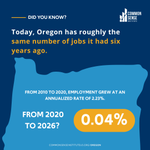
Oregon’s job growth has hit the brakes. From 2010 to 2020, employment grew at an annualized rate of 2.23%. From 2020 to 2026? Just 0.04%. Today, Oregon has roughly the same number of jobs it had six years ago. Why has Oregon’s job growth stalled? Learn more in CSI's full report: bit.ly/4hygqOh
1
1
31
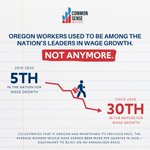
Oregon workers used to be among the nation’s leaders in wage growth. Not anymore. Oregon ranked 5th in the nation for average wage growth from 2010 to 2020. Since 2020, it has fallen to 30th. CSI estimates that if Oregon had maintained its previous pace, the average worker would be earning $3,431 more per year. What changed for Oregon workers? GET THE FACTS ⬇️ bit.ly/4hygqOh
1
2
79
CSI research found that in 2025 alone, reported and unreported financial fraud was estimated to cost the state: - $3.9 BILLION in GDP - $2.6 BILLION in personal income - More than 15,000 jobs Those findings are getting renewed attention in a recent Hoodline article covering a major identity theft investigation in Beaverton. Read the article: bit.ly/3VctbVW Read CSI's full report: bit.ly/4xPvZpE
20
CSI research is featured in The Wall Street Journal! The WSJ article highlights CSI’s latest affordability research, which finds Oregon ranks 46th in the nation for affordability, as rising costs continue to put pressure on household budgets. See the research behind the headlines and what the data show about affordability in Oregon ⬇️ Read the article: on.wsj.com/4d8t1oK Read the report: bit.ly/4zg1z1v
1
2
41
ICYMI 💡 Did you know that Oregon has some of the worst mental health outcomes in the nation? The state ranks 51st overall for the prevalence of mental health and substance use issues. What will it take to improve mental health outcomes in Oregon? Get the facts: bit.ly/4d49nKp Read the latest news: bit.ly/4dwzCJE
1
30
ICYMI: CSI research found Oregon is the 5th least affordable state in the nation. With Election Day just two weeks away and affordability top of mind for Oregonians, CSI has the facts behind the rising cost of living. Our research estimates Oregon households needed $18,300 more in 2025 to cover basic necessities than they did in 2019. Get the facts ➡️ bit.ly/4zg1z1v
1
3
61
Today, we remember the lives lost on September 11, 2001, honor the heroes who answered the call, and reflect on the strength and unity that followed. We will never forget. 🇺🇸
21
Oregon’s animal-related industries have experienced substantial employment growth. From 2001 to 2025, private employment in animal production and aquaculture, fishing, hunting and trapping, and animal-production support activities grew about 45% in Oregon, compared with about 30% nationally. These industries have therefore experienced stronger employment growth in Oregon than their national counterparts. Read the full report⬇️ bit.ly/4qNv2Mx
22
Strong workforces build strong communities and a stronger economy. This Labor Day, Common Sense Institute recognizes the workers across the country whose contributions drive economic growth, strengthen communities, and create opportunity. Happy Labor Day from CSI! 🇺🇸
27
In 2022, nearly one-third of all agricultural sales in Oregon came from livestock, poultry, and related products, totaling $2.12 billion. 🐄 Cattle and calves: $1.22 billion 🥛 Milk from cows: $559 million 🐓 Poultry and eggs: $228 million From Eastern Oregon to the North Coast and Willamette Valley, livestock production is a significant part of Oregon’s agricultural economy. Check out CSI's latest research to take a closer look at the numbers behind the industry and its economic footprint across the state. Learn more: bit.ly/4qNv2Mx
33
Hunting, fishing, and wildlife viewing generated an estimated $1.2 billion in spending and supported 11,661 jobs statewide in 2019. Adjusted for inflation, the Oregon Department of Fish and Wildlife estimates that spending at approximately $1.47 billion in 2024 dollars. From local businesses to jobs and labor income, outdoor recreation has an economic footprint that reaches communities across Oregon. Dig into the data ⬇️ bit.ly/4qNv2Mx
1
24
Oregon’s fight over the future of hunting, fishing, and farming is already heating up ahead of 2028. The proposed Oregon Freedom Amendment has cleared its first procedural hurdle, setting a potential path to the ballot to constitutionally protect the rights to hunt, fish, farm, trap, ranch, and manage wildlife. And the economic stakes are significant. The CSI report highlights an estimated $1.2 billion in spending associated with hunting, fishing, and wildlife watching across Oregon in 2019. With multiple paths to the 2028 ballot now taking shape, this is a debate worth watching. Read the article: bit.ly/4xl7vo5 Read the report: bit.ly/4xsZvSz
1
27