

The @CSIS Middle East Program focuses on the drivers of change in the region and is led by @myacoubian. Follows/RTs ≠ endorsements.
Washington, DC
Joined June 2016
- Tweets8.3K
- Following401
- Followers7.6K
- Likes186


Last weekend, the Houthis conducted their deadliest attack in Saudi Arabia for over a decade. What options does Saudi Arabia have going forward? @WillTodman, @AllisonMinor_, & Michael Ratney unpack recent developments in a new State of Play episode below.
csis.org/podcasts/state-play…

In the wake of the Riyadh airport attacks, Saudi Arabia risks getting sucked into another long, costly war that ultimately only emboldens the Houthis and deepens the regional conflict. @AllisonMinor_ outlines a better approach. Read here: csis.org/analysis/avoiding-a…

The CSIS Middle East Program is excited to announce that @AllisonMinor_ has joined the team as a senior fellow. Read the press release here: csis.org/news/allison-minor-…

The Iran war has exposed new questions about Saudi Arabia’s security partnerships. Read "Saudi Arabia Faces the Era of Disequilibrium" by Michael Ratney, former U.S. ambassador to Saudi Arabia, here: csis.org/analysis/saudi-arab…

CSIS Middle East retweeted

In the latest #ChinaPower podcast, @CSISMidEast @myacoubian discusses the current state of the Iran conflict, China's evolving relationship with Tehran, and what the recent Trump-Xi summit revealed about how Washington and Beijing view the conflict. Listen here: buff.ly/3s5EZhG

"In the immediate term, Saudi Arabia is faced with the same two options it has always had: military operations and diplomacy," writes former U.S. ambassador to Saudi Arabia Michael Ratney about Houthi attacks against Saudi Arabia. csis.org/analysis/united-sta…

📈 Charting the Middle East: The Price of Exclusion
@WillTodman examines how Western aid cuts have exposed the limits of the international response to Syrian refugees—and why economic inclusion could reduce aid needs while enabling greater self-reliance.
csis.org/analysis/price-excl…

CSIS Middle East retweeted

“In 2026, most Syrian refugees remain dependent on aid, excluded from formal labor markets, burdened by debt, and ill-prepared to rebuild their lives in a post-Assad Syria.”
In a new report, @CSISMidEast’s @willtodman argues that a window of opportunity exists to radically reformulate the refugee response.
Read the report: csis.org/analysis/self-relia…

In a new report, @WillTodman argues that the current model for refugee management has failed, and that international actors should advance a new approach that prioritizes Syrian refugees' self-reliance and private sector integration.
Read here: csis.org/analysis/self-relia…
A new regional order is emerging in the Middle East. At the launch of the Middle East Futures Project, experts discussed alternate futures, regional realignments, and how U.S. policy could shape—and be shaped by—the region’s transformation. csis.org/events/middle-east-…

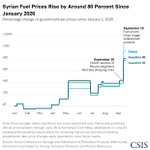
This installment of Charting the Middle East by @myacoubian and Kira Nygren examines the rapid rise in government-set fuel prices in Syria that led to the most widespread public demonstrations since the fall of former president Bashar al Assad. csis.org/analysis/fueling-di…

The Middle East is entering a period of profound uncertainty as the old regional order gives way to something new. @myacoubian examines this “hinge moment” and the forces that could shape what comes next. csis.org/analysis/middle-eas…
The Levant is at a potential turning point. For The Middle East Futures Papers, @paul_salem examines whether Syria and Lebanon can capitalize on a changing regional environment to build stronger states and a more stable regional order. Read here: csis.org/analysis/levantine-…

Lebanon is at a critical economic juncture. Finance Minister H.E. Yassine Jaber joined @myacoubian and @paul_salem to discuss banking reform, the financial gap, IMF negotiations, public finances, and the path toward economic recovery. csis.org/events/conversation…

What does the emerging regional order in the Middle East mean for U.S. policy?
At the launch of the CSIS Middle East Futures Project, an expert panel examined alternate futures, regional realignments, and the evolving role of the United States.
Watch: csis.org/events/middle-east-…
“Saudi Arabia still sees opportunity, but also graver risks than it may once have recognized,” writes Michael Ratney about the Iran war’s impact on the kingdom. Read the fourth installment of The Middle East Futures Papers here. csis.org/analysis/saudi-arab…
CSIS Middle East retweeted

Excellent discussion on the Middle East and potential future trajectories and US policy

TODAY at 11:30 AM EDT: Join us for Middle East Futures: U.S. Policy in an Emerging Regional Order, an expert panel launching the Middle East Futures Project. Featuring @vali_nasr, Michael Ratney, @paul_salem, & @DanielBShapiro. Moderated by @myacoubian.
csis.org/events/middle-east-…
HAPPENING NOW:
Tune in to this expert panel examining alternate futures, regional realignments, and how U.S. policy could shape—and stand to be impacted by—the emergence of a new regional order.
Watch here: csis.org/events/middle-east-…
CSIS Middle East retweeted

TODAY at 11:30AM EDT: @CSISMidEast hosts an expert panel launching Middle East Futures, exploring U.S. policy in an emerging regional order.
Tune in to the discussion with Vali Nasr, Michael Ratney, Paul Salem, Daniel B. Shapiro & Mona Yacoubian here: buff.ly/4h1Lpiu

TODAY at 11:30 AM EDT: Join us for Middle East Futures: U.S. Policy in an Emerging Regional Order, an expert panel launching the Middle East Futures Project. Featuring @vali_nasr, Michael Ratney, @paul_salem, & @DanielBShapiro. Moderated by @myacoubian.
csis.org/events/middle-east-…