

We make #science cool for kids! #ActualLivingScientist's bringing fun engaging hands-on #STEM/#STEAM to 30K kids, parents & teachers each year. https://xitter.cf/t.co/oprSrmGp1m
Colorado Springs, CO, USA
Joined October 2010
- Tweets5.1K
- Following2.7K
- Followers1.3K
- Likes5.9K









Cool Science retweeted

Same video as before of ATLAS observing the DART impact, but tracked sidereally (with the stars). Each frame is about 40 seconds, and the entire sequence is about two hours.


Cool Science retweeted

Microgravity provides a unique look at fluids like water, and we’re taking advantage of that in @Space_Station research! Scientists use surface tension to gain a new perspective on diseases and examine small forces that control liquids. #WorldWaterDay
Cool Science retweeted

The Brain Magic
Here are two neurons sensing each other and trying to connect. This is the way our brain learns and develops
Source: @AcademicChatter
Credit @rockatscientist
RT via @pascal_bornet

Cool Science retweeted

Alignment of the James Webb Space Telescope is now complete!👏 These new engineering images of sharply focused stars in the field of view of each instrument demonstrate that #Webb is fully aligned and in focus. Learn more here: blogs.nasa.gov/webb/2022/04/… 📷 : NASA/STScI

Cool Science retweeted

The balls behind the horizontal lines are all the same color.
This one and many other color illusion by @NovickProf are available here: bit.ly/2O74l2I
Explanation of the Munker illusion: engineering.utep.edu/novick/…

Cool Science retweeted
The holes in honeycombs don't actually start out as hexagons. Bees create circular tubes staggered with one another. The heat formed by the activity of the bees softens the wax. Then the wax hardens into the the most energy efficient shape, the hexagon buff.ly/35ETQgI

Cool Science retweeted

It doesn't matter how beautiful your theory is, it doesn't matter how smart you are. If it doesn't agree with experiment, it's wrong. In that simple statement is the key to science.
*Cornell University Lecture, 1964*
Cool Science retweeted

Biology and wonder. Aliens among us.
You can look inside the glass frog and see its organs. (Hyalinobatrachium dianae, Costa Rica.) bit.ly/3j6CEYr

Cool Science retweeted
Guttation is the exudation of drops of xylem sap on the tips or edges of leaves of some vascular plants, such as grasses. It's not dew and can create particularly awesome effects [read more: bit.ly/2zk1bka]

Cool Science retweeted
The beauty of physics!
SpinLaunch is a giant vacuum centrifuge for launching 200kg satellites into orbit at 5,000 mph
>> It utilizes 4x less fuel, for 10x less cost!
Source: @cctech100
via @pascal_bornet
Cool Science retweeted

Q: What do you do?
A: I'm a geologist.
Q: So, you just look at rocks all day?
A: Actually, no! Geology is much more than field work. It's also GIS mapping, writing, analyzing satellite images, studying rock slices under the microscope, & flying in helicopters. #GeologistsDay 1/3

ALT Two women and four men standing in front of a cliff exposure of layered sedimentary bedrock.

ALT A woman seated at a desk looking through the eye piece of a petrographic microscope.

ALT Two female geologists and two make geologists with a Blackhawk-type helicopter in the background.
Cool Science retweeted

#DidYouKnow?
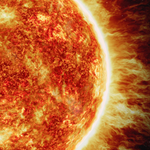
A solar flare is an intense burst of radiation coming from the release of magnetic energy associated with sunspots. Flares are our solar system’s largest explosive events. They are seen as bright areas on the sun and they can last from minutes to hours. 🤓 Cr: @NASA

Cool Science retweeted
Giraffes have a blue tongue to protect them from sunburn, because they graze on the tops of trees for up to 12 hours a day in the direct sunlight. Their tongue contains melanin, the same pigment responsible for tanning [read more: buff.ly/2I25biB]



Cool Science retweeted
Bar-linkage mechanisms have attracted the attention of mathematicians for centuries because they can be used as “stand alone” calculators. This linkage mechanism by @KeishiroUeki converts binary numbers to decimal [read more: buff.ly/37VSVNz]
Cool Science retweeted
On November 12, 1833, there was a meteor shower so intense that it was possible to see up to 100,000 meteors crossing the sky every hour. At the time, many thought it was the end of the world. This woodcut by Adolf Vollmy was inspired by the event [more: buff.ly/3d5XQKo]


