

Senior Fellow, Manhattan Institute. Opinions my own.
Joined July 2017
- Tweets17.1K
- Following331
- Followers3.9K
- Likes8.9K




Pinned Tweet
Everyone knows what conservatives don't like about the welfare state.
It's time for a right-of-center vision of what it *should* be doing:
amazon.com/dp/1630695432/

Gaps in targeted programs can be filled at feasible budgetary cost.
Shortfalls in universal benefits reflect unavoidable hard limits on fiscal capacity.
wsj.com/world/europe/rioting…


Politicians want to expand HCBS benefits to seniors regardless of income. But middle-class seniors have incomes, assets, informal help, and prior careers to set aside for non-institutional LTC needs.
I/DD beneficiaries deserve help more because their needs are uninsurable.
Medicaid is a $900bn/yr program and we have very little idea of where the money is going.
Its long term care benefit has 5 main, largely mutually exclusive, eligibility pathways, and there's essentially no data on the breakdown of enrollment or spending by each.
Making HCBS a nationwide mandatory Medicaid benefit would surely be a non-starter due to: 1) NFIB v Sebelius, 2) moral hazard related to 90% match rate necessary to get states to accept it.
To be fair, the HCBS Access Act (with 19 Senate D sponsors) side-steps the first concern by establishing a 100% FMAP for HCBS (without any cap!) congress.gov/bill/119th-cong…
The scope of mandatory benefits it establishes is wild.
An R should ask for a @CBO score just for the LOLs...

It's amusing to see the Senate D report on LTC say there is no problem of fraud in HCBS on p28, and then on p29 warn that private equity owns most of the home health agencies in NY and could easily fleece the program to an extraordinary degree 🤔
finance.senate.gov/imo/media…
Medicare For All will get the media attention, but expanding HCBS looks like the mainstream health policy thrust if Democrats pick up Congress: finance.senate.gov/imo/media…

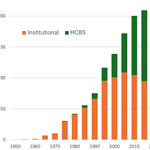
Medicaid's structure has allowed a $150bn/yr HCBS benefit to develop through incremental statutory and executive actions. It wouldn't be difficult for major further expansions to occur largely unnoticed.
It's hard to think of a country where you can't find a long list of news articles by Googling "[countryname] hospital crisis"
That said, I must admit that I was unaware of the shortcomings of Liechtenstein's healthcare system: medicalxpress.com/news/2014-…
Chris Pope retweeted

Why do private plans have stronger incentives to serve beneficiaries in Medicare than in Medicaid? @Paragon_Inst Demetrios Kouzoukas & @borisvabson will discuss with @CPopeHC & John Kaelin, who was previously an executive at Centene.
October 14 at 2.
paragoninstitute.org/event/m…

Ideas-based theories of policy change tend to generate policies which hang on partisan good favor.
Circumstances-based theories offer less prospect of immediate success, but are more successful in the long run because they are more independent of factional fortunes.
The growth of Medicaid long-term care spending has slowed noticeably since the 2014 ACA Medicaid expansion.
Is this because states would now rather get a 9:1 match for acute care spending on ABAWD expansion enrollees than less than a third of that for the disabled?


Good to see Pallone proposing a shift away from arbitration for surprise billing. It will be interesting to see if Rs also signal support for reform before the elections: thehill.com/policy/healthcar…

Milei's healthcare reforms sound remarkably similar to Worker's Choice ICHRAs: hubinternational.com/en-us/h…

Maryland is America's laboratory for hospital payment regulation, which is supposed to reduce costs and improve access to care.
It's having the opposite effect: manhattan.institute/article/…
