CICOES retweeted
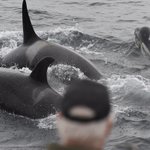
The team tested them on Southern right whales and found the tagged whales showed no signs of negative health effects. They're now refining and testing the design to make it smaller and further reduce risk to the animals.
@CICOESresearch
fisheries.noaa.gov/feature-s…
#TechWeek #Whales

ALT The image features information about lab testing of a new design. The text describes how the tags were subjected to intensive stress tests, even being struck with a hammer, and held up under simulated ocean conditions. A diagram of the design measures 5.3 inches in length over a design of blue sky and ocean.

ALT This image is titled "Safer and stronger." It discusses testing a tag design on Southern right whales in Argentina, highlighting its safety and longevity. Two photos of whales are shown in Polaroid style, labeled "Península Valdés, Argentina." Text mentions the tags stayed attached for an average of 24 days, more than twice as long as implantable tags. The background has a light blue and white design, resembling clouds.
The second leg of KWEST is now underway. Meet the scientists!
KWEST is a partnership between CICOES & NOAA. The US Navy, which funds the survey, will use data to inform marine species monitoring and mitigation requirements for training activities.
NMFS Permit # 25563-02
The KWEST research cruise just wrapped the end of its first leg.
KWEST is a partnership between CICOES & NOAA. The US Navy, which funds the survey, will use data to inform marine species monitoring and mitigation requirements for training activities.
NMFS Permit # 25563-02
CICOES and NOAA scientists are exploring a new tool, the McLane Robotic Cartridge Sampling Instrument, to expand autonomous environmental DNA (eDNA) monitoring on stationary moorings.
Read more: cicoes.uw.edu/2026/08/10/adv…
How do you study whales across a vast area? One way is by listening.
During the Navy-funded KWEST research cruise, we’re using sonobuoys as one of our tools to find whales at sea using the sounds they make below the surface. (See our last post for more info about KWEST.)
CICOES & NOAA recently launched the KWEST cruise inbegan the northern Gulf of Alaska. The US Navy, which is funding this survey, will use the data to further inform marine species monitoring and mitigation requirements for training activities during Exercise Northern Edge.
In this profile by Argos, CICOES scientist Alexandre Zerbini discusses how advances in satellite tracking have expanded what researchers can learn about whales.
Read the full story: argos-system.org/argos-whale…
CICOES is prepping for the Arctic field season.
Researcher Jiaxu Zhang recently led a series of drone test flights ahead of the next Arctic AIR mission.
Learn more: pmel.noaa.gov/news-and-media…
CICOES researcher Aaron Levine was interviewed by Powder Magazine about the potential effects of a "Super El Niño" on the 2026/2027 ski season.
Read the story:
powder.com/news/super-el-nin…
CICOES Magazine spotlight: UW researcher Craig Norrie.
"It’s two in the morning on a cold November night in Hood Canal. I am surrounded by thousands of oysters, destined to be served in the finest restaurants across the country."
Read the full story:
cicoes.uw.edu/.../growing-re…
CICOES is proud to share that Fred Averick, our Assistant Director of Finance and Administration, has received the University of Washington College of the Environment's Distinguished Staff Award. Congrats, Fred!
Read more:
cicoes.uw.edu/2026/05/18/uw-…
CICOES retweeted
Read the #OpenAccess article by Doherty et al. [2026] for free on @WileySTEM!
🔗 doi.org/10.1029/2025AV001939
@UW @CICOESresearch @FloridaState @FSU_EOAS
#AGUPubs
ICYMI: The 2025 CICOES Magazine is now available online! This year’s edition highlights CICOES-affiliated researchers and the discoveries, collaborations, and questions driving our work to better understand climate, oceans, and ecosystems.
cicoes.uw.edu/about/magazine…
CICOES researcher Aaron Levine spoke with the Seattle Times about the potential effects of an El Niño: less snowfall and snowpack, exacerbating drought conditions the following summer along with raising wildfire risk.
Read the full story:
seattletimes.com/seattle-new…
Today is #HuskyGivingDay, and your gift to CICOES can make a lasting impact. When you give, you power our people, programs and possibilities.
Support CICOES today to contribute to our research and education goals:
washington.edu/giving/make-a…
Last spring, NOAA and CICOES scientists completed the most extensive aerial survey of Arctic ice seals to date, flying more than 24,000 miles over sea ice to track four species across U.S. waters.
Learn more in this recent story from NOAA Fisheries: fisheries.noaa.gov/feature-s…
The first-ever CICOES summer intern, Angel Adames-Corraliza, won a 2025 MacArthur "Genius" Award. Learn more about his journey from the most recent issue of UW Magazine:
cicoes.uw.edu/2026/01/20/fro…
Microbes are important sentinels of change that provide a metric for long-term ocean health - which is why it is critical to design observatories that consistently capture these organisms.
Learn more about recent efforts:
pmel.noaa.gov/ocean-molecula…
Study shows earthquakes cause deep-sea vents to burp up nutrients. CICOES scientist Joseph Resing, who was not involved, says study provides “tantalizing evidence” that earthquakes provide nutrients to life at the surface. “I love this paper."
More here: cicoes.uw.edu/2026/01/06/dee…