

On a mission to deliver clean fusion energy fast enough to meet humanity’s biggest challenges with SPARC®, ARC™, and Fall Line™ Fusion Power Station.
Devens, Massachusetts, USA
Joined March 2017
- Tweets986
- Following384
- Followers24.4K
- Likes1.2K




“We have a saying at CFS that in the future, the two markets that matter are energy and gray matter. It’s really human creativity and energy, and then the possibilities are endless.”
That’s @BrandonSorbom, CFS Chief Science Officer and Co-Founder, speaking about the long-term potential of fusion energy at @TechCrunch Disrupt 2026 this week. Quality of life measurements rise with energy, he added:
“If you look at literacy or infant mortality or life expectancy, they all correlate positively with energy use. So regardless of what we're applying the energy towards, there's always going to be a need for more energy.”
#FusionEnergy #TechCrunchDisrupt

To hear more from Brandon at TechCrunch Disrupt 2026, check the full video here: youtube.com/watch?v=UN8fvBJL…
Q>1 is one of the most important milestones on the path to fusion power. But what does it actually mean? Alex Creely, Chief Engineer of ARC, breaks it down in simple terms.
Fusion has the potential to unlock a huge amount of clean energy. But first, a fusion machine has to prove it can make more energy than it uses. That’s what Q>1 means. We put power into the machine to keep the fusion fuel incredibly hot, and Q>1 happens when the fusion reactions give off more power than we put in.
It’s not the only thing a fusion power plant needs — but it’s a crucial first step.
#FusionEnergy #Energy #Physics #Science
You can read more about Q>1, the fourth step on the path to fusion energy, here: blog.cfs.energy/fourth-step-…

Through the U.S. Department of @ENERGY's Genesis Mission, fusion energy machines are about to get a lot smarter.
CFS is the only private company leading a Genesis Mission Phase II project, directing a group of American companies, universities, and labs that’ll extend our work applying artificial intelligence and digital twin technology to our SPARC fusion demonstration machine. With decades of publicly funded fusion science data and the might of DOE supercomputers, we’ll be able to put faster AI technology to use. This phase of the Genesis Mission is designed to help expand the impact of projects with a demonstrated potential to benefit from AI and to improve the nation’s scientific capability.
A digital twin is a sophisticated clone of real-world hardware, a 3D representation with two-way communication links that show what’s happening in the tokamak while also helping us control it. Building AI models into this digital twin adds ultrafast AI simulations, giving us new abilities to understand SPARC fusion pulses in just moments. That rapid learning will let us chart the best path to progress so we can deliver fusion energy to the grid as fast as possible.
In effect, AI can serve as a co-pilot to run the machine, and the digital twin gives us a better flight simulator cockpit. DOE supercomputers will help us train AI models validated with data from decades of fusion research, helping to turn hours of plodding computer simulations into immediate insights.
“This project will convert decades of R&D performed across the U.S. fusion community into tools that can be applied to accelerate SPARC operations,” said @BrandonSorbom, Chief Science Officer and Co-founder of CFS. “Together, our team of public and private leaders in AI and fusion will be able to unify and apply decades of U.S. research and tackle some of the fusion industry’s biggest challenges — creating new opportunities to move fusion to the grid faster.”
The group we’re leading on this project also includes laboratories (@Livermore_Lab, @ORNL, @PPPLab, @SLAClab), universities (@CarnegieMellon, @MIT), and private companies (@GoogleDeepMind, @nvidia, @Synopsys, and @GeneralAtomics).
#FusionEnergy #Energy

For more details, check our press release: cfs.energy/news-and-media/co…
"SPARC was designed with the intent not to be connected to the grid but to have 13 of the 17 systems you need in a power plant to show the world that we have a near-scale fusion machine that can work as a power plant. The rest of the things we can work in parallel — we wanted to go on the fastest path possible."
That's Jennifer Ganten, Chief Global Affairs Officer, chatting with Daniel Hewitt on the Everything Energy podcast from the @IEA, alongside other fusion observers. Jennifer and Dan discussed how the SPARC facility has become a beehive of daily activity with hundreds of people onsite.
SPARC, our fusion demonstration machine, is now about 80% complete, and we anticipate turning it on next year. Tune into the podcast to learn more about our progress on SPARC and our parallel approach to working on the ARC power plant.

Listen to the full podcast here: iea.org/podcasts/everything-…

"We forget that up until the Wright brothers, there were people saying that [flight] was physically impossible — despite the evidence that birds fly."
Fusion is the energy source of the sun and stars and, as CFS CEO and Co-founder @BobMumgaard points out during this chat with @axios, @Livermore_Lab in California proved it can work on Earth, too.
Similar to what the Wright brothers achieved at Kitty Hawk, we're now approaching that moment when fusion "takes flight." CFS plans to turn on our #SPARC machine next year, and shortly after it'll be clear fusion energy is on its way to the power grid.
#FusionEnergy
In a one-day sprint 10 years ago, researchers at @MIT helped chart the CFS path to commercializing fusion energy — even before CFS was actually founded.
That sprint took place during the last day of service for Alcator C-Mod, a type of fusion machine called a tokamak. C-Mod is the progenitor of the SPARC demonstration machine we’re building today and the ARC power plant we’ve begun designing. And we’re putting the C-Mod lessons to good use.
C-Mod showed that a compact tokamak employing very high magnetic fields is well suited not only for high fusion performance but also for economical power generation. And during that last day, researchers showed three separate paths to high performance in a competition to push the machine as far as it could go. It set a record that stands to this day, unmatched by any other tokamak.
Unmatched until we start running SPARC, that is. The knowledge gained from C-Mod helps propel us to achieving net fusion energy, aka Q>1, with SPARC.

For more on how MIT’s C-Mod paved the way for CFS, check our blog post:
blog.cfs.energy/how-the-alca…

Fusion energy is often discussed as a matter of plasma physics, funding, and machine design, but bringing commercial fusion to the grid also requires a global industrial base that can manufacture critical components at scale.
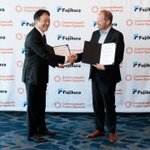
Today CFS took an important step toward meeting that need, announcing an agreement to purchase more than 10,000 km (3 GA-m) of high-temperature superconducting (HTS) tape from Fujikura Ltd. It’s the largest single purchase order for HTS tape, a critical component of our breakthrough magnets.
This news is important evidence that our fusion industrial supply chain is taking shape. Our order allows Fujikura to invest in new manufacturing capacity for the long term, stepping up in our global network of more than 1,000 suppliers across 30 countries.
We already built a supply chain for our SPARC fusion demonstration machine, but this agreement helps secure HTS tape for our next chapter: building ARC power plants, starting with our first at the Fall Line Fusion Power Station in Virginia. The ARC effort is moving ahead with design, technology development, and commercialization work like applying to connect that first ARC plant to the grid with PJM Interconnection, the largest U.S. wholesale electricity market.

For more details on our HTS supply chain agreement with Fujikura, check our press release here: cfs.energy/news-and-media/co…
“Think about what [fusion] means in a technological race. Power is the thing that powers the next economy, right? All the geostrategic strife we have right now is about power in the form of natural resources. Who has them? What are they? What boats are they on through what body of water? Fusion takes all of that off the table.”
That's CFS CEO and Co-founder @BobMumgaard speaking at the @heatmap_news House at #ClimateWeekNYC last week, discussing how commercializing #FusionEnergy will radically transform how we think about energy creation and consumption. The world today is heavily influenced by the acquisition, management, and consumption of finite resources like fossil fuels that we currently use to power the globe.
Fusion offers an alternative — a near-unlimited source of energy that can be built anywhere to generate clean, safe, steady power.


Commonwealth Fusion Systems retweeted

.@CFS_Energy CEO @BobMumgaard tells @Ben_Geman that “even if you had all the tools to fight climate change, you would still want to innovate.”
“If we can make energy more accessible, if we can make it lower impact, if we can make it lower price, that is a better world to live in.” #AxiosHouse
Fusion energy costs are indeed key to its eventual success. Those costs are deeply connected to a fusion company’s choice of architecture, where it’s critical not only that the eventual power plants can be economical, but most fundamentally, that a commercially relevant machine can actually work.
That’s what we’re tackling with our SPARC machine outside Boston. Our project got a head start thanks to many years of collective operational experience that people have gained by running tokamaks around the world (to date over 1800 tokamak-years of operation across over 150 machines over the last 50+ years!).
On top of that we add all our experience designing, manufacturing, constructing, commissioning, and operating SPARC. That work confirms our understanding of the physics, engineering, supply chain, performance, reliability, and cost. This collection of factors is the kind of knowledge that gets a company onto the cost curve so it can then scale up and drive down that cost curve.
None of this is a slam dunk. But bear these points in mind when looking at the levelized cost of energy (LCOE) and fusion competitiveness:
• Every other form of energy on the grid also went through this shift toward being economical. What might look routine today, like burning coal or fissioning uranium, was once at the cutting edge of what was technologically possible.
• The widely cited LCOE analysis by the energy experts at @Lazard only recently began to address the added cost some energy sources face to ensure they're firm (predictably available). And even then their extra firming costs only include 4 hours of power from a battery or firm power from a nearby gas plant, neither of which is really clean, firm 24x7 power.
• LCOE has been increasing for all forms of energy in recent years, and demand for energy also is soaring.
• While the cost for power is represented well by LCOE, the value of that power can be quite different. This is especially true for power that’s both clean and firm, but fusion has other advantages, too. It’s also highly energy dense and therefore land efficient. It’s safe and siteable nearly anywhere, including close to demand, and therefore requires less transmission. It has essentially negligible costs from fuel that’s abundant, available nearly everywhere, and essentially limitless. It’s highly secure, providing energy not through some collected or purchased resource, which leads to fuel volatility costs and geopolitical capture, but rather from a technology that can be built, owned, and fully fueled from day one.
#FusionEnergy #Energy

Fusion has moved beyond the question of whether the physics can work.
Now comes the harder test: Can companies build commercial power plants cheaply enough to compete with solar, batteries, gas and nuclear?
@willwwade and I dug into the economics:
bloomberg.com/news/articles/…

It was a bustling and productive week at #ClimateWeekNYC, and our team joined a variety of conversations about subjects on everyone's mind — not just climate, but also energy security, AI, and more. Because one of the strongest tools to tackle climate issues — energy — also addresses other challenges around the world, and fusion energy has a big role to play there.
Here are some scenes of our team in action, including CEO and Co-founder @BobMumgaard with @axios, Chief Global Affairs Officer Jennifer Ganten with @cleanaircatf, Chief Engineer of ARC Conceptual Design Alex Creely with @xprize, and Vice President of Plasma Physics Phil Snyder with @CUSEAS.
#FusionEnergy


Some big progress advancing fusion energy in the United States today: the introduction of the American Leadership in Fusion Act, a bill with bipartisan backing that would hasten the day that the country could benefit from this new source of energy.
The bill’s sponsors come from both sides of the aisle: @RepZoeLofgren, the Ranking Member of the House Science, Space, and Technology; Rep. @JayObernolte, Chairman of the Committee’s Research and Technology Subcommittee, and Reps. @RepDonBeyer, @RepGallagherCA1, and @RepLoriTrahan.
The bill, which dovetails with the work of the @scsp_ai's bipartisan fusion energy commission, is a good response to make sure the U.S. remains competitive in a world where countries like the U.K, Germany, and China are already investing heavily in fusion commercialization programs. Fusion, the energy source of the sun and other stars, holds the promise of clean, safe, secure, baseload electricity. This bill responds to the SCSP’s fusion commission’s call to action and accelerates development and deployment work to bring fusion onto the nation’s power grid sooner and at a larger scale.
The American Leadership in Fusion Act is a catalyst to fusion commercialization efforts. It provides $10 billion over several years in two broad categories. About $5 billion would fund vital research and a collection of facilities to accelerate commercially-relevant technologies like materials science for power plants and blankets to capture fusion energy. Another $5 billion would support the U.S. Department of @ENERGY's Milestone-Based Fusion Development Program to support fusion company progress to bring fusion power to the grid. Of that, $2 billion would fully fund the present phase of the Milestone program to help companies design their fusion power plants and $3 billion for a new demonstration phase of the Milestone program to cost-share first-of-a-kind fusion power plants.
The bill also would restructure DOE’s fusion R&D efforts by codifying the DOE’s reestablishment of an Office of Fusion to sustain research efforts while expanding the department’s commercial focus as the industry continues to grow and mature around the world. We at Commonwealth Fusion Systems join other fusion energy companies, universities, and non-profits, in supporting this bill.
#FusionEnergy #Energy

