

Foreign policy news and analysis. CFR takes no institutional positions on policy. Follows, RT ≠ endorsements. ✉️ Subscribe for more: https://xitter.cf/t.co/ehd5lKYrLs
New York, NY
Joined November 2008
- Tweets86.8K
- Following145
- Followers58K
- Likes2K




President Trump announced a new diesel deal with Russian President Vladimir Putin on October 9 to the surprise of many U.S. allies. Experts argue the agreement could undercut Western economic pressure on Russia and solidarity efforts with Ukraine while doing little to lower fuel prices.
“The announcement of the deal is really for political effect at home, to try to influence voters in this election,” expert Vijay Vaitheeswaran said. “The idea that there might be lower prices coming because of an innovative deal that President Trump did, with his relationship with Putin, sounds pretty good [to voters].”
Beyond lowering fuel prices, the Trump administration reportedly hopes the deal will signal Washington’s openness to working with Moscow and bring the country back to the negotiating table to end the war. Few experts believe the diesel deal will have much of an effect on global oil markets in the near future. Instead, several said it would only bolster Russia economically and further strain transatlantic unity.
“The diesel deal shows that Washington’s Russia policy is now driven by high prices at the pump before the November 3 midterm elections, rather than by any shared transatlantic strategy,” expert @m2matthijs said. “The irony is that the U.S., and especially President Trump, has lectured the Europeans for years about the dangers of buying Russian energy; now it is easing sanctions to buy Russian diesel itself, without consulting anyone in Europe.”
Whether or not it is implemented, the surprise diesel deal has strained relations between the United States and its allies. “For many EU leaders, [the diesel deal] is further proof that the Europeans can no longer afford to outsource their security policy and can no longer rely on the United States to contain Russia,” Matthijs said.

Read more: cfr.org/articles/trumps-russ…

We are now accepting applications for our 2027-28 fellowship programs, which offer unique, transformational opportunities for U.S. citizens with a demonstrated commitment to a career in foreign policy. Selected fellows broaden their perspectives on foreign affairs by gaining exposure to a new environment in a policymaking setting, at CFR, or overseas.
Applications close on October 30, 2026. Apply or learn more: cfr.org/fellowships?utm_camp….

.@RBlumenstein knows the value of putting in the work as a journalist. The CFR member and president of editorial at NBC News built her career by starting small, covering local and regional news in Florida and Michigan, before making her way to national news organizations, including the Wall Street Journal and the New York Times.
With the news landscape under enormous pressure, Blumenstein says she remains optimistic about the future of journalism. “I think that trust is so important, and I believe that a lot of consumers are realizing that there's a lot of misinformation out there."
"My biggest advice, especially to young people, is to do your job, but also be someone who your boss is happy to see because they know you're going to take the initiative and be the closer who will help carry things across the finish line," Blumenstein says.
Read more about the experiences that have shaped her career, from small-town newsrooms to some of the most influential news organizations in the country: cfr.org/articles/how-i-got-m…

Trump announced a new diesel deal with Putin on October 9 to the surprise of many U.S. allies. Experts argue the agreement could undercut Western economic pressure on Russia and solidarity efforts with Ukraine while doing little to lower fuel prices. cfr.org/articles/trumps-russ…
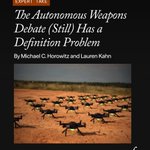
The debate over autonomous weapons and the debate over frontier AI safety are about different problems, argue experts @mchorowitz and @Lauren_A_Kahn. To regulate them, policymakers need a framework to address it, they write.
“Everyone wants autonomy to be a clear binary, yes or no. . . . In reality, autonomy is a spectrum defined by the technology being used and the human choices that are made to employ a weapon system. The question isn't, ‘Is it autonomous?' but rather, ‘How autonomous is it?'”
“What few people understand is how much autonomy is already in modern military systems—and has been for decades,” they write.
Read their analysis: cfr.org/articles/the-autonom…


Council on Foreign Relations retweeted

#OnThisDay in 1962, President John F. Kennedy was in his bedroom reading the newspaper when he learned that the Soviet Union was installing ballistic missiles in Cuba. He had decisions to make, but first had to greet a visiting US astronaut and his family. cfr.org/articles/jfk-learns-…

Iran’s closure of the Strait of Hormuz sent shock waves through the global economy. China has weaponized its supply-chain dominance over magnets and critical minerals to its strategic advantage. And, for years, the United States has leveraged the global power of the dollar to pursue its interest and levy sanctions against adversaries, most notably Iran and Russia. CFR President @MikeFroman explains the growing importance of chokepoints in geopolitics and warns that the United States could lose some of its long-held advantages if it’s not careful.
For more, read his guest essay in the New York Times: nytimes.com/2026/10/09/opini…
In this episode of The Spillover, cohost Rebecca Patterson and Veda Partners cofounder @HenriettaVeda discuss the upcoming 2026 U.S. midterm elections. Treyz notes that although “the House is a guaranteed pickup” for Democrats, Senate races will prove more challenging. “If you are in the United States Senate, you have an 88 percent chance of winning your election if you are already the incumbent,” says Treyz.
Watch the full episode here or wherever you get your podcasts: youtu.be/bZIXcFDkr2k?si=nlYA…
When President Donald Trump announced a deal to buy diesel from Russia at the end of last week, “it was easy to shrug off the move as a feeble effort to limit energy prices in advance of the midterms,” writes expert Stephen Sestanovich.
"A week later, the story looks disturbingly different; the possible consequences, much more serious, and likely to last well beyond" the elections.
A day after announcing new diesel imports from Russia, Trump began calling for Ukrainian President Volodymyr Zelenskyy’s removal from office. He followed this up by claiming that Moscow and Kyiv had agreed to suspend attacks on each other’s main energy targets.
"This, it quickly became clear, was pure invention. Reports suggested what had actually happened was that U.S. negotiators were pressing the Ukrainian government to do something far more radical than a mutual ceasefire—to cease its attacks unilaterally, whether Russia complied or not," Sestanovich writes.
“It is hard to overstate how much this new public hostility by U.S. officials—above all, the president—has disoriented Ukraine’s leadership,” he writes. “In searching for a new way to handle Trump, Ukraine’s leadership has seemed suddenly at sea."
"Rather than see the prospect of postwar riches as the key that will bring Putin to the table, he now acts as though pressure—on Zelenskyy, not Putin—will be the crucial instrument of a breakthrough, ” Sestanovich argues.

Read his full analysis: cfr.org/articles/trumps-dies…

Watch the full conversation here: cfr.org/event/the-road-not-t…

“This is not in any standard engineering text, government study, industry forecast, or climate model. Why not? Because it’s not a technology; it’s a design method. And few people yet think of design—how you put the pieces together—as a path to speed and scale,” says Amory Lovins, cofounder and chairman emeritus of the @RockyMtnInst, explaining simple design changes to pipes, pumps, engines and other common systems that could significantly reduce global energy consumption.
What happens if the world’s pharmacy decides to close? From ibuprofen to amoxicillin, a majority of the essential medicines used in the United States depend on ingredients from China. This dependence has left the United States vulnerable to a geopolitical rival that could decide to cut off its access at any time.
On this episode of Why It Matters, @RushDoshi, senior fellow at CFR, and Olivia Kosloff, senior fellow at the American Economic Liberties Project, unpack how the dependency came about and what’s at risk if the pharma supply chain snaps.
Listen to the episode here or wherever you get your podcasts: podcasts.apple.com/us/podcas…

“Of [a car’s] gasoline, less than 1% of that energy ends up moving the driver,” says Amory Lovins, cofounder and chairman emeritus of the @RockyMtnInst. If companies make cars out of carbon fiber–reinforced plastic, he states that “you take out almost 700 pounds of weight, but the car costs the same because you need fewer batteries to haul less weight around.” According to Lovins, the most efficient car about to enter production in the United States “is a two seater that gets the equivalent of 343 miles a gallon. In fact, so efficient—three times better than a Tesla—that just the solar cells on top of the car will run it 11,000 miles a year without having to plug in.”
Watch the full conversation: cfr.org/event/the-road-not-t…
CFR asked members of the Society for Historians of American Foreign Relations what they considered to be the best and worst foreign policy decisions in U.S. history.
A U.S. Air Force surveillance flight over Cuba in October 1962 turned up evidence of what U.S. officials had feared: the Soviet Union was installing nuclear-armed missiles on the island. The discovery triggered a 13-day crisis, beginning on October 16, that brought the world to the brink of nuclear war.
Worried about escalation, President John F. Kennedy pursued backchannel communications with Soviet leader Nikita Khrushchev that ended the crisis and led to several agreements that opened the door to the arms-control era.
Surveyed historians ranked Kennedy’s handling of the Cuban Missile Crisis as the tenth-best U.S. foreign policy decision.
See how other U.S. foreign policy decisions were ranked: cfr.org/ten-best-ten-worst-u…
Food has increasingly become a deliberate tool of war.
Whether in besieged farming communities in Sudan or in the destruction of grain siloes in Ukraine, it is targeted, strategic, and rarely punished. In conflicts around the world, food weaponization has triggered humanitarian devastation, disrupted global food provisions, and directly threatened states’ national security.
We mapped where it's occurring globally—and explain what it reveals about the world order: cfr.org/articles/the-world-a…
