

A trusted leader in high-quality, independent financial research for 60 years.
Joined July 2013
- Tweets6K
- Following3.4K
- Followers11.9K
- Likes558




#IndexFunds may be called passive, but the decisions behind them can have very active consequences. In a two-part conversation with Lotta Moberg, PhD, CFA, on Financial Thought Exchange, Rob Arnott examines the ideas presented in his brief with Lillian Wu, “The Active Side of Indexing.”
In Part One, Arnott talks about what happens when #stocksenter and leave major indexes, and why costs stay hidden. In Part Two, they continue their discussion focusing on index construction and the gap between the largest 500 stocks and the next 500 by #MarketCap.
Watch Part One: youtube.com/watch?v=ox7-y7PZ…
Watch Part Two: youtube.com/watch?v=ShaI1N1B…

ICYMI: In Q3, CFA Institute Research Foundation publications explored how #investors can think more critically about market history, portfolio structure, and the benchmarks that shape investment decisions.
Our Financial Thought Exchange conversations examine what centuries of market evidence can tell us about risk and return, how a total portfolio approach changes institutional decision-making, and why index investing involves more active choices than its “passive” label may suggest.
Revisit these themes in the following research and podcast episodes:
📘”Exponential Wealth: Centuries of Stock and Bond Returns” rpc.cfainstitute.org/researc…
📘”Total Portfolio Approach: A Critical Literature Review” rpc.cfainstitute.org/researc…
▶️ ”The Active Side of Indexing with Rob Arnott” youtube.com/watch?v=ox7-y7PZ…
▶️ “Index Construction and Fundamental Indexing with Rob Arnott” youtube.com/watch?v=ShaI1N1B…

What can centuries of #Global #FinancialMarkets data tell #Investors today about risk, return, and resilience? A group of financial luminaries led by Roger Ibbotson, PhD, and Larry Siegel tackle this question in a new book published by @CFAResearchFndn and supported by Morningstar. “Exponential Wealth: Centuries of Stock and Bond Returns” revisits the original publication of “Stocks, Bonds, Bills, and Inflation: Year-by-Year Historical Returns (1926-1974),” authored by Ibbotson and Rex Sinquefield, on the 50th anniversary of the article and in a market environment where in-depth data analysis is considered a baseline. The book expands on the data from the original article, and introduces the Ibbotson Equity and Bond Indices that replace the original SBBI data. With 21 chapters, nearly 400 pages, and 24 authors and co-authors, the publication is set to serve as a new resource for anyone seeking a deeper understanding of market performance from a big picture perspective. Download now: rpc.cfainstitute.org/researc…
Historical return #data can look precise, but how that dataset is composed can have a major impact in the story being told. In the latest episode of #Financial Thought Exchange, Lotta Moberg, PhD, CFA, speaks with Roger Ibbotson, PhD, and Larry Siegel about their new book coming soon, “Exponential Wealth: Centuries of Stock and Bond Returns,” and why long-run #CapitalMarket evidence must be interpreted with attention to survivorship bias, #Index construction, and historical context. Watch the episode for the details and their analysis: youtube.com/watch?v=EZuVfQu_…
Is it possible to generate substantial #wealth with the #investment of a single dollar? The answer is “yes, but it’s complicated.” In the latest Financial Thought Exchange episode, host Lotta Moberg, PhD, CFA, discusses the details with Roger Ibbotson, PhD, and Larry Siegel, and their upcoming publication, “Exponential Wealth: Centuries of Stock and Bond Returns." The new book expands on the 1976 article “Stocks, Bonds, Bills, and Inflation: Year-by-Year Historical Returns (1926-1974)” by adding 50 years of data for 100 years of market analysis. Listen to part one of the conversation: youtu.be/wyVlpZQ6qc4
Does the #TotalPortfolioApproach (TPA) lead to better outcomes? Our publication, “Total Portfolio Approach: A Critical Literature Review,” examines the evidence and the institutional conditions that shape the answer. Exhibit 1, featured here, maps the institutional foundations needed to put TPA into practice.
Read the report: rpc.cfainstitute.org/researc…

ALT Exhibit 1 from “Total Portfolio Approach: A Critical Literature Review”
A new topic page from the CFA Institute Research and Policy Center brings together more than two decades of our work on the #EquityRiskPremium, including major forums, recent briefs, and foundational literature reviews. It also features video conversations with leading #investment thinkers on long-term returns, stocks versus bonds, and the assumptions that shape the debate.
Explore 🔎 rpc.cfainstitute.org/topics/…
“Passive” indexes are filled with active decisions. Quantitative models still require human judgment. And pension systems designed for one market may not work in another. Financial Thought Exchange takes a closer look at the ideas and assumptions shaping #investment practice.
Subscribe on YouTube for thoughtful conversations with the researchers and practitioners approaching #finance’s biggest questions from new angles: youtube.com/@CFA_Research_Fo…

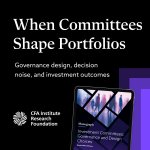
#Investment committees are often treated as a mark of strong #governance. But effectiveness depends on more than who sits in the room. In “Investment Committees: Governance and Design Choices,” Dr. Bernd Scherer examines how committee structure, group dynamic, CIO influence, decision noise, and aggregation methods can shape portfolio outcomes.
Read the entire monograph for further insights. cfainst.is/4vZbu9U

What role can reinforcement learning play in financial decision-making? In this clip from Financial Thought Exchange, Petter Kolm, PhD, and Gordon Ritter, PhD, explain how reinforcement learning differs from inverse reinforcement learning, and why that distinction matters for financial applications. Watch the two-part episode to get a full picture of this paradigm. ▶ Part 1: youtube.com/watch?v=QjQwoR1O… ▶ Part 2: youtube.com/watch?v=z0w9lZ1_… #ArtificialIntelligence #PortfolioManagement
In a recent Financial Thought Exchange episode, Seda Peksevim, Ph.D., and host Larry Siegel explore why #retirement systems in #EmergingMarkets must account for the realities workers face — from income instability to #inflation, market #volatility, and behavioral barriers. Learn more: cfainst.is/4efXCjL
The same #ETF can serve different purposes. That is why ETF due diligence cannot stop at the headline features. Read about an Efficiency, Tradability, and Fit framework for evaluating ETF choices in “A Comprehensive Guide to ETFs (2nd edition), Module 2: Evaluating ETFs:" cfainst.is/4xdAV8v
#InfrastructureDebt is moving to the center of #InstitutionalPortfolio conversations. In the latest Financial Thought Exchange episode, the authors of “Infrastructure Debt: Alternative Credit to Finance the Future” discuss the #AssetClass and the forces reshaping the market: cfainst.is/49w6d0f
What looks passive in #PortfolioConstruction can become highly active in implementation. In “The Active Side of Indexing,” Rob D. Arnott and Lillian Wu examine the mechanics of cap-weighted #Index reconstitution, the hidden costs, and inherent bias. Read the brief to learn more: cfainst.is/4dNbPpi

#Retirement saving is not just a #financial problem. It’s a design problem. In this clip from Financial Thought Exchange, Seda Peksevim, Ph.D. explains why pension systems in #EmergingMarkets need to combine behavioral tools with financial incentives. Watch the full episode here: cfainst.is/42Vet67
In #finance, numbers need context, perspective, and someone looking beyond the obvious. The Financial Thought Exchange podcast was built for this: bringing thoughtful voices to answers questions investors are asking, and those that have yet to be asked. Watch the latest episode now: cfainst.is/4dcyn2s

In the last 10 years, the #ETF story has become more complex and even more important to understand. "A Comprehensive Guide to ETFs, Module 1" examines the features that powered ETF #growth, plus the risks and operational realities. Read it now before Module 2 is out this spring: cfainst.is/4etLxJw

Once a specialist corner of #Finance, today #InfrastructureDebt is playing a much larger role in how long-term assets get built, financed, and refinanced. Read our latest brief for a look at the asset class across project stages, #Investor types, and the risks taking shape. cfainst.is/4dF3NiT
From global market shifts to portfolio construction evolution, the need for thoughtful, long-horizon #InvestmentResearch has never been greater. Donate to @CFAResearchFndn and advance our mission to inform, challenge, and elevate investment practice: cfainst.is/3PQiu8M

In an increasingly digital research environment, format still plays a critical role in how insights are absorbed. Our publications are available in e-reader formats from Amazon Kindle and Apple Books, making it easier to engage with longer-form research across devices, whether desktop, tablet, or mobile. Our monographs are also available in print through Amazon print-on-demand.
This added flexibility allows practitioners to integrate rigorous #research into their workflow wherever they are, but without sacrificing depth or usability.
Access available formats at the bottom of each report page.
