

Independent Iron Age OSR and 5e creators with a love for RPG art, history & philosophy. Let’s collaborate!
Vancouver, British Columbia
Joined July 2020
- Tweets8.2K
- Following2.8K
- Followers9.3K
- Likes66K




Pinned Tweet
The 5e Jester is out.
Non-magical. Reaction-driven. Built around misdirection and punishing bad decisions.
• 2 classes,
• 2 subclasses
• 2 magic items
• 6 Jester Troupes
• Jester Troupe Generator
PWYW!
drivethrurpg.com/en/product/…

L1: The Secret of Bone Hill, written by Lenard Lakofka with cover art by Bill Willingham, for TSR 1981.
The first installment of the Lendore Isles series, it introduces the coastal town of Restenford, its inhabitants, and the surrounding countryside, where rumours of strange creatures and mysterious activity draw adventurers toward the ruins of Bone Hill.
Rather than presenting a tightly scripted adventure, Lakofka provides a detailed town, wilderness locations, NPCs with their own motivations, and numerous opportunities for exploration. Players are free to investigate the countryside, get involved in local affairs, or pursue the mysteries surrounding the ruined castle. There’s plenty of danger, but relatively little insistence on how the characters should approach it.
The module’s greatest strength is also its weakness. There’s a tremendous amount of material to work with, but the DM must supply much of the connective tissue, and the concentration of monsters around Restenford can strain credibility. It’s arguably better suited to an experienced DM looking for a campaign setting than a beginner expecting a ready-made adventure.
The module’s original working title was The Restenford Mystery, and it was followed in 1983 by L2: The Assassin’s Knot.

Saturday Morning Cartoons!
King Arthur and the Knights of Justice (1992–1993).
Merlin transports an American football team to Camelot to replace the captured King Arthur and his knights. Their quarterback? Arthur King. You certainly can’t accuse them of overthinking the name.
The series ran for two seasons and 26 episodes. With the original knights imprisoned by Queen Morgana, the newcomers must find the Twelve Keys of Truth to free them and return home. In the meantime, there’s a kingdom to defend and some rather impressive magical equipment to get acquainted with, including shields whose animal emblems can come to life.
It also features a rockin’ hair metal theme song. The band clearly approached the job like this was their shot at headlining Monsters of Rock. Absolute commitment.
The Legendary Sanjulián (1941–2026)
The world of fantasy and horror illustration has lost one of its true giants. Manuel Sanjulián, the legendary Spanish painter whose extraordinary artwork helped define the look of fantasy, horror, and science fiction throughout the 1970s and beyond, has passed away at the age of 85.
For generations of readers, Sanjulián’s paintings were an invitation into worlds of dark fantasy, gothic horror, and sword-and-sorcery adventure. His unforgettable covers for Vampirella, Creepy, and Eerie, along with his remarkable interpretations of Conan the Barbarian, rank among the finest examples of fantasy illustration ever produced.
For those of us who grew up captivated by the covers of old horror magazines, fantasy paperbacks, and comic books, his work was part of the magic.
Sanjulián leaves behind an extraordinary body of work and a legacy that will continue to inspire artists and lovers of fantastic art for generations.
RIP

Pegasus, issue 1, with cover art by Erin McKee, from Judges Guild, 1981.
This issue marked the debut of another ambitious fantasy gaming magazine during the early years of the hobby. The premiere issue offered a mixture of AD&D material, campaign supplements, fiction, reviews and interviews, with a particular emphasis on Judges Guild’s own expanding fantasy worlds.
Highlights include an interview with Dave Arneson, co-creator of Dungeons & Dragons, discussing the origins of the game and his adventures in fantasy gaming. Arneson also contributes an article on disease in fantasy campaigns, while Bob Goodsell’s The Forgotten Mines provides an 11-page introductory adventure. There’s also The Black Ring, a substantial 36-page city-state adventure by Dan Hauffe, and a collection of new monsters, spells and other material for AD&D.
The 96-page magazine also features wilderness encounter tables, alternative hit point rules and new magical treasures and monsters.

Imagine Magazine, issue 25 (April 1985) A Far Eastern Fantasy
Published by TSR UK, Imagine was the British counterpart to Dragon magazine, running from 1983 to 1985. Although it never achieved the longevity of its American cousin, it developed a distinctive identity, combining adventures, new rules, campaign material, reviews, and a healthy dose of British eccentricity.
Issue 25, released in April 1985, was a Far Eastern special, arriving at a time when samurai, ninja, and Asian-inspired fantasy were capturing the imaginations of Western gamers.
What I particularly love about these old gaming magazines is that they capture a period when the hobby was still figuring itself out. Designers weren’t afraid to experiment, introduce bizarre character options, or publish something simply because it sounded like a good idea. Not everything worked, but that was half the charm.
Imagine would cease publication later that same year, making this one of its final issues.

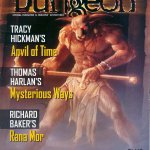
Remember when Dungeons & Dragons magazines came with actual monsters you could punch out and throw onto the gaming table? Well, Dungeon Magazine issue 86 certainly does!
Published in 2001, this issue arrived during the early days of D&D’s 3rd Edition, when Wizards of the Coast was breathing new life into the game and Dungeon was still one of the best ways to get your hands on professionally written adventures without shelling out for another hardcover.
Leading the charge was Tracy Hickman’s Anvil of Time, bringing one of Dragonlance’s original creators back to the pages of Dungeon. Alongside it were Thomas Harlan’s Mysterious Ways and Richard Baker’s Rana Mor, offering plenty of opportunities to get your adventuring party into trouble.
But the adventures weren’t the only attraction. This issue also featured the Stormdancers in Rage on the Mount, the mysterious Pharaoh’s Shrine, an adventure design guide, and, perhaps most importantly, 26 D&D monster tokens. Because nothing says old-school tabletop gaming quite like punching cardboard monsters out of a magazine and unleashing them on your unsuspecting players.
There was something special about Dungeon in those days. Before digital marketplaces, virtual tabletops, and endless downloadable adventures, a single magazine could provide an entire month’s worth of gaming material, complete with maps, monsters, and enough inspiration to keep a Dungeon Master busy for weeks.

Saturday Morning Cartoons!
The Pirates of Dark Water (1991) was one of the most ambitious animated series to come out of the early ’90s, and one that deserved a much longer run.
What made the show so memorable was its atmosphere. The bizarre creatures, strange landscapes, grotesque villains, and elaborate world-building gave it a distinctly darker edge than most Saturday morning cartoons. There was something of Heavy Metal, Dungeons & Dragons, and old-fashioned swashbuckling adventure in its DNA.
Unfortunately, the series was cancelled after just 21 episodes, leaving its central quest unresolved. It’s a shame, because the world of Mer had enormous potential, and the show felt like it was only beginning to explore it.
Escape from New York (1981) was one of my favourite movies as a kid, and probably the first genuinely adult film I ever saw. I remember the excitement of watching something so violent, grimy, and unfamiliar. Carpenter perfectly captured the zeitgeist of a city on the brink of collapse, turning the crime, decay, and hopelessness of 1970s New York into a post-apocalyptic nightmare. For me, Kurt Russell’s Snake Plissken was the coolest bastard alive.
Escape from New York: The Game, released by TSR in 1981, was a board game adaptation of John Carpenter’s cult science-fiction action film starring Kurt Russell as Snake Plissken.
Designed for 2 to 4 players, the game takes the film’s basic premise and turns it into a race through the dangerous streets of Manhattan. Players navigate the prison island, contend with its inhabitants and attempt to complete their objectives before their opponents. It’s an interesting departure from the fantasy roleplaying games TSR was best known for, and part of the company’s early experimentation with licensed properties.

Barry E. Jackson, 1981. The one-sheet that sold Escape from New York before a frame of film did.
Painted for John Carpenter’s dystopia and still the coldest movie poster of the decade.

Dragon issue 98, published in June 1985, celebrated the magazine’s ninth anniversary with another packed issue. One of the highlights is Ed Greenwood’s “Nine Hells Revisited,” expanding on the infernal material he had developed in earlier issues. There’s also Len Lakofka on gods and clerics, Roger E. Moore on tailor-made treasure, and “Creative Magic Items” by Kim Mohan, advice for creating magical objects rather than simply pulling them from a table.
The issue wasn’t exclusively AD&D. Douglas Lent’s “Mutant Manual” provides new creatures for Gamma World, while the ARES section covers science-fiction gaming.
The cover is “Algernon,” by @DensLairStudio is great anniversary cover, packed with little details and the sort of treasure pile that makes you wonder how many failed adventuring parties are represented by the equipment scattered around it.

1992 Advanced Dungeons and Dragons Trading Cards 9: Cloaker
Card 9 in TSR’s enormous 750-card 1992 trading card set features the Cloaker, one of D&D’s classic “that harmless object is actually trying to eat you” monsters.
The Cloaker attacks by wrapping itself around its victim and biting them while lashing out at everyone else with its tail.
I love the artwork on this one. Rather than simply looking like a flying cloak, this version is an enormous, grinning subterranean nightmare that looks like it has been waiting patiently for someone to ask, “Is that cloak magical?”


Circus of Fear, written by Rose Estes and published in 1983, was book 10 in TSR’s original Endless Quest series. This time you’re Laela, a young girl whose visit to a travelling circus quickly turns into something considerably stranger when she discovers that the performers and creatures aren’t quite what they seem.
The adventure mixes the familiar D&D world with the slightly creepy atmosphere of an old-fashioned fantasy circus, with branching paths involving magical creatures, suspicious performers and plenty of opportunities to make a disastrous decision. Like the other early Endless Quest books, there are no dice or character statistics, just choices that send you jumping through the book toward one of numerous endings.
The fantastic cover is by Larry Elmore, with interior illustrations by Jim Holloway, giving it two of TSR’s most recognizable artists of the period. Rose Estes was also the driving force behind the early Endless Quest line, writing many of its most memorable books.

Saturday Morning Cartoon:
Highlander: The Animated Series arrived in 1994 and took the mythology of the films somewhere completely unexpected.
Set centuries after a catastrophic meteor strike devastated civilization, it follows young Immortal Quentin MacLeod as he travels a post-apocalyptic world with his mentor Ramirez. His goal is to gather the knowledge of the surviving Immortals and eventually confront Kortan, who has spent centuries hunting them down.
The big twist is the Jettator, an oath taken by the Immortals to preserve humanity’s knowledge and stop fighting one another. Kortan, naturally, has other ideas.
Running for 40 episodes across two seasons from 1994 to 1996, the series feels like Highlander crossed with the post-apocalyptic adventure cartoons of the ’80s and early ’90s. Ruined cities, lost technology, strange tribes and sword fights make it one of the franchise’s weirdest, and most interesting, offshoots.
Back when MTV made room for some seriously strange animation, The Maxx arrived on its Oddities strand in 1995. Thirteen short episodes brought Sam Kieth’s work to television with its jagged edges intact.
The visual approach still stands out. Comic panels spring into motion, heavy shadows swallow the screen, and hand-drawn animation collides with CGI and live-action footage. Those shifts give the whole thing an unstable, dreamlike quality perfectly suited to the material.
The Maxx (Image Comics, 1993–1998)
Sam Kieth’s The Maxx ran for 35 issues, with William Messner-Loebs providing dialogue for much of the early run. Its purple hero certainly looked at home on a 1990s comic rack, though the story took readers into some uncomfortable territory.
Maxx lives on the streets, where social worker Julie Winters looks out for him. In the dream world of the Outback, he sees himself as the protector of the Jungle Queen. The connection between these lives drives a story about trauma and the ways people retreat from it.
Kieth’s art makes the book. His characters seem to bulge out of their panels, while a shift in drawing style can send a scene straight into nightmare. The 1995 MTV adaptation captured much of that look, with Kieth contributing artwork himself.
