

An IT Partner Where Every Interaction Matters
North America
Joined March 2011
- Tweets3.2K
- Following273
- Followers318
- Likes108




If you’re running anything for Cybersecurity Awareness Month, KnowBe4’s free 2026 kit is worth a look. It’s organized into four weekly themes: phishing and social engineering, AI safety and deepfakes, data security and passwords, and incident reporting. It comes with training videos, interactive modules and a weekly planner.
Check it out: hubs.ly/Q04BDZYm0

In regulated industries, your cloud architecture is part of your compliance controls.
Identity management, audit trails, network segmentation, data residency and recovery all need to be designed in from the start. Adding them after a migration is slower, costlier and harder to prove to auditors.
Building them into the architecture makes compliance part of how the environment runs, not a separate project.
See how we design and manage cloud environments for regulated organizations:: hubs.ly/Q04BfXzk0

Which IT skills should be permanent on your team, and which do you only need for a set period?
It’s a key question when planning for the year ahead. Alba Garza, our VP of Professional Services, shares six signs your IT workforce model needs to change.
One example: the real cost of an open role often isn’t how long it takes to fill. It’s the work that gets put off while it stays open. Each sign comes with a question to test against your own team.
Read Alba’s full piece: hubs.ly/Q04BfWJv0
#ITLeadership #WorkforcePlanning
Working with several IT providers? Watch for the coordination work it puts on your internal team.
When infrastructure, applications, the service desk and security each sit with a different vendor, someone has to connect them. Too often that becomes your IT team, chasing handoffs and escalations instead of working on priorities.
A managed services model with clear ownership across service areas takes that integration work off your team's plate. See how we bring IT services together under one accountable model:: hubs.ly/Q04BfV5K0

Running cloud infrastructure in a regulated industry means answering to two audiences: your architecture review, and your auditor.
A provider’s compliance attestation covers the provider. Your configuration, your access model and your monitoring stay yours.
Josh Mahar, VP of Cloud, Infrastructure and Security, has written a guide to the decisions that boundary forces. Giving every requirement a control owner, an evidence source and a retention period. Establishing identity, networking, logging and backup before any workload arrives. Enforcing approved configurations in the pipeline so governance does not quietly drift.
Written for healthcare, financial services, and anywhere sign-off comes from legal and risk as well as IT.
Read the full piece: hubs.ly/Q04B3hrr0
#CloudArchitecture #RegulatedIndustries #CloudGovernance

To our colleagues, clients and partners in Canada: Happy Thanksgiving 🍁 Enjoy the long weekend with family and friends!

At Buchanan, Community Matters is more than something we say—it’s about showing up, giving back and supporting the communities where we live and work.” – LaRessa Cox, our VP of Marketing
Last Saturday, that meant breakfast duty at the Mary Kay Ash Foundation’s 22nd Annual #MK5K, where we were proud to be a Diamond sponsor.
Read the full press release: hubs.ly/Q04zBlvv0
If "other" is the biggest category in your help desk, that's a problem. Our COO Steve Sweett shared that advice with IT Brew in a new piece on how help desk data can reveal larger tech-stack issues.
Well-defined categories like password resets, device failures, and Wi-Fi outages make it possible to spot trends and dig into root causes. Broad buckets like "Microsoft Office issue" or "other" hide them.
The full article also covers tracking volume, sentiment, and seasonality, and how ticket patterns can point to processes ready for automation. Read the article: hubs.ly/Q04zr6W60
How often does your team revisit its ticket categories?
For the 22nd year, our team was back in Addison on Saturday for the MK5K, supporting the Mary Kay Ash Foundation.
The Foundation funds research into cancers affecting women and supports survivors of domestic violence. Since 1996 it has contributed more than $98 million to that work.
Our people were back on breakfast duty, cooking for runners and handing out giveaways all morning. Thank you to everyone who ran, walked, volunteered and donated, and to the Mary Kay Ash Foundation for another great morning.
October is both Breast Cancer Awareness Month and Domestic Violence Awareness Month. If you'd like to support the Foundation's work, you can donate here: hubs.ly/Q04zfkKd0
#MK5K #GivingBack #CommunityMatters


AI raises the cost of weak knowledge because a problem that once affected one analyst can now be repeated automatically across many interactions. The intelligence layer has to be trustworthy before the interface sitting on top of it can be trusted.
That is why we see knowledge management becoming more important—not less—as ITSM adopts more AI. Before scaling service automation, we want to know whether the underlying knowledge is current, governed, reusable, permissioned correctly, and connected to the workflows where it will be consumed.
Read more: hubs.ly/Q04z1rQZ0

Oracle EBS can remain business-critical long after the support model around it stops being sustainable.
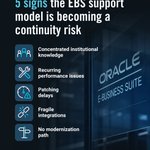
Five warning signs we watch for:
- Critical knowledge is concentrated in one or two people.
- Patching and maintenance are continually deferred.
- Performance issues recur without root-cause remediation.
- Integrations have become fragile or poorly documented.
- There is no clear modernization path, even if modernization is years away.
None of these automatically means EBS should be outsourced. They do mean the operating model deserves scrutiny. The question is whether the organization has enough depth, documentation, coverage, and engineering capacity to support the platform reliably without creating a growing dependency on individual people or reactive work.
For mature enterprise applications, support strategy is part of continuity planning.
The longer the platform remains important to the business, the more deliberate that strategy needs to be.

Plenty of organizations have invested in AI models, vector databases and retrieval pipelines, only to find their answers are capped by what was ever documented.
Knowledge capture is the step most AI programs skip. ECI Research's analysts argue it's a prerequisite for AI readiness, not a soft cultural project. They expect it to become a formal line item in AI readiness plans within the next 12 to 24 months.
The practical starting point is to find where expertise sits with one or two people and get it documented before anything gets built on top of it. Our COO Stephen Sweett's view on why this comes first is in the analysis from Paul Nashawaty and Samantha Weston.
Read here: hubs.ly/Q04yDBxP0
#AI #KnowledgeManagement #ITLeadership

Ten years. Ten HDI Pinnacle of Excellence Awards. 🎉 Congratulations to our Support Center team, who have kept 100% of Buchanan's support staff HDI certified for the 10th consecutive year and extended our HDI team certification streak to 13 years.
Keeping every certification current, year after year, takes real commitment from everyone on the team, and we don't take it for granted. Thank you to every analyst, lead and manager who made this happen, and to HDI for the recognition.
Full press release: Read the full release, including a word from Thomas Nieuwhof and our CEO, Mike Werblun:

Meta is reportedly building an AI "second brain" to capture what its employees know. Most organizations don't have Meta's resources, but they face the same challenge: critical knowledge that sits with just a few people.
In a new Efficiently Connected analysis, ECI Research looks at why knowledge capture is a foundational AI use case, with perspective from our COO Stephen Sweett.
hubs.ly/Q04ykcqJ0
#AI #KnowledgeManagement #EnterpriseAI #AIReadiness #ITLeadership

Outsourcing Oracle EBS support won't make you more compliant. It won't make you less compliant either. What decides it is the controls on both sides, who's responsible for what, and how well each party does its part.
So before you sign, look closely at the provider's privileged-access controls, incident response, evidence retention, data residency, subcontractor access, and any independent assurance reports. Bring your legal, audit and security teams in early. Be wary of anyone who says a service guarantees SOX compliance. The responsibility stays with you. A good partner makes it easier to carry.
Compliance is one of nine factors in our guide to deciding whether outsourcing EBS support is right for you, along with cost, coverage, SLAs and keeping control. Read more: hubs.ly/Q04ydF2B0
#OracleEBS #ERP

Go-live is a milestone, not the finish line for IT service management. Once the platform is in place, the harder question becomes: who owns how it operates over time?
Workflows need to evolve. Service catalogs need governance. Knowledge becomes outdated. Reporting needs interpretation. Automation needs maintenance. Processes that worked at implementation may no longer reflect how the business operates six or twelve months later.
Without clear ownership, the platform may continue running while the service management model around it gradually loses effectiveness. That ownership can sit internally, be shared through a co-managed model, or be fully managed. The structure can vary.
What matters is that responsibility for administration, governance, measurement, and continual improvement is clear. More on our approach to IT service management: hubs.ly/Q04y9yTl0
#ITServiceManagement #ServiceManagement #ITOperations


Service automation creates value when it removes appropriate work from the queue. At Humber College, a chatbot resolved 35% of tickets, reduced digital ticket cost 67% and contributed to 25% overall savings in month one.
Those results came from applying automation to defined service workflows where the outcome could be measured. That is an important distinction.
We do not think every support interaction should be automated.
The better target is high-volume, repeatable work where automation can improve speed and economics without introducing unnecessary complexity or risk.
Start with a bounded use case. Measure it. Improve it. Then expand. More on the case study: hubs.ly/Q04y59ZY0
Application performance stops being an IT metric when it affects a customer’s ability to complete a transaction. For a leading electronics reseller, slow ERP workflows were creating long planning cycles, browser timeouts, and significant order abandonment. After performance optimization, the organization achieved:
- An 80% reduction in planning-cycle time
- 40% faster order booking
- Order abandonment reduced from 45% to less than 1%
The technical work mattered because of what sat on top of it: revenue-generating business processes. That is why we treat application performance as more than CPU, memory, query time, or uptime. Those measurements help us find the constraint. The business process tells us why fixing it matters.
When applications support ordering, invoicing, manufacturing, planning, or customer interaction, performance engineering can have a direct relationship to business output.
Full story: hubs.ly/Q04x-Q0Y0

An application can be available and still be failing the business process it supports. For one electronics reseller, a manufacturing planning cycle took more than 10 hours, while slow order booking created browser timeouts and contributed to a 45% order-abandonment rate.
After performance optimization:
- Planning-cycle time decreased by 80%
- Order booking improved by 40%
- Order abandonment fell from 45% to less than 1%
That is why application performance should not be measured only through infrastructure and system-health metrics. When the application sits inside ordering, planning, invoicing, manufacturing, or another critical workflow, the business transaction itself is part of the performance measure.
The question is not only, “Is the application running?” It is, “Can the business process run the way it needs to?”
Full story: hubs.ly/Q04xN1vC0
#ApplicationPerformance #EnterpriseApplications #Oracle


The most useful knowledge management metrics are diagnostic, not just descriptive.
If knowledge reuse is rising but first-contact resolution is flat, that can signal a gap between finding content and being able to act on it.
If first-contact resolution is strong overall but varies by agent, the variation may point to inconsistent knowledge use, training, or differences in case complexity.
If self-service usage is high but escalations remain high, usage alone may be overstating the value of the self-service experience.
The point is not to track more metrics. It is to read them together and use the patterns to identify where the knowledge program needs attention. More on rethinking knowledge management in modern information technology service management: hubs.ly/Q04xMKbF0
#KnowledgeManagement #ITServiceManagement
