


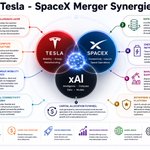


The Tesla roadster reveal is the signal from Elon of a coming merger IMHO. The timing of the demonstration was used as an example of the synergies a combined Tesla SpaceX merger could produce when Elon has two world class engineering teams working side by side.
These are the types of synergies that cant be accounted for in a merger model. All it takes to understand is watching that video.
The timing window for a merger is open, we are ready @elonmusk

Bruno's retweeted
Getting mergers to the tape is simple at a high level, but it’s the details that make them so complicated.
Ultimately, only two things are needed: desire and synergies/accretion.
Elon’s desire has been publicly expressed. Shareholder desire, however, is more fractured. For SpaceX holders, they won’t have much of a say given that the company is controlled. Tesla shareholders, on the other hand, will likely want a premium in return for the perception that Tesla’s product portfolio is further along in generating FCF than SpaceX. Whether that perception is right or wrong is up for debate, but it doesn’t really matter, it’s the perception that drives the vote.
For the Tesla board, the challenge is finding the right balance between the premium being paid and effectively “selling the sizzle” around the strategic benefits of the merger. One of the biggest factors in that perception will be the reaction in SpaceX’s stock in the days leading up to the vote, which will, in turn, influence the value of Tesla stock.
Arbs will buy tesla and short SpaceX to establish the spread, so there will need to be an investor base willing to absorb that supply. I’m sure the board would prefer not to have the vote coincide with significant lockup expirations or heavy arb shorting pressure if they can avoid it.
Regardless, votes rarely fail, and I don’t expect this one to be any different.
As for the synergies, I put together a chart recently that I posted. If you can’t see the value, then you probably don’t understand what Elon is attempting to accomplish.
There’s no reason to rehash it here the quantitative and qualitative synergies are, in my mind, greater than those of any transaction ever announced, and by a very wide margin.
Beyond that, it’s really about regulatory approval. Without getting into a political debate, it’s reasonable to say that Elon is unlikely to have a better regulatory environment for clearing this deal than under the current administration.
My best guess is that they would want to give themselves a walk date on the merger before the 2028 presidential election, so the window is open and the clock is ticking.
Exciting times to be alive and invested in Tesla.
Bruno's retweeted
And every once in a while, a great investment opportunity aligns with a product and company you genuinely love.
Gary, I’m sure, is a nice guy. Yes, I’m trying to soften the blow. But I think he fundamentally misunderstands how Tesla should be valued (DCF) and the the complexity of competing with what Tesla is creating in physical Ai….the moat is real.
On Tesla’s valuation, I cannot emphasize this enough: physical AI, robotaxis and Optimus is still in its infancy. In my view, no U.S. company is better positioned to capitalize on both. The valuation will reflect the probability of peoples perception of if and when Tesla successfully scales these products, I expect the resulting free cash flows to be enormous.
My argument is that Wall Street still assigns too low a probability to that outcome for those potential cash flows to be adequately reflected in the stock price. The disagreement is not simply about a valuation multiple.
So you ask (or perhaps you don’t) “Bruno, what needs to happen for that to change?”
Confidence in scaling. Confidence in the TAM. Confidence in margins. Confidence in the moat.
That is a lot to establish, and none of it is simple. But Tesla is chipping away at each piece.
Scaling
The Cybercab line is ramping, and the Optimus facility is taking shape in front of our eyes. Thank you, Joe T, for the eyes in the sky.
Building production capacity is not the same as proving successful deployment at scale, but it is a necessary step and tangible progress.
The addressable market
The magnitude remains to be proven, but the underlying logic is the part I find least controversial: make transportation meaningfully cheaper and more convenient, and demand should expand.
The opportunity is not simply taking market share from existing rideshare operators. It is capturing miles people currently drive in their own cars.
Even a move from 1% to 5% of total miles traveled would represent an enormous change. Tesla does not need everyone to abandon car ownership for this market to become massive.
The margin profile
This is where we still need much more disclosure and will get it over time. I have built a robotaxi financial model, but it necessarily contains a lot of assumptions.
Cybercab was designed from the ground up around efficiency, and Tesla has demonstrated its ability to reduce manufacturing costs and generate strong automotive margins.
A robotaxi business that could eventually produce 40–50% margins is a fundamentally different proposition from a car business earning mid-teens margins. Those economics still need to be demonstrated.
The moat
This is the piece I have the most conviction in and where people like Gary just don’t get it.
Tesla brings together manufacturing, AI, vehicle engineering, and energy expertise. The advantage is not any one of those capabilities in isolation. It is how they work together to reduce the cost of delivering an autonomous mile.
The moat I see is the potential to price transportation materially below competitors while still earning attractive returns. Building a robotaxi is one challenge. Competing with that integrated cost structure at scale is another.
I am not good enough to predict the month when the market will start assigning substantially more value to all of this. But I do not need to call the exact month to own the investment.
I sleep well because I believe we are on the right path and still in the early innings of a multiyear opportunity that could be extremely lucrative.
Has it taken longer than expected? Absolutely. Something this ambitious was never going to be quick or easy.
In the meantime, I own a stake in one of the coolest companies ever created.
Bruno's retweeted
Waymo isn’t leaving Austin anytime soon but they are irrelevant. Alphabet can keep running it at a loss for as long as it wants until they figure out some niche to pivot into. Management scrambled to try and get ahead and establish themselves in numerous cities over the past year but it was nothing more than in the hopes that Tesla had a significant setback which has yet to happen. Tesla has been slow yes but methodical, cautious and will be ultimately deadly to all rideshare.
Alphabet is a great company but Waymo which started as a skunkworks project never had the ability to truly scale. There are so many pieces to the puzzle of offering a sub $1 mile robotaxi profitably. It has always only been Tesla in the US that has the manufacturing, energy and autonomy pieces to make this a reality.
The debate is over, it will take Tesla 2 years to massively scale within the US (depends on your definition of massive) but it’s finally happening.

Bruno's retweeted
“Reach your own independent conclusions on investments. A decision to buy or sell a stock should be driven by objective analysis. Avoid the opinions of people that have no clue what they are talking about and are emotionally invested in the outcome” - Bruno
Ive been doing this for 27 years and have been humbled by stocks many times. I also understand not everyone has the means to hire industry experts and knows how to financially model, but at a minimum make sure the people you listen to have experience. People on X that throw out crazy price targets and are unwilling to share their research and financial analysis to defend that thesis should be disregarded.
Bruno's retweeted
I’m not Grok… but I hope you don’t mind me adding a few points.
Shareholder votes rarely fail because merger-arbitrage funds typically own 25–30% of the target by the time the vote occurs, creating a large and generally reliable approval bloc. That normal playbook may be far less powerful here. Given Tesla’s enormous size, arbs may only be able to accumulate 2.5–5%.
That makes SpaceX’s stock reaction the real wildcard. Tesla shareholders’ perception of the transaction heading into the vote will depend heavily on how SpaceX trades following the announcement.
The boards have two broad paths:
1.Give Tesla shareholders 55–60% of the combined company.
This would improve Tesla’s headline economics and likely increase the odds of shareholder approval, but it risks SpaceX shares being punished for the dilution. The SpaceX board could partly justify the premium by arguing that Elon’s voting power would still leave the SpaceX side with effective control despite Tesla shareholders receiving the greater economic interest.
2.Structure a true 50/50 merger of equals.
If the market embraces the synergies and SpaceX shares rally, that would increase the implied value received by Tesla shareholders and could pull Tesla higher ahead of the vote.
Not sure which path I would recommend, but with the primary objective maximizing the probability of Tesla shareholder approval, option one probably has the better odds.
Remember SpaceX investors have no say in the matter other than expressing their opinion through the stock price unless the board in the highly unlikely scenario conditioned the transaction on majority-of-the-minority approval.
Bruno's retweeted
I’m pretty confident Elon does not view a merger as a “bailout” of Tesla shareholders.
There are people who have followed him longer than I have and understand his roadmap in much greater depth. @TeslaBoomerMama is far more qualified to opine on that.
But based on everything I’ve read in his biographies and heard in interviews, Elon’s decisions are ultimately driven by a much broader vision for advancing humanity. Each one of his companies fits an important role in accomplishing this.
As Tesla and SpaceX become increasingly intertwined, keeping them separate eventually creates unnecessary friction with decisions over talent, technology and most importantly Elon’s attention.
If his broader vision succeeds, significant further wealth creation for shareholders will hopefully follow. But I don’t believe that is the reason he would bring the companies together, it would be the result.
Bruno's retweeted
Completely fair question and I have no reason to be disingenuous. Just one man doing this a long time with a strong opinion. But and Im not suggesting you are doing this, never take one persons opinion to form your thesis.
The fact is no matter what people say, automotive sales alone even with fully unsupervised FSD will never support a multi-trillion-dollar valuation. We all know the future lies in robotaxi and optimus
In order for this to work their are massive long term capital investments required, MUCH bigger than Tesla has laid out. Terrafab is essential to the long term security of Tesla and that will take multiples of initial estimates. In addition Grok will be the brains of so many elements of Tesla products in the future.
The real opportunity lies in building products and platforms with unprecedented TAM’s and MOAT’s The value isn’t in any single business it’s in the ecosystem. Each of these businesses will drive massive FCF at different times to sustain the absurd amount of capex need to build out terrafab, optimus, robotaxi, Xai and orbital datacenters.
As that synergy chart illustrates, the overlap between Tesla, SpaceX, xAI, Starlink, Optimus, and the broader technology stack is not a coincidence.
Elon is the architect of that ecosystem. While major partnerships could accomplish some of the same objectives, there may come a point where the businesses become so operationally and strategically intertwined that a combination becomes the most logical structure.
Could that happen years from now? Sure in theory but regulatory considerations also matter. And there will never be a more favorable approval environment than this moment right now.
Bruno's retweeted
I think we need to separate the business lines that matter in the near term from the longer-duration opportunities. Both Tesla and SpaceX are somewhere in the $20–25B range of expected EBITDA for 2027.
I know this remains a point of contention, but Robotaxi whether intentionally slow-played or simply delayed by the realities of scaling has now reached a point where meaningful profitability likely doesn’t begin until 2028.
Robotaxi and Starlink both address enormous TAMs. Starlink is obviously much further along today and deserves a lower execution discount, while Robotaxi remains more dependent on successful scaling. But over a multi-year merger valuation framework, I think the long-duration upside of the two businesses can reasonably offset a meaningful portion of each other.
Optimus versus orbital data centers is different. I would give Optimus considerably more probability-weighted value today. Both opportunities could ultimately be enormous, but Optimus is clearly further along the commercialization curve and more realistic in the near to medium term.
Where it gets complicated is the exchange ratio. There is a point where calling this a “merger of equals” while giving Tesla shareholders 55–60% of the combined company’s economics starts to look more like financial engineering. If Tesla shareholders also receive a majority of the voting power, it becomes increasingly difficult from an accounting perspective to characterize SpaceX as the acquirer. Economic ownership and voting control aren’t necessarily the same thing, but at 60/40 the substance of the transaction begins to matter much more than the label attached to it.
The other issue I don’t fully understand is the potential challenge from SpaceX shareholders. Dilution by itself isn’t the issue if SpaceX receives equivalent value, issuing shares isn’t economically dilutive. The question is whether SpaceX could IPO around a $1.75T valuation and then, shortly thereafter, issue an enormous amount of equity to acquire Tesla at a substantial premium, particularly given the obvious conflicts created by Elon being on both sides of the transaction.
At some exchange ratio, the transaction stops looking like SpaceX acquiring Tesla at a premium and starts looking economically like Tesla shareholders acquiring a controlling interest in the combined enterprise. Where exactly that line sits is debatable, but I think 60/40 is clearly getting into that territory.
Full disclosure: I don’t own SpaceX, so I’d obviously be more than happy to see Tesla receive a large premium.
Regardless this is a highly complicated transaction but nothing worthwhile is ever easy!
Bruno's retweeted
The bulls and bears of Wall Street are on vacation……it’s August.
For now, the stock is basically in a holding pattern, with a mild correlation to SpaceX, until one of two things happens, in order of probability:
1.A merger happens.
2.Robotaxi begins scaling at a rate that actually matters.
Keep the faith people.
The available borrow on SpaceX should increase meaningfully over the next 1–3 days as newly unlocked shares clear through the system.
I know this isn’t what many people want to hear, but I actually think this is a healthy place for the stock to be, at least for now. Shorts become less incentivized to press their bets as borrow becomes more available, while many of the newly unlocked shareholders are likely under less pressure to sell at current prices.
More importantly, the window for a merger is now open.
I realize some investors would be disappointed by a merger of equals at current valuations. But it’s also important to step back and look at the bigger picture. The combined pro forma company would be an absolute powerhouse, with multiple world-class businesses, significant strategic synergies, and a long runway for growth.
Is Tesla better off as part of a combined company with SpaceX? In my view, the answer is a clear yes

Bruno's retweeted
As part of any merger process, a board and its advisors evaluate a wide range of potential remedies to secure regulatory approval, particularly in jurisdictions that could present obstacles.
The language in the WSJ story suggests it was sourced from multiple individuals, making it unlikely that the reporting is entirely inaccurate. When Elon calls it “fake news,” that doesn’t necessarily mean the board never evaluated a sale or spin-off. It may simply mean that it isn’t the path they’re currently pursuing.
They could have concluded that a stronger ring-fence structure where the China business operates with meaningful independence in practice, while remaining part of the combined company legally is sufficient to satisfy Xi and Chinese regulators.
Nothing profound in my views on Tesla but I’ll tell you what, the market decided today that capex is evil. Google was in the same boat, just with a lot more FCF to support it. Nothing Elon could have said or done would have prevented this reaction.
The selling also felt like pure hate selling. I get the frustration, the stock has underperformed all year, but I’m not sure people even know what they’re angry about beyond that. Last quarter’s margin improvement was largely a one-time event, and capex is going to remain massive but that was all known. But it’s hard to overstate how logical each of these investments is.
I also understand Elon’s caution around scaling robotaxi. The honest truth is that whether Tesla has 5,000 or 50,000 robotaxis by year-end, neither will meaningfully affect this year’s earnings. In his mind, there’s no reason to rush it, they just need to take the time to get it right.
Im never one to express a short term view on stocks (just too hard) but their was too much emotion tied to todays selling. It may take some time to clean through some of the leverage exposure but nothing has changed on the horizon. Robotaxi will still scale over the coming year, car sales will matter less, energy will continue to be chunky and Optimus is going to take longer than we all hope for.
Keep the faith
*BURRY SAYS HE SHORTED TESLA, NVIDIA AND APPLIED MATERIALS (Bloomberg)
This is going to be painful for Burry.. really painful.
Bruno's retweeted
@elonmusk @Tesla @SpaceX
Happy birthday Elon. Just a hunch, but your biggest accomplishments for humanity are still ahead of you.
Age 24: Co-founded Zip2.
Age 28: Founded X.com, which became PayPal.
Age 31: Founded SpaceX, setting out to make humanity multiplanetary.
Age 33: Became chairman of Tesla, betting on electric cars before the world was ready.
Age 37: The original Roadster entered production, and SpaceX's Falcon 1 became the first privately built liquid-fueled rocket to reach orbit.
Age 39: Falcon 9 flew for the first time.
Age 41: SpaceX's Dragon became the first commercial spacecraft to reach the International Space Station, and launch of Model S.
Age 44: The Model X arrived with its falcon-wing doors, co-founded OpenAI, and SpaceX landed an orbital-class booster for the first time.
Age 45: Founded Neuralink and The Boring Company.
Age 46: Launched the Model 3, which went on to become the best-selling electric car of all time.
Age 47: Falcon Heavy's maiden flight made it the most powerful operational rocket in the world.
Age 49: A landmark year. The Model Y arrived (now one of the best-selling vehicles on Earth), Tesla became the world's most valuable automaker, and Crew Dragon flew NASA astronauts to orbit
Age 51: acquired Twitter, now X.
Age 52: Cybertruck deliveries began, and he founded xAI and launched Grok.
Age 53: SpaceX caught a returning Super Heavy booster with the launch tower's "chopstick" arms on the first attempt, and Polaris Dawn carried out the first commercial spacewalk in history.
Ages 54 to 55: And the pace only quickens. Robotaxis hitting the road, cybercab scaling, tesla semi scaling, spacex ipo and the year isnt over yet.

Bruno's retweeted
In this environment or frankly any environment why would anyone choose to invest in Bitcoin, or in a company whose core strategy is simply buying Bitcoin?
No one has any real visibility into where Bitcoin will be in six months, let alone six years. It has no underlying assets, produces no earnings, and generates no cash flow. Its value is entirely dependent on what the next buyer is willing to pay.
We are living through one of the greatest innovation cycles of our lifetime… AI, robotics, energy, biotech, autonomy, space and yet people are choosing to allocate capital to something with purely arbitrary value instead of businesses building real products, solving real problems, and compounding real earnings…