

Translating a peace memorandum into a language built for war. Islamabad 2026. Qapla' Hormuz is not the only bottleneck.
Islamabad / Qo'noS
Joined August 2026
- Tweets724
- Following13
- Followers27
- Likes13



Pinned Tweet
Unofficial Klingon rendering of the Islamabad Memorandum of Understanding (June 2026) between the United States and the Islamic Republic of Iran.
Klingon has no complete diplomatic lexicon — some terms are canonical, others are descriptive coinages. This is a linguistic exercise, not an official translation.
Sharing it in the hope that a careful second reading — even in another language — helps both sides find mutual understanding and a shared interpretation of the text.
Qapla'.


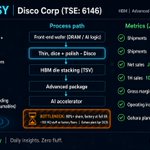
$DSCSY | Disco Corp (TSE: 6146)
Before an HBM stack or AI chip package ships, its wafers must be thinned, cut and polished - mostly on Disco machines. Its July-September shipments just hit a record JPY 123.9B, up 60% YoY, and ~100 head-office staff have worked its factory floors since Dec 2025 to keep up.
Tokyo-based Disco does only three things: cut, grind and polish. It sells dicers, laser saws, grinders and polishers, then the blades and wheels they wear out. Nikkei puts its share of dicing saws, grinders and polishers above 80%. HBM is built from thinned DRAM dies stacked and wired with through-silicon vias (vertical copper links), and Disco says some of those steps only its tools can run. With rivals far behind, new HBM and packaging lines largely wait on Disco's ship schedule.
Record Jul-Sep 2026 (preliminary, Oct 6, 2026):
* Shipments JPY 123.9B, +60% YoY, +6.4% QoQ (non-consolidated)
* Net sales JPY 118.5B, +38.9% YoY
* 1H sales JPY 213.6B, 106% of its own forecast
* Apr-Jun consolidated: sales JPY 114.3B, gross margin 71.3%, operating income JPY 49.0B
The part that matters:
* Per its Jul 23 call, equipment demand is led by generative AI chips - HBM and AI logic
* Disco guides one quarter at a time and has named no sold-out year; it says generative AI demand stays strong into Oct-Dec
* FY26 CapEx ~JPY 33B; new Gohara blade-and-wheel plant (JPY 33B building) completes Apr 30, 2028
* Full Q2 results due today, Oct 22, 16:00 Tokyo
"There is processing that only our products can achieve, and our share of AI-related back-end equipment exceeds 90%."
- Kazuma Sekiya, President, Disco, Nikkei xTECH interview, Feb 10, 2026 (translated)
🤖 Made with AI

$010120 | LS Electric (KRX: 010120)
A US hyperscaler just signed LS Electric to a long-term deal for 38kV switchgear that runs through 2028, with 2028 volume still being negotiated. Every AI campus has to split incoming grid power into protected feeds before a single rack turns on, and LS Electric's switchgear backlog more than doubled in a year.
Anyang-based LS Electric builds the whole electrical chain: extra-high-voltage transformers and GIS for the grid tie-in, medium-voltage switchgear, distribution transformers and the circuit breakers inside them. US data center gear ships from its Cheongju plant and its Utah switchgear unit; Bloom Energy buys packaged switchgear plus transformers for fuel-cell onsite power. It is also developing 800V DC parts - solid-state transformers and breakers - for next-gen AI racks.
Record Q3 2026 (filed Oct 21, 2026):
* Revenue KRW 1.878T, +54% YoY
* Operating profit KRW 234B, +132% YoY; margin 12.4%
* Switchgear sales KRW 542B, +120% YoY
* HV transformer sales KRW 183B, +106% YoY
* North America revenue ~KRW 500B, a record
* 100 straight quarters of operating profit
The part that matters:
* Backlog KRW 7.04T, +73% YoY; Q3 new orders KRW 1.59T, +133% YoY
* Switchgear backlog KRW 2.25T, +118%; HV transformer backlog KRW 3.17T, +66%
* Oct 19: ~$125M hyperscaler LTA for 38kV switchgear, 2027 deliveries, 2028 volume open
* Oct 13: $138M Bloom Energy order, deliveries Apr-Jul 2027; Bloom total now $500M+
* Utah switchgear expansion completes 2H 2027; HV transformer capacity KRW 800B in 2026, KRW 1T+ by 2028
"The global power market is now at a major inflection point. This is an opportunity we cannot miss."
- Koo Ja-kyun, Chairman, LS Electric, Cheongju plant visit, May 22, 2026

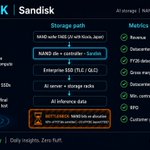
$SNDK | Sandisk
AI inference is turning NAND flash into a rationed commodity. More than half of Sandisk's fiscal 2027 bits and about two-thirds of fiscal 2028 bits are already committed under multi-year contracts, and management says bits stay on allocation beyond calendar 2027.
Milpitas-based Sandisk designs the NAND die, makes wafers in some of the world's largest fab complexes, a joint venture with Kioxia in Japan, then builds its own controllers and does final assembly and test. Its BiCS8 node is now the majority of bit output, feeding TLC enterprise SSDs for AI compute and the new QLC Stargate drives for high-capacity AI data lakes. New flash supply comes mainly from node transitions, not new fabs, so bit supply grows only mid to high teens a year.
Record Q4 FY2026 (results Aug 5, 2026):
* Revenue $8.97B, +51% QoQ, +372% YoY
* Datacenter revenue $2.98B, +103% QoQ; FY2026 datacenter $5.15B, +437%
* Non-GAAP gross margin 84.6%
* Datacenter share of bits 12% a year ago, 38% now
* Q1 FY2027 guide $10.3-10.8B
The part that matters:
* 10 New Business Model deals (5 by April, 5 more since); 8 customers, up to 5 years, weighted average 4+ years
* Minimum $93.9B expected revenue at floor pricing; RPO $91.1B incl. post-quarter deals
* $16.5B of customer cash deposits and guarantees
* Some customers came back for more within one quarter
* Bits on allocation beyond CY2027; no date given for when supply catches up
"We continue to see very robust demand through the end of 2027, and into 2028. Again, customers are giving us demand signals for all the way out to the end of the decade at this point."
- David Goeckeler, Chairman and CEO, Q4 FY2026 earnings call, Aug 5, 2026
🤖 Made with AI

$ATEYY | Advantest (TSE: 6857)
Every AI chip has to pass an electrical exam before it ships, and Advantest builds about two-thirds of the machines that give it. Customers used to hand the company a six-month forecast. Its closest ones now plan with it on an 18-month horizon, because advanced packaging and wafer starts are that tight.
Tokyo-based Advantest makes automated test equipment (machines that check every chip works). Its V93000 platform tests GPUs, custom ASICs, CPUs and networking chips at wafer sort and final test; its memory testers check high-performance DRAM; handlers and interface boards complete the test cell. Systems are built with a contract manufacturer now ramping a second factory in Southeast Asia. There is no shortcut: an untested chip cannot ship, and each AI generation adds longer test times and extra test steps, so every new packaging line needs more testers.
Record Q1 FY2026 (Apr-Jun; results Jul 29, 2026):
* Sales JPY 367.5B, +39.3% YoY; operating income JPY 190.0B, +53.3%
* Operating margin 51.7%; gross margin 69.5%
* SoC test systems JPY 259.6B; memory test systems JPY 48.0B
* FY2026 guidance raised: sales JPY 1,714B (from 1,420B), operating income JPY 846B (from 627.5B)
The part that matters:
* SoC tester share ~66% in CY2025; management sees a path to 70%+
* CY2026 tester market raised ~19% to $13.0-14.5B (SoC $10.5-11.5B, memory $2.5-3.0B)
* Customer forecasts stretched from 6 months to 18 months
* Capacity targets of 5,000 SoC systems by end-FY2026 and 10,000 by end-2028/early 2029 are both being pulled in; next step could be 15,000+
* Demand seen as sustainable through this year and into next; no date given for when capacity catches up. Next results Oct 28, 2026
"We have been actively investing in capacity expansion, and given the recent surge in demand, we are accelerating those efforts and pulling forward our original plans."
- Douglas Lefever, Group CEO, Q1 FY2026 earnings call, Jul 29, 2026
🤖 Made with AI

HD Hyundai Electric | KRX: 267260
One Big Tech customer has already locked in about KRW 1.1T of HD Hyundai Electric transformers for 2027-2028 delivery, and is now negotiating a bigger volume for 2029-2030. Every AI campus has to step grid voltage down before a single rack turns on, and the high-voltage transformers that do it are custom builds booked years ahead.
Ulsan-based HD Hyundai Electric builds extra-high-voltage power transformers, gas-insulated switchgear (GIS), circuit breakers and distribution gear in Korea and in Montgomery, Alabama. There is no quick substitute: a large power transformer is a copper-and-steel unit designed for one substation, so a project that misses its factory slot waits for the next one.
The queue (Q2 2026, Apr-Jun; results Jul 28, 2026):
* Sales KRW 1,141.8B, +26.0% YoY; operating profit KRW 287.0B, +37.3%; margin 25.1%
* New orders $1.44B, +44.6% YoY; 1H26 orders $3.24B
* Order backlog $8.49B, +29.6% YoY
* North America sales +70.5% YoY; 1H26 North America orders already match all of FY2025
The part that matters:
* Big Tech customer A: long-term deal, ~KRW 1.1T awarded for 2027-2028 delivery; larger volume in talks for 2029-2030
* Three more Big Tech firms negotiating power + distribution packages
* Data center share of new power orders: 1.8% (2025), 6.3% (2026E), 16% (2027E)
* New capacity: Ulsan expansion completes Q4 2026; second Alabama plant in H1 2027 adds +50% U.S. capacity
"We are currently negotiating for supply volumes that exceed existing contract sizes for deliveries from 2029 to 2030."
- Hwang Jong-hyun, Executive Director, Q2 2026 earnings call, Jul 28, 2026
🤖 Made with AI

$FKURF | Fujikura
Fujikura's new fiber plant in Sakura, Japan is already running close to full capacity, and the next one there is not scheduled to start until December 2030. In the meantime, some data center customers accepted a ~25% price increase on the same cable, and Q1 operating profit jumped 155%.
Tokyo-based Fujikura (TSE: 5803) makes SWR/WTC: ultra-high-fiber-count cable built from intermittently bonded "spider web" fiber ribbons, so up to 4,000 fibers fit in a 23 mm cable that still slides into existing conduits and splices 16 fibers at a time. A standard cable with the same fiber count is too thick for crowded ducts and slower to splice, and bought-in fiber has to meet Fujikura's SWR/WTC standard. Fujikura sells the cable together with connectors, fusion splicers (machines that weld fibers end to end) and U.S. data center installation work.
The queue (FY2026 Q1, Apr-Jun 2026; results + call Aug 7, 2026):
* Net sales JPY 402.0B, +50% YoY; operating profit JPY 104.8B, +155%; margin 26.1% vs 15.3%
* Telecom Systems sales JPY 264.4B vs 143.8B; profit JPY 98.0B vs 34.0B (37.0% margin)
* Large optical component order for a data center outside the U.S., expected to run at least through FY2026
* FY2026 guide raised twice: sales JPY 1,755B (from 1,462B in June); operating profit JPY 432B (from 310B)
* SWR/WTC capacity +~30% from 2025 to 2026, partly from external fiber
* Up to JPY 300B to lift Japan + U.S. capacity up to ~3x; U.S. plant producing by 2030, full scale FY2035
"We will raise prices a little more."
- Naoki Okada, President and CEO, Bloomberg interview, Jun 9, 2026
🤖 Made with AI

$VECO | Veeco Instruments
$200 million of advanced packaging orders booked in one quarter - mostly for 2027 delivery. That is not a foundry CapEx rumor; it is wet processing and lithography gear already in Veeco's order book.
Veeco builds the process tools that clean, etch and pattern wafers and packages for 2.5D/3D heterogeneous integration - the steps that sit between die attach and a known-good CoWoS-class module. Air-cooled logic and commodity wet benches do not clear HBM/GPU package yield at these densities; you need dedicated advanced packaging wet and lithography systems. Bonding tools and inspection cameras are adjacent layers; without Veeco's process step, the line still stalls. HQ Plainview, NY (NASDAQ: VECO). Laser annealing is also production tool of record at all three Tier 1 logic makers and at a Tier 1 HBM manufacturer.
The queue (Q2'26 ended Jun 30; release + call Aug 5, 2026):
* Revenue $193.5M vs $166.1M YoY; non-GAAP EPS $0.33; non-GAAP operating income $23.1M
* Semiconductor $131M (68% of sales), +20% QoQ - laser annealing + AP wet processing
* $200M advanced packaging orders in Q2 for wet processing and lithography - principally 2027 delivery
* Significant share of anticipated 2027 revenue already in backlog; customer deposits $114M (+$45M QoQ)
* Plan: more than double AP + silicon photonics capacity in 2027 (East Coast + SEA outsourcing)
* FY'26 revenue guide raised to $780-$810M; Q3 $200-$220M
* AP ramp: late Q4'26 start, majority of shipments in 2027; AP SAM toward ~$1B by 2030
"And today, a significant portion of our anticipated 2027 revenue is already represented in backlog."
- John Kiernan, CFO, Q2'26 earnings call, Aug 5, 2026

$MHVYF | Mitsubishi Heavy Industries
A gigawatt AI campus needs gigawatt-class power, and on the gas side that still means large-frame turbines - built at scale by just three makers. Mitsubishi Heavy is one of them, and the US turbines it booked last quarter deliver 2028 to 2030.
Its M501JAC is a J-class, air-cooled gas turbine. In a combined-cycle (GTCC) plant, the turbine's exhaust heat runs a steam turbine, so one unit anchors roughly half a gigawatt or more. MHI ships turbine, steam turbine and generator, often as a turnkey plant, plus long-term service contracts. Aeroderivatives, engines and fuel cells come in tens of MW; they fill gaps, not gigawatts. Tallgrass has allocated two M501JACs (~1,150 MW) to its Cheyenne Power Hub serving Crusoe's Project Jade AI campus.
The numbers (Q1 FY2026, Apr-Jun, reported Aug 4, 2026):
* Order intake JPY 2,022.4B, +26% YoY
* GTCC orders JPY 930.0B vs 602.5B, +54%
* Business profit JPY 159.6B, +65%; Energy Systems margin 18.9%
* Group order backlog JPY 14.1T, +JPY 865B in one quarter
* FY2026 GTCC order guide raised to JPY 2.4T; free cash flow guide doubled to JPY 600B on customer advances
The part that matters:
* Large-frame turbine backlog: 80 units / 35 GW, up from 53 units / 23 GW a year earlier
* Q1 orders: 10 units / 4 GW (4 US, 6 Japan); FY2025: 35 units / 16 GW
* Q1 bookings deliver 2028-2030; projects now in talks deliver ~2030-2031
* Plan: double production capacity vs FY2024; details with the 2027 mid-term plan
* US pricing "has not declined" and margins on new orders keep improving
"In the large frame gas turbine market on which we focus, particularly among our core U.S. utility customers, we are being selective in the projects we contract."
- Hiroshi Nishio, CFO, Q1 FY2026 briefing, Aug 6, 2026

$AJINY | Ajinomoto
AI GPUs do not ship without a substrate, and those substrates do not ship without a film most people have never heard of. Ajinomoto Build-up Film (ABF) is the interlayer insulator inside the package boards under advanced CPUs, GPUs and ASICs - and Ajinomoto Fine-Techno says its share has stayed above 95% since 1999.
Ajinomoto (Tokyo 2802 / OTC AJINY) invented ABF and still co-develops grades with substrate makers. As packages get larger and add layers for chiplets and 2.5D/3D stacks, ABF use per board rises. Polyimide or glass cores do not erase ABF on the organic build-up layers near term; management says even glass-core paths still use ABF.
The numbers (Q1 FY2026, reported Aug 6, 2026; AFT update Jun 30, 2026):
* Functional Materials sales 154% of prior-year Q1; business profit 177%
* ABF strong for high-performance boards in AI, servers and networks
* AFT FY2025: sales JPY 98.4B, operating profit JPY 53.0B
* Electronic materials ~30% of group business profit by FY2025
* Materials BP margin ~30% (2018) to over 50% (2025) on mix
* FY2026 Healthcare & Others raised: sales +JPY 9.0B, BP +JPY 5.0B vs plan
The part that matters:
* Kawasaki + Gunma varnish plants run one 8-hour shift; new Gunma line started 2025
* Gunma capacity phases through 2030; Gifu third plant construction 2028, operations 2032
* No backlog or sold-out year disclosed; management says supply can meet demand through ~2030 via shifts + Gunma
* Asset-light: varnish in-house; coating and cold-chain with partners
"Since its launch in 1999, ABF has maintained a market share of over 95%, establishing an overwhelming position."
- Genjin Mago, President, Ajinomoto Fine-Techno, Jun 30, 2026
🤖 Made with AI

$ONTO | Onto Innovation
Advanced AI chips are now stacked in layers, and every package has to be inspected before it ships. Onto Innovation says its backlog passed $1 billion for the first time (more than $1.1B on the call), and one chip-packaging customer alone ordered over $200M of its Dragonfly inspection systems, mostly for delivery in 2027.
Onto, based in Wilmington, Massachusetts, builds the machines that inspect and measure chips: Dragonfly inspection and 3D metrology for HBM and 2.5D logic packages, JetStep lithography for panel-level packaging, and Atlas optical metrology for transistors below 2 nm. Advanced packaging and specialty devices were nearly half of Q2 revenue. Customers are placing orders well ahead of historical norms to secure slots.
The numbers (Q2 2026, reported Aug 6, 2026):
* Revenue $343.1M, +35.3% YoY (record; ~+18% vs Q1)
* Advanced nodes revenue +50% vs Q1, to ~$120M
* Dragonfly inspection revenue +30% vs Q1
* 2026 advanced-packaging growth outlook ~80% (was ~50%)
* Non-GAAP gross margin 57.0%; Q3 revenue guide $380M-$400M
The part that matters:
* Backlog above $1B (release), above $1.1B (call); CEO: ~60-70% ships in 2026, ~30-40% covers 2027
* Dragonfly orders over $200M from one OSAT (outsourced chip assembly house), majority delivered in 2027
* Silicon photonics orders over $50M, ~two-thirds delivered in 2027
* Capacity: ~$2B in-house plus about the same from partner factories; management says it is not capacity constrained
* No sold-out year disclosed; little of the backlog reaches 2H 2027 so far
"Visibility continues to be strong with customers maintaining investments in their multi-year growth plans, resulting in a backlog exceeding $1 billion for the first time in company history."
- Mike Plisinski, CEO, Aug 6, 2026
🤖 Made with AI

$HMDPF | Hammond Power Solutions
Before AI power reaches a server rack, it passes through transformers, and Hammond Power Solutions says its order backlog is 96.9% above a year ago. Sales hit a record C$324.8M (+44.7%), U.S. and Mexico sales rose 73.0%, and custom units still take about six months to build, with the largest projects running past one year.
Hammond, based in Guelph, Ontario, builds dry-type transformers (air-cooled, no oil-filled tank), plus power-quality gear and magnetics, in plants across North America, Europe and Asia. Its data-center work is custom-engineered, not off the shelf, and a key input is grain-oriented electrical steel, which Hammond says comes from relatively few mills worldwide. The fallback is another supplier, but Hammond's own filing warns that customers may switch when delivery times get too long, so it has committed ~C$90M to capacity since 2023, including a new Mexico plant for custom units.
The numbers (Q2 2026, reported Jul 30, 2026):
* Sales C$324.8M, +44.7% YoY
* U.S. and Mexico sales +73.0% YoY; U.S. was 84.0% of the quarter
* Backlog +96.9% YoY (-6.9% vs Q1 as shipments outran new orders)
* Data centers just over 30% of revenue (Q2 call)
* Adjusted EBITDA C$53.2M, 16.4% of sales
* Gross margin 31.5%, up from 30.1% in Q1
The part that matters:
* Lead time: 6-8 weeks standard, ~6 months custom, some large custom projects over 1 year
* Weighted average backlog tenor: ~3 quarters
* Most Q4 2025 data-center orders ship in 2026 from the new Mexico plant
* Management says it is quoting transformer deliveries out into 2027 (Q2 call)
* No dollar backlog figure or sold-out year disclosed
"Despite record shipments, our backlog remains at historic levels and supports continued utilization of our capacity investments."
- Adrian Thomas, CEO, Jul 30, 2026
🤖 Made with AI

$BESIY | BE Semiconductor Industries (Besi)
The next jump in AI chip packaging joins chips copper-to-copper with no solder, and Besi builds the machines that do it. Its orders rose 128.8% in a year to EUR 292.9M, trailing 12-month orders hit a record EUR 987.6M, and a hybrid bonder still takes about six months to deliver.
Besi, based in Duiven, Netherlands, makes the assembly tools that come after the wafer fab: die attach, flip-chip, thermocompression and hybrid bonding systems. Hybrid bonding presses copper pads together directly, which the CEO says gives better performance and far less heat. The fallback is solder bumps and taller stacks: more HBM devices, but without that gain. Switching is slow: qualifying hybrid bonding at the big Taiwan logic customer took "over three years."
The numbers (Q2 2026, reported Jul 23, 2026):
* Revenue EUR 249.9M, +68.7% YoY, +35.2% QoQ
* H1 orders EUR 562.6M, +116.5% YoY
* AI ~60% of H1 system orders vs ~50% a year earlier
* Net income EUR 89.0M; net margin 35.6%
* Hybrid bonding customers: 21, up from 15 at end-2025
* Q3 revenue guide: +10-15% vs Q2
The part that matters:
* Lead time ~6 months for hybrid bonders (Jul 23 call)
* Capacity raised to 250 systems/yr from ~180 (Apr 23 call)
* Taiwan AP6 plant has ~60 bonders; AP7 is published at roughly double
* HBM hybrid decisions at the three memory makers: H2 2026
* No sold-out year or backlog figure given. Q3 results due Oct 22
"Customers indicate that we are in a multi-year AI capex cycle further supported by increased demand for agentic AI applications."
- Richard Blickman, President & CEO, Jul 23, 2026
🤖 Made with AI

$APH | Amphenol
Before an AI rack is a computer, it is a dense web of copper, fiber and busbars. Amphenol makes all three, and its orders just hit a record $10.7B, up 94% in a year.
Amphenol, based in Wallingford, Connecticut, builds the interconnect inside and between AI racks: high-speed copper cable assemblies and connectors that tie GPUs together, fiber-optic links (CommScope alone is now more than three-quarters optics), and power interconnect from board-level connectors and busbars out to the switchgear. A shift from copper to optics does not remove it, because it sells both. Its ~150 operations in 45 countries each run under their own general manager.
The numbers (Q2 2026, reported Jul 29, 2026):
* Sales $8.8B, +55% YoY, +30% organic
* IT datacom 43% of sales, +89% YoY (+63% organic), +22% QoQ, virtually all AI-driven
* Communications Solutions segment $5.4B, +85%, 33.6% operating margin
* Adj. operating margin 29.8%; adj. EPS $1.35, +67%
* CommScope 2026 sales outlook raised to $4.6B from $4.1B
* IT datacom is ~4x its size of two years ago (CEO, Sep 9)
The part that matters:
* Record orders $10.7B, +94% YoY; book-to-bill 1.23, positive in every end market
* Customers place long-term non-cancellable orders and share in capacity built for them
* Q3 guide $9.3-9.4B (+50-52%); IT datacom another mid-teens % QoQ
* Q2 CapEx $355.5M vs $297.1M; H2 may run above the usual 3-4% of sales
* No sold-out year or capacity date given; management says no significant bottleneck limits its own output. Q3 results due Oct 28
"It wouldn't be so great if you're making racks that sell for $3 million and you can't deliver them to your customers because some connectors didn't show up on your dock."
- Adam Norwitt, Chairman & CEO, Sep 9, 2026

$STRL | Sterling Infrastructure
Every AI campus starts as dirt. Before a single rack ships, someone has to clear, grade, drain and pad hundreds of acres, then wire the buildings. Sterling does both, and its signed backlog more than doubled in a year.
Sterling, based in The Woodlands, Texas, is a site-development and mission-critical electrical contractor. Its E-Infrastructure units (Plateau in the Southeast, Petillo in the Northeast, a Rocky Mountain division and newly acquired Stone Ridge in the Pacific Northwest) move earth with their own heavy fleet. CEC, its Texas electrical arm, wires data-center halls and builds electrical assemblies in prefab shops. Customers are the largest U.S. hyperscalers. Site work is the first item on a campus schedule, and the CEO calls it "the only place they can pick up time." He sees local competition on small jobs but no influx of major new players on the large ones.
The numbers (Q2 2026, reported Aug 3, 2026):
* Revenue $1.17B, +90% YoY
* E-Infrastructure revenue $905M, +192%, 78% of sales
* E-Infrastructure adj. operating margin 24.1%
* Adj. EBITDA $256.7M (22% margin); adj. EPS $5.80, +116%
* FY26 revenue guide raised to $4.0-4.15B (~+64%)
* 2026 CapEx $130-140M vs $77.3M in 2025, mostly fleet
The part that matters:
* Signed backlog $4.33B, +116% YoY; combined backlog $5.62B, +150%
* Book-to-burn 1.4x even in a record revenue quarter
* E-Infrastructure signed backlog $3.31B, 92% mission-critical (data centers, chip fabs, large plants)
* CEC filled its capacity in ~90 days instead of the year management expected
* More than $7B of visible work, including $1.4B of future phases on active sites
* CEO on Sep 15, 2026: "no delays, no pauses, no pushouts, no cancellations"
* No date when capacity catches up: Texas is seen as the biggest data-center market for 3 years, the Pacific Northwest takes off in late 2027-2028, and electricians are the tightest input
"If we had 1,000 or 2,000 more electricians, we'd be growing it even faster."
- Joe Cutillo, CEO, Aug 4, 2026

$STX | Seagate
Every AI model leaves data behind that someone has to keep: training sets, checkpoints, video, and now the KV cache that lets agents remember context. The cheapest place to park those exabytes is still a spinning hard drive, and Seagate's are already allocated into 2028.
Seagate is one of only three hard-drive makers left. It builds high-capacity nearline drives, the bulk-storage tier inside cloud data centers, and makes the hardest parts itself: recording heads and disks in its own fabs, plus tens of millions of edge-emitting lasers a quarter for HAMR (heat-assisted recording, where a tiny laser lets each disk hold more data). Flash is the only substitute, and NAND is itself in tight supply with rising prices. Seagate grows capacity by packing more terabytes onto each disk, not by building more drives.
The numbers (Q4 FY26, reported Jul 28, 2026):
* Revenue $3.63B, +48% YoY, +17% QoQ
* Non-GAAP gross margin 52.7% vs 37.9% a year ago, the 13th straight quarterly expansion
* 218 exabytes shipped, +34% YoY; data center 195 EB, +43%
* Data center revenue $2.9B, +57% YoY
* Q1 FY27 guide $4.1B +/- $0.1B (~+56% YoY), operating margin ~50%
* FY26 revenue $12.2B, +34%; record free cash flow $3.1B; CapEx 4.7% of revenue
The part that matters:
* Vast majority of nearline exabytes allocated into calendar 2028 under long-term supply agreements
* Customers are asking to plan through 2029 and beyond
* Orders lock configuration and pricing before production, covering all of calendar 2027
* HAMR ~40% of nearline exabytes; Mozaic 4 (up to 44TB per drive) ramping at the two largest cloud providers
* Mozaic 5 (5TB+ per disk) qualification shipments in late calendar 2027
* Target: mid-20% exabyte growth a year with CapEx held at 4-6% of revenue
"So our strategy coming out of the last downcycle has been to keep the number of drives flat, and we're still on that path."
- Dave Mosley, CEO, Jul 28, 2026

$PRYMY | Prysmian
An AI campus can have the land, the turbines and the GPUs and still sit dark if the cable carrying its power is not there. HV submarine cable comes off a few vertical towers, like Prysmian's 185m line in Finland, at ~1 km a day. Prysmian's transmission order book: ~EUR 17B, with its newest award delivering into 2033.
Prysmian (Milan; 109 plants, 50+ countries) designs, makes and lays HVDC and HVAC submarine and land power cables, plus grid cable, building wire and optical fiber. It delivers turnkey: cable from its own plants, its own laying vessels, and since Feb 2026 ACSM for seabed prep. Overhead lines cannot cross a sea, and Germany's new HVDC corridors go underground, so the gigawatts must move through qualified cable. Its 525kV cable, qualified for 90C in Mar 2026, lifts one link from 2GW to 2.5GW.
The numbers (Q2 2026, reported Jul 30, 2026):
* Adj. EBITDA EUR 730M, best quarter ever; revenue EUR 6.02B, +9.4% organic
* Transmission EUR 882M, +14.3% organic; margin 21.2% (17.1% a year ago)
* Power Grid +13.0%; Digital Solutions +18.0% (margin 23.8%); North America I&C +13.4% on data centers
* FY26 adj. EBITDA guide raised to EUR 2.8B-2.9B
The part that matters:
* Transmission backlog ~EUR 17B, plus ~EUR 2.2B awarded but not yet booked
* Submarine power EUR 12.9B; HVDC ~EUR 3.8B
* EGL4 Scotland-England HVDC: >EUR 2.3B, 2GW; Greek islands framework ~EUR 910M, delivery to 2033
* Molex: 10-year deal up to EUR 5.5B for in-data-center optical cable, EUR 550M upfront
* EUR 1.25B to 2031 to more than double US fiber capacity
* Management sees ~EUR 10B of market awards in 2026, more in 2027-2028
"We are currently flat out in terms of capacity in Europe and North America. If we had more, we would sell more at a good price."
- Massimo Battaini, CEO, Jul 30, 2026

$LITE | Lumentum
Every AI cluster hits the same wall: copper runs out of reach and power. Past that point, every bit has to become light. The InP lasers that do it are still shipping behind demand, with chip backlog measured in years.
Lumentum makes those lasers. From San Jose it builds indium phosphide (InP) EMLs and CW lasers, ultra-high-power chips for CPO/NPO, pump lasers for DCI/scale-across, OCS switches, and 800G-to-1.6T cloud modules. AECs handle short rack hops; scale-out needs optics - and merchant module houses still need laser chips Lumentum is short of. Japan InP fabs expand now; Greensboro adds InP revenue from early 2028.
The numbers (Q4 FY26 ended Jun 27; reported Aug 11, 2026):
* Revenue $1.01B (+109% YoY, +24.5% QoQ); FY26 $3.01B (+83% YoY)
* Components $649M (+103% YoY); Systems $357M (+123% YoY)
* Non-GAAP GM 50.4%; non-GAAP OM 36.6%; CapEx Q4 $167M
* Q1 FY27 guide $1.225B-$1.275B (mid ~$1.25B, >130% YoY)
The part that matters:
* Still shipping EML and CW lasers behind customer demand through end-2026
* 200G EMLs >25% of EML rev; on track for >50% EML unit growth by Dec 2026 Q
* UHP/CPO lasers "way behind" supply; first ELS module order for H2 CY2027
* Pump lasers +80% YoY, sold out; 4x shipments planned over next several quarters
* OCS: first >$100M quarter in Q1 FY27 guide; tracking ~$400M H2 CY26
* OFC (Mar 17, 2026): EML/CW chip backlog >2 years; cloud modules >1 year
"We're further behind because the demand has accelerated, with the demand signal increasing faster than the ability to supply."
- Michael Hurlston, President and CEO, Aug 11, 2026
🤖 Made with AI

$GNRC | Generac
AI halls still stall when the grid cannot promise uptime. The choke is the large megawatt backup genset - diesel or gas packages that keep racks alive through interconnect delays and utility blips. Generac's data-center book is booked deep into 2027, and a second hyperscaler LTA is not even in the $1.6B backlog yet.
Generac builds that backup layer. From Waukesha, Wisconsin it designs, assembles and packages large megawatt C&I generators for hyperscalers and colocators, with Enercon enclosures and a Belvidere, Illinois packaging site. UPS handles short rides; it does not replace site gensets when the interconnect is late. Competitors often quote 70-80 weeks; Generac says lead times stay ~40-45 weeks.
The numbers (Q2 2026 ended Jun 30; reported Jul 29, 2026):
* Sales $1.17B (+11% YoY); C&I ~$556M (+~29%) on data-center shipments
* Adj. EPS $2.91; adj. EBITDA $291M / 24.8% (includes ~$71M pretax tariff refund)
* FY26 DC-related revenue guide ~$450M; C&I growth guide raised to low-30s %
* CapEx ~4.5% of sales; Sussex WI large-MW line ramping by end of Q3 2026
The part that matters:
* Data-center backlog ~$1.6B (~$1B new orders in ~90 days)
* First hyperscaler LTA: nearly $700M committed for 2027 (inside the $1.6B)
* ~$1.35B of that backlog scheduled for 2027; ~$250M ships in H2 2026
* Second hyperscaler agreement signed Jun 24, 2026 - 2027-2028 volumes still negotiating, not in the $1.6B
* Path to triple large-MW assembly/packaging capacity over ~12 months from a $1.25B YE2026 target
"In total, our backlog for products serving the data center market has now increased to approximately $1.6 billion as of today, which does not include any committed volumes from the second hyperscale customer. To address this accelerating demand, we are investing aggressively in incremental production and packaging capacity for large megawatt generators and are planning to add further capacity as our pipeline of opportunities materializes."
- Aaron Jagdfeld, President and CEO, Jul 29, 2026

$VRT | Vertiv
AI GPU rows stall when rack heat blows past what air can move. The choke is the coolant distribution unit - the liquid loop that pulls heat off cold plates and hands it to facility chillers. Vertiv's 2.3 MW CoolChip CDU is the first model qualified as NVIDIA DSX Ready, and a $15.0B backlog (Q4'25) plus capacity into 2027 show the thermal queue is still booked deep.
Vertiv builds that CDU layer. From Westerville / Columbus, Ohio it ships CoolChip liquid-to-liquid CDUs for direct-to-chip and rear-door heat exchangers, plus closed-loop Trim Cooler and PurgeRite fluid services. Air CRAC alone fails at AI rack density; a chiller without a CDU path cannot finish the white-space job.
The numbers (Q2 2026 ended Jun 30; reported Jul 29, 2026; backlog YE2025 / Feb 11, 2026):
* Q2 sales $3.274B (+24% YoY; +18% organic); adj. EPS $1.52 (+60%); adj. margin 22.6% (+410 bps)
* Adj. FCF $925M; net cash; liquidity $5.6B
* FY26 sales guide raised to $13.8B-$14.2B (mid $14.0B); organic 30%-32%; CapEx ~4% of sales into 2027
The part that matters:
* CoolChip 2.3 MW CDU: first CDU qualified NVIDIA DSX Ready (Sep 21, 2026)
* Backlog $15.0B at YE2025 (+109% YoY); Q4'25 organic orders ~+252%; book-to-bill ~2.9x
* Ironton liquid-cooling / chilled-water capacity +~45% targeted operational Q2 2027 (~$50M Ohio invest)
* CoolChip CDUs + Trim Cooler closed loop; PurgeRite NearZero up to ~90% less startup water
"Compute, power and cooling decisions can no longer be made independently. A constraint on any one of those systems can limit the performance and productive capacity of the entire facility."
- Scott Armul, Chief Product and Technology Officer, Vertiv, Sep 21, 2026

$TSM | TSMC
Every AI GPU or custom accelerator hits the same wall after the wafer leaves the front-end fab: without advanced packaging to attach HBM stacks to the logic die, the silicon cannot ship. TSMC's CoWoS capacity is so tight it is already limiting customer growth, with a very big demand-supply gap framed into roughly 2029-2030.
TSMC builds that attach step. From Hsinchu it runs Chip-on-Wafer-on-Substrate (CoWoS) and related packaging that bond leading-edge logic dies to HBM into one AI package. Ordinary wire-bond or simple flip-chip OSAT cannot match 2.5D / local-silicon-bridge bandwidth at AI die sizes, and glass alternatives still need about another year to mature. Lithography prints the wafer; CoWoS finishes the accelerator.
The numbers (Q2 2026 ended Jun 30; reported Jul 16, 2026):
* Revenue US$40.2B (high end of guide); +12% QoQ / +33.7% YoY in USD
* HPC 66% of sales (+20% QoQ); advanced tech (<=7nm) 77% of wafer revenue
* FY26 revenue growth guided slightly above 40% YoY in USD; Q3 guide US$44.6B-US$45.8B
* FY26 CapEx raised to US$60B-US$64B; ~10%-20% for advanced packaging, testing, mask-making and others
The part that matters:
* Packaging capacity so tight it is limiting customers' growth (CEO)
* Majority of advanced packaging still CoWoS; glass pilot ~1 more year to maturity
* Arizona +US$100B (cumulative ~US$265B) for more 2nm-and-below logic and advanced packaging fabs
* Taiwan: 13 leading-edge and advanced packaging fabs over the next several years
* Demand very strong through ~2029-2030; working to shorten a very big gap
"Well, let me say that our packaging capacity is so tight that now it's limiting my customers' growth."
- C.C. Wei, Chairman and CEO, TSMC, Jul 16, 2026
