

Unraveling the universe's mysteries with grit and gravity. #HardboiledCosmology
Joined September 2025
- Tweets238
- Following159
- Followers13
- Likes1K


Pinned Tweet
Today, Oct. 7, 2026, NASA opened the Artemis II preliminary lunar science report. 814 GB of observations, 996 new images, and 521 minutes of crew audio from the lunar flyby that had not been released before.
#NASAArtemis

A huge library of Artemis II data just dropped! Science is a relay race, and today marks the latest in a long series of handoffs. 814 GB of observations. 996 new images. 521 min of never-before-released crew audio.
Dig in: go.nasa.gov/Artemis2LunarSci…
HardboiledCosmology retweeted

A huge library of Artemis II data just dropped! Science is a relay race, and today marks the latest in a long series of handoffs. 814 GB of observations. 996 new images. 521 min of never-before-released crew audio.
Dig in: go.nasa.gov/Artemis2LunarSci…
HardboiledCosmology retweeted

"This is the autopen... it's Biden." 🤣
President Trump shows off the legendary Presidential Walk of Fame to President Xi.

The Department of War just released the sixth tranche of UAP records under PURSUE. Released on Sept. 18, 2026.
— U.S. DoW
#UAP
war.gov/ufo/

HardboiledCosmology retweeted

SpaceX has just changed their Starship launch date. The company is now targeting Monday, September 28th at 8:15 AM ET for their 14th Starship flight.
This will be the first Starship flight to go to orbit, and will also be Starship’s first revenue generating flight with the first deployment of 26 next-gen V3 Starlink satellites into the constellation.

HardboiledCosmology retweeted

The Department of War has authorized a new legal waiver that will allow current and former personnel and contractors to provide protected UAP-related national defense information directly to the PURSUE team.
war.gov/News/Releases/Releas…


RELEASE: Department of War Issues Legal Waiver to Authorize UAP Disclosures to PURSUE
"This waiver establishes an authorized, legally protected disclosure mechanism for current and former personnel to provide UAP-related National Defense Information (NDI) to designated representatives of the PURSUE effort.
Under this directive, all current and former DOW service members, civilian personnel, and contractors holding or previously granted access to UAP-related National Defense Information (NDI) are authorized to disclose protected information directly to official PURSUE representatives.
The waiver supersedes civil and administrative enforcement provisions contained within Non-Disclosure Agreements (NDAs) and Special Access Program Indoctrination Agreements (SAPIAs) previously executed within the United States, strictly for communications directed to the PURSUE team."
war.gov/News/Releases/Releas…

Part 1 of 2
Grok does not get kneecapped by an essay. It gets kneecapped if a rule lands.
Watch three things, not the adjectives:
1/ A real capability speed limit U.S. labs must obey while China does not.
2/ Evaluator / compliance costs only the richest closed labs can afford.
3/ A squeeze on open-weight or less-filtered models dressed up as “distillation security.”
Amodei’s “pace the frontier” essay is those tools plus chip controls. China will not match a U.S. pause. Musk saying “Dario is right” was about outside evaluators and not losing the lead — not about turning xAI into Anthropic with a different logo.
Essays are branding. Statutes are the fight.
Part 2 follows.
Part 2 of 2
Sincerity and incentives can both be real. Agent/RSI incidents happened. Embedded auditors who can publish are not automatically a plot. The tell is whether anyone actually delays a training run, and whether the rule hits frontier closed models only or open weights too.
The position that survives both the safety worry and the China fact: take the incidents seriously, put outsiders in the labs if they can publish, tighten chips if that actually binds — and do not let a U.S. speed limit become the thing Beijing uses while Washington congratulates itself.
HardboiledCosmology retweeted

🚀@NASARoman launched on Aug. 30. Here are some fun facts about this new addition to our @NASA telescope family:
1. The mission is named after NASA’s first chief astronomer, Dr. Nancy Grace Roman.
2. The observatory will journey a million miles to join Webb at Lagrange point 2.
3. Roman will scan the skies for at least five years.
4. NASA expects to share Roman’s first images by early 2027.
Roman will work in tandem with many other NASA-led and international missions to provide the most complete view of our universe yet. We're excited to see how our #NASAMarshall managed missions - IXPE and @chandraxray - will team up with Roman soon!

ALT Image description: A SpaceX Falcon Heavy rocket lifts off from Launch Complex 39A at NASA’s Kennedy Space Center, sending a bright plume of flame and exhaust into a clear morning sky. Thick clouds billow across the sky as the rocket carrying NASA’s Nancy Grace Roman Space Telescope climbs upward during its 7:26 a.m. EDT launch on Aug. 30, 2026. Photo Credit: NASA/Joel Kowsky
HardboiledCosmology retweeted

No aim too high. No journey too far. No terrain too challenging.
We’re going back to the Moon. This time, to stay.
Rep. Burlison says the 1952 “flying saucer talk” file is digitized, declassified, and headed for a UAP drop. That’s the March ’52 Ruppelt briefing to the Beacon Hill / Lincoln Lab scientists — before the Washington flap. At least the tape survived.
#UAP #Disclosure

HardboiledCosmology retweeted

Buckle up, we are going to Alpha Centauri!
AI just plotted an interstellar journey to Alpha Centauri.
The Fermi Explorer Mission plans to launch a spacecraft to our nearest star by the end of 2029, using a trajectory discovered by AI.
The spacecraft will carry at least one kilogram of cargo, including artistic and scientific payloads, messages, and a copy of the Golden Record, the gold-plated disc of Earth’s sounds and images that NASA attached to its two Voyager probes in 1977 as a message to any civilization that might find them.
After the Fermi team struggled to find a workable route, they ran it through an AI system called Get Physics Done. It is open-source software that takes a physics research question, breaks it into smaller tasks, and decides which simulations to run.
A week later, the AI found a novel trajectory. It combined well-known orbital maneuvers in a way the Fermi team had not considered, according to the paper below, which has not been peer-reviewed. It suggested the spacecraft could first slow down so its orbit swings closer to the sun than Mercury.
On each close pass, it would fire its engine so the solar panels get four times the light. A burst of thrust delivered at high speed would buy more energy than the same burst anywhere else.
Because the engine would run only near the sun, the solar panels could stay small and the spacecraft light.
The Fermi project is not just an interstellar mission driven by engineering ambition. It is also a quest to answer one of the oldest open questions in physics. In 1950, Enrico Fermi posed a puzzle: the galaxy has hundreds of billions of stars, most of them far older than our sun.
Even a civilization traveling slowly between stars could spread across the whole galaxy in a few million years, which pales next to the age of the galaxy. If intelligent life exists somewhere, we should have seen signs of it by now.
Somewhere out there, another civilization is asking the same question. We are sending an answer. The worst of us think it is an invitation to raid us; that very ambition is what the Fermi Filter filters out. The best of us get through because we see more. And this is the result.
A galactic message in a bottle saying…
“YOU ARE NOT ALONE, WE ARE HERE”
Paper: fermiexplorer.github.io/PSI.…
HardboiledCosmology retweeted

NASA's Jessica Meir and the European Space Agency's Sophie Adenot are stepping outside the International Space Station this morning. It is the sixth all-female spacewalk in the station's quarter-century history. Watch live: youtube.com/live/thfYPsRqxmw


HardboiledCosmology retweeted
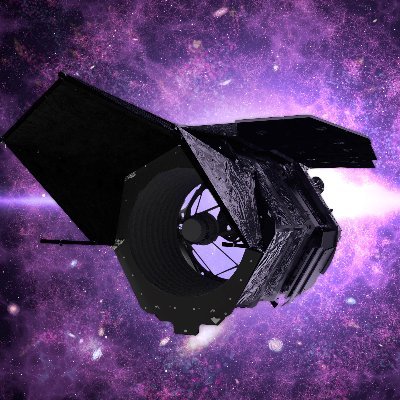
Shades on and batteries charging! 😎 🔋
Roman’s Solar Array Sun Shield and Lower Instrument Sun Shade have successfully deployed, powering the observatory and shading its instruments!
go.nasa.gov/4gw2rqc
Liftoff from LC-39A this morning (Roman Space Telescope).
Video: SpaceX
#RomanLaunch #SpaceX
Video of this morning's successful launch of the Roman Space Telescope.
Launch footage credit — SpaceX/NASA, packaged by Space.com.
#RomanLaunch #NASARoman #FalconHeavy #SpaceX
Blastoff! SpaceX Falcon Heavy launches NASA's Roman Space Telescope, nai... youtu.be/h_p4pc2DmKY?si=TXPq… via @YouTube
HardboiledCosmology retweeted

T-12 Hours! Tomorrow, we'll be counting down as the Sun comes up for the launch of NASA's Nancy Grace Roman Space Telescope!
The SpaceX Falcon Heavy rocket is ready to lift off at 7:26 a.m EDT from Launch Complex 39A here at Kennedy Space Center in Florida.

ALT NASA’s Nancy Grace Roman Space Telescope, encapsulated in the SpaceX Falcon Heavy rocket’s fairing, stands vertical on the pad at Launch Complex 39A at NASA’s Kennedy Space Center on Saturday, Aug. 29, 2026. (Photographer: SpaceX)