

Husband, father, and associate professor of practice in Digital & Precision Agriculture at Iowa State University. All opinions are my own.
Humeston, Iowa, USA
Joined September 2015
- Tweets3.1K
- Following2.2K
- Followers2.6K
- Likes7.3K

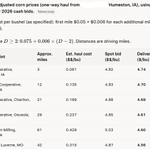




I set up a Grok automation to determine net corn price (after trucking) to various elevators/terminals in my area based on spot corn price and estimated trucking expense. Get an email every morning with the updated values. @tgmiller46 @DanAllred1 @MendenhallZach


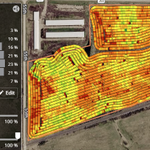
Question: Your trusted ag retailer comes to you pre-harvest with an offer for crop-removal fertilizer application based on satellite-guided yield estimates. These could be +\- 10% but adjusted once yield comes in. They offer you a discount if you accept now.
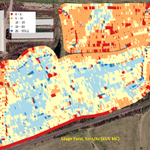
Looking at the Crude Protein % of corn silage from the John Deere HarvestLab sensor - I wonder if this could be useful to help determine areas in a field with more/less N mineralization?


“Hello, is it me you’re looking for?”
Not you, SDS.
At the previous scouting this field looked awesome: 15” rows, clean of weeds and disease, tall. But SDS has now come in on part of the field worse than the rest.


“Hello darkness my old friend.”
At least we are at mid R5 growth stage and should have minimal impact from this southern and common rust. I found the impact spotty across the field, not nearly as uniform as last year.


Anecdotal nitrogen x pest observation: In my small plot trial at the first row of plots, Wyffels W6886 was attacked by raccoons (earliest maturity in trial). However, only the 130 & 172 lbs N/ac rates were hit; the 215 lb N plot next to 172 was untouched. 🤔


It’s that time of the year to start estimating corn yields.
Instead of counting kernels by hand, let AskMyFarm do it for you.
Better yet, the satellite-based field estimate gets more accurate as you do this.
More here: askmyfarm.us/counting-kernel…


This is similar to the initial decision process that made the shape file format a standard for precision ag.
Great article from my colleagues at @isuagronomy on where nitrogen sits today and where it could have been if precip went other directions using the APSIM crop growth model.
crops.extension.iastate.edu/…

AskMyFarm Field Monitoring provides complete visibility of what’s going on in the field, including GDUs and precip, yield estimation, field operations and scouting notes.
Everything at your fingertips.


Common smut galls, I believe?
Pollination is still in full force. Seeing some elongated silks, possibly due to poor pollination conditions (heat, drought).


My great-grandparents homesteaded in Haskell Co KS in the early 1900’s, later owning local newspapers before moving back to IA in 1919. A friend apparently sent this 1930 special years later about the county.
Just before/as the Dust Bowl hit.


