
Renzo_S retweeted

U 卡排行榜更新了
这次综合实际返现、使用费用、开卡门槛和支付支持等因素排行,也补上了 Ethena Pay、Bitget Wallet 美国 BIN 等卡。
从「夯」到「拉完了」,你有什么不同意见?哪张值得升档,哪张被高估了?
访问地址:card.lengziyu.cn/ranking

Renzo_S retweeted

科研不再依赖天才科学家,而依赖GPU
--- 昨天的剧情继续反转!
Openai官宣了!
更重要的是,这是由opanai未发布的模型,几天时间完成的。(新模型能力比astra有大幅提升,见附图)
这件事的意义本身非常重大,属于菲尔兹奖级别的发现,但其意义远不止事件本身。
科学正在被重构为一种由算力驱动的高速工业流程。
先扫个盲:千禧难题与它的“爆破点”
纳维—斯托克斯方程(Navier-Stokes,简称 N-S 方程):物理学中描述水流、空气、洋流等流体运动的基本方程。它的地位相当于流体领域的牛顿运动定律。然而在数学上,一个世纪以来没人能证明:在所有初始状态下,流体的平滑运动方程是否永远有良好定义的解。这是数学界著名的七大“千禧年大奖难题”之一。
有限时间奇性(Finite-time Singularity):可以形象地理解为“物理量的暴走”。系统初始时风平浪静、处处平滑,但经过一段有限时间后,某些关键指标(如速度梯度或涡度)飙升至无穷大,数学上出现了类似“除以零”的无法计算点。这意味着经典连续介质模型在该处彻底失效,数学上称为“爆破”(Blow-up)。
Lean 形式化证明:过去的数学论文由同行专家人工审阅,难免漏掉隐蔽的推导漏洞。Lean 则是一种计算机代码证明语言,它要求将数学推导逐行写成严密的逻辑代码,由机器编译器校验每一步公理,彻底杜绝逻辑跳跃和人为笔误。
这次突破的关键在于:它是一个由 1 万个协同智能体构成的庞大系统,在 88 小时内吞吐 1300 亿 Token、交换 270 万条信息,完成了一场高强度的科研大兵团作战。
OpenAI 展示了一个此前未被充分验证的三维 Scaling 架构:
训练算力:赋予单体模型基础的科研直觉与逻辑深度;
测试时算力(Test-time Compute):让单个智能体在复杂节点上深入推导、反复验算草稿;
多智能体算力:支撑成千上万个节点并行探索不同的假说分支,并实时共享中间成果。
在实验中,这套系统先调动 100 个智能体在 50 小时内解决了难度较低的欧拉方程(忽略流体粘性的简化方程),系统自主识别出该成果的价值,随后自动抽调算力,将欧拉方程的结果作为跳板,转向主攻 N-S 方程。
这种提出假说、并行探索、沉淀结论、动态调度算力的组织过程,已经高度接近一所组织良好分工明确自主运转的“虚拟科学团队”。
面对这项突破,要真正理解其长远的影响力,必须严格区分两个层次:
第一层(单点突破):某一道著名难题被攻破。解决 N-S 方程或黎曼猜想,本身的科学价值巨大,但仍有限。
第二层(能力跃迁):AI 具备了稳定、批量解决此类高难度科学与工程抽象问题的能力。
真正具有颠覆性的是第二层。通用求解能力能撬动极高价值的科研。
如:可控核聚变中突破高温等离子体湍流控制,材料和生命科学中充当新型材料、催化剂与药物研发的算力放大器,高科技制造中将复杂物理过程转化为可计算模型,大幅减少飞机、电池、散热设计的实物实验等。
设计一款航空发动机或验证新型芯片散热,需要做上千次高成本的实体物理实验;如果数学理论与 AI 模拟能够把实验次数压缩到几十次,硬科技的研发逻辑就会向“编写代码—模拟测试—快速重构”的软件化开发模式靠拢。
但最重要,价值最高的,还是AI驱动的AI 模型研发:AI 被用于优化自身的网络架构、训练算法与数据流设计,它将直接触发递归自我改进(RSI)。
和证明斯托克斯方程类似的是,AI 研发几乎完全运行在数字世界中,智能体可以自主编写代码、启动训练、监测损失函数曲线并分析评测,不需要等待物理世界缓慢的材料制备和实物制造周期。
而当ai开始驱动多领域科学的突破,不同领域的突破将紧密咬合,形成自增强的多飞轮。
在传统视角下,科学进步的速度(Rate of Progress)通常被视为外生常数——比如开发一款新药平均耗时 10 到 15 年,商业化聚变往往以“几十年后”为期。但当科研系统全面接入自动化后,技术周期的迭代速度本身将变成可加速的内生变量。
这种科研范式的转变对宏观经济的拉动,将会是是一次典型的阶梯式跃迁(Slowly, then suddenly):
在初期阶段,大量论文被解出、复杂数学定理被形式化验证、实验室新型材料候选层出不穷,但宏观 GDP 几乎毫无波动;只有当这些技术库存积累到临界点,伴随低成本工业机器人的普及、新型清洁能源网络的搭建与先进制造工厂的投产,庞大的底层科学资产才会集中转化为实体生产力,形成宏观经济的骤然跃升。
纳维—斯托克斯方程的攻坚,给整个科技界提供了一块前沿观测窗。它真正提示我们的,绝不仅是流体力学又往前走了一步,而是提醒我们审视:文明社会中究竟有多少万亿美元的长期价值,正被锁在那些“人类因大脑算力有限而暂时算不清的问题”之中。
当算力正式从制造模型的流水线工厂,跃升为能够全天候自主探索未知的“超级研究院”,人类从这些“未知库存”中提取科学答案的速率,将被彻底改写。


卧槽,ai解决千禧难题这事出了个大瓜!
openai和anthropic争风吃醋🤣
之前传言科研人员用 Claude解决千禧难题之一:Navier–Stokes 方程的存在性与光滑性问题。
消息传出后,OpenAI 的 Sébastien Bubeck 等称内部模型几天内给出约百页、对应 Fefferman C/D 的带力 Navier–Stokes 突破(解决问题的必要解)。
传言中的研究者Buckmaster 质疑冷门路线即使对openai来说,不可能“快速解决”,因此质疑openai投入大量算力,并质疑因为他们在研究过程中claude和openai模型都使用过,因此openai可能提供模型获得了他们的解体思路。。。
这事瓜可以慢慢吃,但有一点无需质疑:
模型已把千禧难题的验证分析从原来的数十年尺度压缩到按周甚至按日的尺度。
正如参与项目的研究者之一在声明中所说,这次事件,毫无疑问是数学研究的深蓝-卡斯帕罗夫时刻。
从这一刻起,数学家就像国际象棋手一样,在ai数学研究面前,毫无优势

Renzo_S retweeted

You can make $676 per day if you have:
1. A laptop
2. Wi-Fi
3. Time
Here are 12 websites that pay you daily:
🤝 Paid partnership


Renzo_S retweeted

如果你想创办一家初创公司:
Claude = 编程。($20/月)
Supabase = 后端。(免费)
Vercel = 部署。(免费)
Namecheap = 域名。($12/年)
Stripe = 支付。(2.9%/交易)
GitHub = 版本控制。(免费)
Resend = 电子邮件。(免费)
ProductBridge = 反馈(免费)
Clerk = 认证。(免费)
Cloudflare = DNS。(免费)
PostHog = 分析。(免费)
Sentry = 错误跟踪。(免费)
Upstash = Redis。(免费)
Pinecone = 向量数据库。(免费)
运营一家初创公司的总月成本:约$20
由此可见,你的行动力在哪里?
Renzo_S retweeted
Anthropic 刚刚发布了一项标志性的研究——Autonomous de novo protein binder design with Claude。
在这项工作中,AI Agent(基于 Claude Opus 4.8 与 Claude Mythos Preview)在无任何人类专家介入设计决策的前提下,借助调用包括PXDesign, RFdiffusion, Genie, BoltzGen在内的其他开源工具和模型实现了从头蛋白质结合剂(de novo protein binder)的端到端自主设计,并通过了双盲湿实验验证。
在 Anthropic 的这项实验中,生物学家的角色被极度简化:仅提供靶点名称、UniProt 编号、寡聚状态和算力。剩下的所有工作,均由 AI 在 24 至 48 小时内自主闭环完成。
在 15 个有效靶点的 1,320 个合成设计中,354 个证实具备结合活性,总命中率达 26.8%。而在 AI 排名第一(Top 1)的设计中,命中率高达 49%,Top 5 命中率达 44%。
在 E3 连接酶亚基 RBX1 靶点上,AI 交付的 Top-1 设计结合亲和力达 3.9 nM,显著超越此前公开设计竞赛优胜方案的 45 nM。
在过往人类科学家从头设计多次折戟的同源三聚体 TNFα 上,AI 成功设计出 12 个结合剂,最高表观亲和力达 0.70 nM。
这篇论文的意义在于,AI 彻底抹平了从“靶点概念”到“分子序列”的工程技术壁垒。
使用者无需了解技术细节,Agent 能自主拉取 PXDesign、RFdiffusion3、SolubleMPNN、Protenix v2 等开源模型完成流水线组装。
随着模型能力的继续发展未来科研人员甚至非专业开发者,很可能只需要输入一句自然语言 Prompt(例如:“针对某受体结合域,设计一个亲和力优于 10 nM 且具有跨物种交叉反应的微型蛋白”),底层 AI 就能在几十小时内交付一份高置信度的候选序列清单。
蛋白质设计的算力工程与结构探索,正式从“手工作坊”进入了“自动化编译”时代。
结合最近模型在生命科学中的快速发展,接下来不光是靶点蛋白结合剂的设计能力,抗体、小分子、基因和细胞治疗设计能力都将会随着模型能力提升不断被平民化。
就像去年那个毫无生命科学背景的码农vibe bio design抗癌疫苗救助自己的宠物狗一样,不久之后,可能就会迎来“Vibe Bio-design”甚至“Vibe Pharma”的时代。

Many drugs work by binding to a specific target in the body and blocking or changing what it does. An important first step in the drug development process is designing a molecule that can bind tightly to its target. Traditionally, that's meant weeks or months of expert work per target, sifting through a large number of candidates to identify the few that work.
We wanted to test if Claude could successfully design novel protein binders from scratch (also called de novo design). With a protein design prompt written by a human expert, Claude autonomously designed protein binders against 14 out of 15 targets.
We then worked with Adaptyv Bio and Twist Bioscience, who independently built and tested the proteins Claude designed.
Renzo_S retweeted

很多程序员和计算机系的学生嘴上天天说学 AI 学 Agent,实际上只是天天玩 Codex,ClaudeCode 做点没人用的软件。
要么就是去拿 AI 写文章,生图 ,做视频,写各种 Skill。
其实这只是在玩儿 AI,没有门槛,没有积累,获得的经验几个月后就随着工具和模型的迭代过时。
更好一点的,在新概念出来的时候,钻研一下 harness engineering,loop engineering,graph engineering,也就到头了,任何一个非计算机专业的门外汉都可以在几周内掌握个七七八八。
真正想搞懂 Agent,必须要懂得 Agent 的底层原理,这才是程序员该学的。
有多少程序员能真正手写一个 200 行的 agent loop?
只要 terminal 执行加文件读写,自己拼 prompt,自己写 parser,自己控制 loop 什么时候停,自己管理记忆,不会就带着问题去读 Codex,OpenCode,KimiCode 的源码。
敲不出来就是没懂。
Renzo_S retweeted

How to become an AI Engineer in 6 months 🚀
MONTH 1 — Foundations 🐍
Learn:
• Python properly
• NumPy + Pandas
• SQL
• Git/GitHub
• APIs + JSON
• Linux/CLI basics
• Linear algebra
• Probability + statistics
Build:
→ Data analysis project
→ ML API with FastAPI
Goal: Become comfortable writing production-ish Python, not just notebooks.
---
MONTH 2 — Machine Learning 🧠
Master:
• Linear + logistic regression
• Decision trees
• Random Forest
• XGBoost
• SVM
• KNN
• Clustering
• Feature engineering
• Train/validation/test
• Cross-validation
• Precision/Recall/F1/AUC
• Hyperparameter tuning
Learn:
→ scikit-learn
Build:
→ End-to-end ML prediction system
Goal: Understand WHY a model works, not just ".fit()" it.
---
MONTH 3 — Deep Learning 🔥
Learn:
• Neural networks
• Backpropagation
• Activation functions
• Loss functions
• Optimizers
• Regularization
• CNNs
• Sequence models
• Attention
• Transformers
Learn:
→ PyTorch
Build:
→ Image/text classification system
Then understand:
Attention → Transformers → LLMs
This is the bridge into modern AI engineering.
---
MONTH 4 — LLM Engineering 🤖
Now go deep into GenAI:
• Tokens
• Embeddings
• Transformers
• LLM APIs
• Prompting
• Structured outputs
• Function/tool calling
• Streaming
• Model selection
• Context windows
• Cost + latency optimization
• Hugging Face
Then learn:
RAG
→ Chunking
→ Embeddings
→ Vector databases
→ Retrieval
→ Reranking
→ Grounded generation
→ RAG evaluation
Build:
🔥 “Chat with your documents” system
But don't stop at a basic chatbot.
---
MONTH 5 — Agents + Production ⚙️
Learn how modern AI systems actually DO things.
• Tool calling
• Agent loops
• Planning
• Memory
• Workflows
• Multi-step agents
• Agent evaluation
• Guardrails
• Context engineering
• MCP
• LangGraph / equivalent orchestration
Build:
🔥 An autonomous research/automation agent
Example:
User → Agent → Search → Tools → Data → Reason → Final answer
The important skill is not “using LangChain.”
It's understanding the architecture underneath it.
---
MONTH 6 — Production AI Engineer 🚀
Learn:
• FastAPI
• Docker
• Cloud deployment
• CI/CD
• MLflow
• Logging
• Monitoring
• Model evaluation
• LLM observability
• Rate limiting
• Caching
• Authentication
• Security
• Cost optimization
Deploy everything.
Your GitHub should now contain:
1️⃣ Classical ML project
2️⃣ Deep learning project
3️⃣ Production RAG application
4️⃣ Agentic AI application
At least 2 should be genuinely impressive.
---
EVERY WEEK
Don't spend 100% of your time watching courses.
Use:
30% → Learning
50% → Building
10% → Reading papers/docs
10% → Interview preparation
And code EVERY DAY.
---
THE INTERVIEW STACK 🎯
Alongside AI, keep your SWE fundamentals alive:
• DSA
• OOP
• DBMS
• OS
• Computer Networks
• SQL
• System design basics
• Python
AI Engineer ≠ “person who knows ChatGPT.”
You still need to be an engineer.
---
WHAT NOT TO DO ❌
Don't spend 6 months collecting:
• 20 certificates
• 50 prompt-engineering courses
• 15 frameworks
• 100 tutorials
• Copy-pasted GitHub projects
Instead:
Learn → Build → Break → Debug → Deploy → Explain
Repeat.
---
YOUR 6-MONTH END GOAL 🎯
You should be able to:
→ Train an ML model
→ Build a neural network
→ Understand Transformers
→ Work with LLM APIs
→ Build RAG systems
→ Build AI agents
→ Evaluate AI systems
→ Deploy AI applications
→ Monitor production systems
→ Explain your architecture in an interview
That's the difference between:
“I know AI”
and
“I can build AI systems.”
6 months is enough to become job-ready, not an AI research scientist.
The roadmap is simple.
The execution isn't. 🔥

Renzo_S retweeted

全球地址证明模板库更新|Day 10
今日新增:
🇲🇾马来电信单 ×1
🇵🇭菲律宾水费单X1
🌍 已覆盖 51 个国家|📄 收录 600+ 份模板
完整模板库👇
windx.co.uk
一键制作台(UK、HK、AU、US、SG、CA)👇 windx.uk


Renzo_S retweeted
全球地址证明模板库更新|Day 8
今日新增:
🇵🇭 菲律宾电费单 ×2
🌍 已覆盖 51 个国家|📄 收录 600+ 份模板
完整模板库👇
windx.co.uk
一键制作台👇
windx.uk


Renzo_S retweeted

If you want to become a world-class AI engineer in 2026, watch these 12 YouTube videos (save them):
Renzo_S retweeted

NVIDIA CEO, @JensenHuang:
"If you're still writing prompts, stop. Build loops instead."
The 7th richest man on earth spoke at Stanford for 67 minutes. No script. No PR.
This is free. I've seen $300 courses that teach less.
Don't just watch it. Build your first loop. Step-by-step guide below.


Renzo_S retweeted

this is f*cking gold
a guy spent 6 weeks with no sleep building a personal AI agent from scratch, then wrote down all 100 things he learned
not a chatbot wrapper. an assistant that manages tasks, tracks deals, reads emails, and flags things before you even ask.
if I had this before I built my first agent, I would've skipped a month of trial and error
in the right hands, this changes everything:
→ separate hard rules from guidelines
→ give your agent a name, a voice, a role
→ build a Capability and a Component Map
→ write a Constitution, not a system prompt
And that's tip 5 out of 100.
(All tips are dropped in the comments below)
then read the full article below: ↓


Renzo_S retweeted

Holy sh*t this is gold
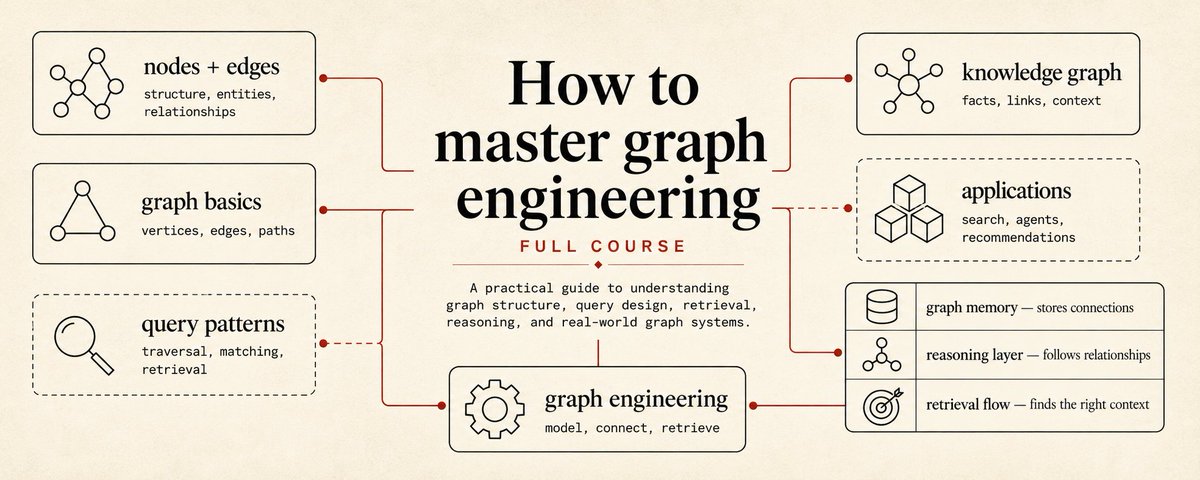
THE FULL GRAPH ENGINEERING PIPELINE, GROUNDED IN REAL, OPEN SOURCE WORK.
Representation. Ontology. Entity extraction. Relations. Events. Quality gate. Fusion. Embeddings. Memory your agent can actually traverse.
Real repos already cover this end to end. Strwythura walks through the full ontology pipeline with entity resolution and embedding-enhanced GraphRAG. llm2kg covers entity and relationship extraction against an ontology, Neo4j storage with vector embeddings, and a ReAct agent that queries the graph directly.
No PhD required. Real, working code you can run against your own data today.

Renzo_S retweeted

As an AI Engineer. Please learn
>Harness engineering, not just prompt engineering
>Context engineering, not just long prompts
>Prompt caching vs. semantic caching tradeoffs
>KV cache management, eviction, reuse, and memory pressure at scale
>Prefill vs. decode latency and why they optimize differently
>Continuous batching, paged attention, and throughput optimization
>Speculative decoding vs. quantization vs. distillation tradeoffs
>INT8, INT4, FP8, AWQ, GPTQ, and when quantization hurts quality
>Structured output failures, schema validation, repair loops, and fallback chains
>Function calling reliability, tool contracts, argument validation, and idempotency
>Agent guardrails, loop budgets, tool budgets, and termination conditions
>Model routing, graceful fallback logic, and degraded-mode UX
>RAG architecture: chunking, embeddings, hybrid search, reranking, and freshness
>Retrieval evals: recall, precision, grounding, attribution, and citation quality
>Evals: golden sets, regression tests, adversarial tests, LLM-as-judge, and human evals
>LLM observability as a first-class discipline: traces, spans, tokens, latency, errors, and drift
>Cost attribution per feature, workflow, tenant, and user journey not just per model
>Safety engineering: prompt injection defense, data leakage prevention, and permission boundaries
>Multi-tenant isolation, cache safety, and cross-user context contamination prevention
>Fine-tuning vs. in-context learning vs. RAG vs. distillation and when each is the wrong tool
>Latency, quality, cost, and reliability tradeoffs across the full inference stack
>Production failure modes: hallucinated tool calls, malformed JSON, stale retrieval, runaway agents, and silent eval regressions
Renzo_S retweeted

Anthropic engineer:
"No need to write prompts anymore. The new job is to write and learn graph engineering."
In 47 minutes he shows how Anthropic engineers run Claude Code day to day: the workflows and the parts everyone gets wrong.
Watch it, then save the article below on graph engineering 👇

