

This page is to educate the history of the American Civil War (1861-1865) • Be sure to follow us on Facebook & Instagram for future contents!
Pittsburgh, PA
Joined February 2021
- Tweets1.3K
- Following598
- Followers3K
- Likes4.8K





The Blue & Gray Historian retweeted

MICHIGAN MONUMENT AT ANTIETAM? The latest episode of the “Antietam and Beyond” podcast features Brian Egen and Jack Dempsey, who are leading the charge to place a monument to Michigan troops at Antietam. Listen at antietambeyond.transistor.fm

The Blue & Gray Historian retweeted

If you haven’t seen the video yet go check this one out. It’s getting to be pretty popular.
youtu.be/1pIZCLtLSCI?feature…

No more shall the war cry sever,
Or the winding rivers run red;
They banish our anger forever
When they laurel the graves of our dead
Under the sod and the dew,
Waiting the judgment-day,
Love and tears for the Blue,
Tears and love for the Gray.
•
Happy Memorial Day everyone! 🇺🇲

The Blue & Gray Historian retweeted
In Episode 33 of the “Antietam and Beyond” podcast, co-hosts John and Tom talk Rufus Dawes of the Iron Brigade (and his G-Grandfather William Dawes, who rode with Paul Revere in April 1775). Check it out at antietambeyond.transistor.fm

The Blue & Gray Historian retweeted

On this day in 1802, the United States Army establishes America's first military academy at West Point, New York. In its 200+ year history, the school has graduated nearly 65,000 alumni, including Grant, Lee, Sherman, Pershing, MacArthur, Patton, Eisenhower and Schwarzkopf.

The Blue & Gray Historian retweeted

A bayonet charge by the 1st Minnesota Infantry Regiment against a Confederate brigade on the battle's second day

The Blue & Gray Historian retweeted

OTD 160 years ago - The Battle of Wyse Fork, North Carolina, March 7-10, 1865
Bragg's Eastern Defensive: The Strategic Importance of Wyse Fork Before Bentonville
Strategic Context: March 1865
By March 1865, the American Civil War was entering its final phase. The Confederacy was in dire straits—Richmond was threatened, Lee's Army of Northern Virginia was essentially besieged at Petersburg, and Sherman's forces had completed their devastating march through Georgia and were cutting a path of destruction through the Carolinas.
After the fall of Savannah in December 1864, Sherman had turned northward. His ultimate strategic goal was to link up with Grant's forces in Virginia, completely isolating Lee's army and rendering the Confederate capital indefensible. By February 1865, Sherman's 60,000-man army had reached South Carolina, capturing Columbia on February 17 and compelling the Confederates to evacuate Charleston.
The Confederate leadership, desperate to stop Sherman's advance, reassigned General Joseph E. Johnston—who had opposed Sherman during the Atlanta Campaign—to command the scattered Confederate forces in the Carolinas. Johnston's unenviable task was to concentrate these dispersed units and somehow halt Sherman's seemingly unstoppable progress north.
Meanwhile, a separate Federal force under General John M. Schofield had captured Wilmington, North Carolina, on February 22, 1865. Schofield's next objective was to march inland and link up with Sherman's forces at Goldsboro, creating an even more formidable Union presence in North Carolina. The capture of Goldsboro was particularly important because it would give the Federal forces control of the Wilmington & Weldon Railroad, a critical supply line.
The Battle of Wyse Fork: March 7-10, 1865
Prelude to Battle
As Schofield's forces moved inland from Wilmington, they divided into two columns. One column under General Jacob D. Cox proceeded toward Goldsboro along the Atlantic & North Carolina Railroad. By March 6, Cox's forces, numbering around 13,000 men, had reached Gum Swamp, about two miles from Wyse Fork (sometimes spelled "Wise Fork"), near Kinston, North Carolina.
Opposing them was a Confederate force of approximately 8,500 men under the command of General Braxton Bragg. Bragg, who had been widely criticized for his leadership at Chickamauga and Chattanooga, was hoping to redeem his reputation with a victory that might slow the Federal advance. His force consisted primarily of remnants from the Army of Tennessee and North Carolina reserves.
Day 1: March 7, 1865
The battle began on the morning of March 7 when Confederate forces under General D.H. Hill launched a surprise attack against the advance elements of Cox's column, specifically the division of General Samuel P. Carter. Hill's Confederates struck hard along the Dover Road, driving back Carter's division and capturing two artillery pieces and several hundred prisoners.
Cox quickly responded by ordering his reserve forces forward and establishing a defensive line anchored on both flanks by swampy terrain. The natural barrier of Southwest Creek provided additional protection for the Union position. By nightfall, the initial Confederate assault had been contained, though they had succeeded in delaying the Federal advance.
Day 2: March 8, 1865
On March 8, Bragg received reinforcements from General Robert F. Hoke's division, bringing Confederate strength to around 8,500 men. Rather than immediately renewing the attack, Bragg spent the day conducting reconnaissance and planning for a major assault on the Union left flank, which he believed was vulnerable.
Meanwhile, Cox used the respite to strengthen his defensive position, constructing field fortifications and repositioning units to better cover potential avenues of Confederate attack. Additional Union reinforcements also began arriving from Schofield's main body, gradually shifting the numerical advantage toward the Federal forces.
Graphics: 1) General Braxton Bragg; 2) Major General Jacob D. Cox; 3) Battle of Wyse Fork painting


The Blue & Gray Historian retweeted
Franklin Battlefield: A Historians Perspective | Joseph Ricci youtu.be/asYlBpvHIhM?feature… via @YouTube
The Blue & Gray Historian retweeted
In the next issue of the Antietam Journal, Institute member and battlefield guide Michael Hill reviews Stephen Budiansky’s book, “A Day in September.” The Journal is a perk of Institute membership.

The Blue & Gray Historian retweeted
If you haven’t seen it please go watch. Great conversation with Chris Mackowski every history buff will love. Battle of Spotsylvania : Live With Chris Mackowski youtube.com/live/DLTlJfFaF-g… via @YouTube

The Blue & Gray Historian retweeted

SPOTLIGHT ON LESSER KNOWN HISTORY: Pamplin Park, a private Civil War park has museums, films, exhibits, period buildings, & exact location where Gen Grant's Army finally broke through the defenses of Gen Lee around Petersburg/Richmond to storm the capitol. americasbesthistory.com/spot…

The mayor of Charleston, South Carolina, surrendered control of the city to Union Brigadier General Alexander Schimmelfennig at 9:00 a.m. on Saturday, February 18, 1865.


The Blue & Gray Historian retweeted

The digital version of our Spring '25 issue is now live for subscribers to read at our website: bit.ly/41kOwwT. Not yet a subscriber? Fix that here: bit.ly/4aERspr. #civilwarhistory #twitterstorians #history #americancivilwar


Unidentified soldiers in Union uniforms with knapsacks, bedrolls, haversacks, pistol holders, hatchet, knife, and walking sticks
•
Source: The Liljenquist Family Collection of Civil War Photographs / Library of Congress
loc.gov/pictures/resource/pp…

The Blue & Gray Historian retweeted
Detachment of 3rd Indiana Cavalry - Petersburg, VA, November 1864


Since I have shared with y'all about what I have been reading lately. I am currently reading The World Will Never See the Like: The Gettysburg Reunion of 1913 by John Hopkins. Tell me what book you are reading? I would love to hear from everyone! Comment below!

The Blue & Gray Historian retweeted
The ANTIETAM AND BEYOND podcast breaks new ground! Latest guest is recent GRAMMY WINNER Taylor Agan, whose 3rd-great grandfather was captured near the Sunken Road at Antietam. He has 12 direct Civil War ancestors! Check it out at antietambeyond.transistor.fm

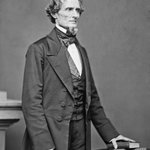
His political service credentials served him well since he was the Secretary of War for Franklin Pierce and a Senator for Mississippi. Davis wanted to serve as a Commander in Chief of the Confederate Armies, but he decided to serve wherever directed.
⬇️
1
7
295
This election made Davis the President of the Confederate State of America with votes from six of seven states with Texas not casting any votes.
1
7
272