

Tolkien, folklore, books, movies. East Javanese. She/her. Header by Oniria. Free Palestine and may vengeful pigeons shit on transphobes.
- Tweets16.5K
- Following1K
- Followers3.6K
- Likes15K






ALT A colored illustration of Rivendell, a valley with lush vegetations and a river running through it. An Elven sanctuary can be seen perching above the river, surrounded by trees.


ALT A photo of my hand holding a book titled Floodlines by Saleem Haddad above the grave of my father.

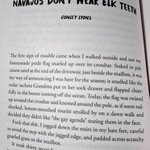
ALT A photo of a page of a short story titled Navajos Don't Wear Elk Teeth by Conlry Lions. The opening says: the first sign of trouble came when I walked outside and saw my homemade pride flag snarled up over its crossbar. Staked in pale coarse sand at the end of the driveway, just beside the mailbox, it was my way of announcing I was here for the season; it smelled like the cedar sachets Grandma put on her sock drawer and flapped cheerfully in the breeze coming off the ocean. Today, the flag was twisted up around the crossbar and knotted around the pole, as if some red-cheeked, lemon-mouthed tourist stroll by on a dawn walk and decided they didn't like the gay agenda staring at them in the facr. Fuck that shit. I jogged down the stairs in my bare feet, careful to avoid the steps with the jagged edge, and padded across scratchy gnarled grass to the mailbox.

ALT A photograph of a book titled Never Whistle at Night: An Indigenous Dark Fiction Anthology. The book cover art shows a colorful illustration of various beastly creatures surrounded by colorful flora, with a black background and white texts for the title.
ALT A photograph of a book titled Never Whistle at Night: An Indigenous Dark Fiction Anthology. The book cover art shows a colorful illustration of various beastly creatures surrounded by colorful flora, with a black background and white texts for the title.

ALT The Last Prophet of Palestine: Enigmatic Emergence from the Ruins of Gaza. Review by: Putri Prihatini. The cover of the novel shows a silhouette of a figure surrounded by a gold halo with an olive tree growing from the halo. The figure is surrounded twelve men in traditional Palestinian robes and keffiyeh. There are embroidery motifs of red poppies on the bottom hem of the figure's robe and the bottom of the book.

ALT What’s the novel about? The Last Prophet of Palestine retells the story of the Messiah in modern-day Gaza, turning it into the tale of the birth of a secret sect, born as a desperate effort to offer hope amidst devastation. The story centered the viewpoints of the “apostles”: men whose life revolved around Ali, a mysterious young man born amidst the occupation and seemingly without a father. Meanwhile, a queer Palestinian woman in Jordan found out about the sect from a woman in Gaza that she met online. Struggling to deal with her fraying relationship and wanting to live abroad with her girlfriend, she wondered if she could turn it into a story that would help her application, turning it into a moral dilemma.

ALT The unflattering humanity. Noor Al-Ahmad is not interested in creating a story that flatters Western sensibility about Gaza, Palestine, and Palestinian people. The book offers a portrait of “the unflattering humanity”: a story born out of survival instinct, with flawed characters and dubious morality. Characters like Kifah, Walid, Anwar, Mohammad, and Naveed were all flawed. Brash, prone to anger, manipulative, backstabber, wanting to run away with a married woman. You name it. Ali, the stand-in for the “Messiah” they tried to uphold, was the same, with unsympathetic moments that would turn some readers against him. And that is the key to challenge our assumption.

ALT This novel describes a contrast between curated myth and real humanity. The stark depiction of destroyed Gaza, the inhumanity, and the violence of the checkpoint (where Ali’s mother was treated harshly by Israeli soldier as she was about to give birth) show you the face of raw humanity. Instead of comfortable narrative where everyone was flawless martyr, Noor challenges us: “If I made all these characters flawed and even didn’t pass your ‘purity’ test, would you still see their humanity and their rights to live a life with dignity and free of occupation?” Quote: I cannot control the tremors in my body, which always arrive paired with that icy impulse in my loins. Am I afraid? Everyone here is afraid. How could one not be? I lead Ali through the ruins, toward people who might, after all, turn out to be animals. (ch. 1)

ALT Deconstructing the face of suffering. Noor Al-Ahmad combined two interesting elements in the intersecting storyline: the plight of Samar, a queer Palestinian woman in Jordan, and a woman in Gaza who she met through a social media post. This woman, who became Samar’s “fixer” to uncover the story of the sect (so that Samar could study and work abroad and be with her girlfriend), was one of the faces behind so many social media posts by Palestinians in Gaza who could only rely on donations to survive. The dialogue between Samar and this woman reflects the outsider’s perspectives about the forming of the sect. The woman delivered brutal truth, while Samar was faced with moral dilemma when choosing a way to tell the story about the sect.

ALT Interestingly, Samar, at times, showed the typical liberal “both sides” perspective. Even when she finally talked to a woman in Gaza, she still insisted on keeping this perspective. The woman, who actually lived amidst devastation, delivered the uncomfortable brutal truth. Samar’s moral dilemma rooted in the face of raw humanity the woman showed and Samar’s deep urge to feel accepted in her new life in the West as a queer woman. Yet, her Palestinian lineage made her question the demand for more palatable “curation of suffering.” Quote: They are slowly turning the city into a grave. They say we are terrorists because we defend ourselves. How else are we supposed to stand up to them? I went to school too; I read about people who fought for freedom. They killed civilians too, but today they are called heroes or partisans, not terrorists. Why? Because they won. (ch. 5)

ALT “Perfect victims” and the critique of pity. It’s hard not to connect The Last Prophet of Palestine with Mohammed El-Kurd’s Perfect Victims and the Politics of Appeal. El-Kurd deconstructs how Palestinians are subjected to impossible moral standards before their basic rights are validated by liberal observers. The structure of The Last Prophet of Palestine serves as a narrative case study of El-Kurd’s thesis. Samar knew European grant boards or readers will reject a story about flawed, angry men forming an erratic sect in the rubble. She felt compelled to rewrite them into sanitized, saintly victims.

ALT El-Kurd described pity as oppression because it is often conditional. Pity requires the victim to remain helpless and passive. The moment a victim exhibits anger, imperfection, or political agency, pity is revoked, and the violence inflicted on them is framed as "justified." Samar’s desire to write a "heroic angle" caters to this dynamic. She offered a digestible fable that allows readers to perform empathy without having to confront the uncomfortable, chaotic reality created by ongoing occupation. Al-Ahmad's portrayal of Ali and the apostles rejected this “pity”. By showing men who are flawed and hypocritical, the novel insists that humanity and the right to exist do not require moral perfection. Palestinians deserve life and liberation not because they are saints, but because they are human.

ALT A photograph of Your Driving is Waiting book by Priya Guns. The cover art is pink with an illustration of a rearview mirror and close up of a tired eye of a brown, dark-haired woman. The title is emblazoned across a pine tree-shaped air freshener hanging from the mirror.

ALT On the Brink of Belief: Queer Writing from South Asia. Embracing the multitudes of our queer existence. Review by: Putri Prihatini

ALT A photograph of a book titled On the Brink of Belief, with the editor's name Kazim Ali at the bottom. The book cover is white with images of two queer people walking together arm in arm, another couple embracing each other in a heart shape, three people gathering in celebratory gestures and raising their hands, and one pointing an arrow to the sky. The illustration is dominated by pink and green colors.

ALT Subverting the supernatural. This book utilizes religious and supernatural beliefs through djinns, shakchunni, and shaitan, connecting them with wider queer experience often associated with taboo and sin. In On This Afternoon, Like Every Other, Ipsa subverted the image of shakchunni, a ghost of unmarried woman in Bengali folklore, into a flash fiction that depicts a shakchunni pleasuring a human woman in bed. It challenges (sorry, SPITS ON) the belief about how not getting married (in a heterosexual marriage) is a horror worse than death for a woman. Quote: They say shakchunnis can stretch their arms into unfathomable lengths and fetch whatever they desire. It’s funny how all of it it’s true, isn’t it? How your arm really can stretch far, far into the places you’ve christened, turning me inside out like scooping the innards of a papaya. (page 86)

ALT One of my favorite entries is Even Shaitan Showers by Begum Taara Shakar, simply because the inspiration is a familiar cultural taboo for me as an Indonesian Muslim: don’t say God’s name in the bathroom because it’s a place of stain where Shaitan resides. Here, the daring question arose: what if God and Shaitan were actually star-crossed lovers? A bathroom musing about the pain of loving in secret turned into imagination about how God and Shaitan are actually trapped in eternal yearning for each other. Quote: The first time your tongue was inside me, I swear I saw god quivering in my skin. I struggle to turn away from light and form when it is all so obviously a love letter. I am constantly afraid. I become the meeting of Shaitan and God together. One of us has left the understanding of each other. (page 116)

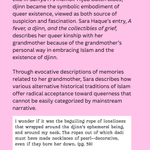
ALT Like in Samya H’s memoir Hijab Butch Blues, djinn became the symbolic embodiment of queer existence, viewed as both source of suspicion and fascination. Sara Haque’s entry, A fever, a djinn, and the collectibles of grief, describes her queer kinship with her grandmother because of the grandmother’s personal way in embracing Islam and the existence of djinn. Through evocative descriptions of memories related to her grandmother, Sara describes how various alternative historical traditions of Islam offer radical acceptance toward queerness that cannot be easily categorized by mainstream narrative. Quote: I wonder if it was the beguiling rope of loneliness that wrapped around the djinn’s ephemeral being, and around my neck. The ropes out of which dadi must have made necklaces of pearl--decorative, even if they bore her down. (page 59)

ALT Interpreting existence through queer lens. Some works in this book might not be explicit in their queer depiction, but they interpreted queerness as a lens used to see the world. Being queer means living in a world that often doesn’t have us in mind, and it manifests in the smallest things. For example, in Dog Days by Kaleemullah Bashir, a vignette of a busy day (waiting in line at a crowded bank) describes a type of modern alienation that reflect the daily experiences of many queer people: feeling alone in a crowd. Quote: Nothing in this city ever made sense to Sadaf. And she had always engaged with the chaotic narratives of the city only as a receiver. This chaos always came with a promise of purpose and some sense of reason, but it always lacked a solid ground. (page 46)

ALT Another distinctive theme of alienation that you can see using queer lens is in Nangsal by Dia Yonzon. Her character, Nyima, was a member of the indigenous Tamang ethnic group in Nepal who prepared to depart to the U.S. She recalled the bitter memory of her father who left to become a monk, and things that she had lost or traded for being able to go abroad. I found the story to be more resonant the moment you read the queer subtext: from the unclear reason behind her father’s sudden decision, to the fact that the title was in Tamang language, which is being threatened by the dominance of Nepali language. Nyima’s worry of going to the U.S. despite the opportunity also reflected the fear of losing one’s root, something experienced by many queer people who are forced to slice off their identities to be accepted.

ALT Books like this always remind me of the words of Billy-Ray Belcourt, a First Nation queer writer from the Driftpile Cree Nation: Indigenous existence is basically queer in nature. Queerness and indigenous existence don’t and shouldn’t oppose each other because both shared a similarity: they challenge the dominant narrative and oppressive status quo. For me, this also reflects something that I always repeat: no one “owns” queerness. LGBTQIA+ people should not be forced to slice off their identities (their culture, their root, their connection to the land, their history, their faith if they embrace it) just to be accepted or be seen as less complicated by the more dominant narrative.

ALT A black and white photograph of Muhammad Ali doing a boxing pose underwater. He wore a pair of boxing shorts and stood at the bottom of a swimming pool, in a pose that resembled a moment before a fight. The photo was taken from his side.

ALT A black and white photocard of Jack Johnsons showing him standing wearing boxing gloves, boxing top and tight, and shoes. He raised his left fist and kept the right one in front of his chest. The handwriting underneath said "Jack Johnsons, who defeated Jeffries in America on July 4th, 1910."

ALT A photograph of seven books arranged on a wooden bench, adorned by a keffiyeh and a colorful woven scarf. The books are Everything We Thought Was Beautiful, On the Brink of Belief, Never Whistle at Night, Floodlines, Pizza before We Die, Fieldwork as a Sex Subject, Your Driver is Here.

ALT An opening slide titled 10 Queer Novel Recommendations by South Asian Authors. The slide is by Putri Prihatini. The background image is a collage of five book covers.

ALT Deviants by Santanu Bhattacharya. A family saga about three generations of gay men in an Indian family. Vivaan was the teenager who seek love and connection in online world. Mambro, Vivaan’s uncle, fell in love with a classmate during the enforcement of colonial-era law criminalizing homosexuality. Sukumar, Mambro’s uncle, had a secret relationship with another man because of social taboo. All fought for love and dignity against the specific currents of their times.

ALT Your Driver is Waiting by Priya Guns. Priya Guns expressed biting social commentary about the pressure of gig work, class disparity, and authenticity of activism through the eyes of Damani, a rideshare driver who lived paycheck-to-paycheck. Her tumultuous, fiery, rather toxic relationship with a rich white girl Jolene snowballed into devastating chains of events that made her question everything she had been fighting for.

ALT How to Date a Fanatic, by Aruni Kashyap. Aruni Kashyap wrote a poignant queer campus novel about navigating relationship under Modi era. Trapped in an unrequited love toward his best friend, New Delhi professor Rohit embarked in relationships with multiple men until he met a charismatic literature student Sayan. Political tension, Hindu nationalism, and student activism became tipping points that changed Rohit’s life as he navigated the challenges and triumph of queer love.
ALT An opening slide titled 10 Queer Novel Recommendations by South Asian Authors. The slide is by Putri Prihatini. The background image is a collage of five book covers.
ALT Deviants by Santanu Bhattacharya. A family saga about three generations of gay men in an Indian family. Vivaan was the teenager who seek love and connection in online world. Mambro, Vivaan’s uncle, fell in love with a classmate during the enforcement of colonial-era law criminalizing homosexuality. Sukumar, Mambro’s uncle, had a secret relationship with another man because of social taboo. All fought for love and dignity against the specific currents of their times.
ALT Your Driver is Waiting by Priya Guns. Priya Guns expressed biting social commentary about the pressure of gig work, class disparity, and authenticity of activism through the eyes of Damani, a rideshare driver who lived paycheck-to-paycheck. Her tumultuous, fiery, rather toxic relationship with a rich white girl Jolene snowballed into devastating chains of events that made her question everything she had been fighting for.
ALT How to Date a Fanatic, by Aruni Kashyap. Aruni Kashyap wrote a poignant queer campus novel about navigating relationship under Modi era. Trapped in an unrequited love toward his best friend, New Delhi professor Rohit embarked in relationships with multiple men until he met a charismatic literature student Sayan. Political tension, Hindu nationalism, and student activism became tipping points that changed Rohit’s life as he navigated the challenges and triumph of queer love.

ALT Blue-skinned Gods by S.J. Sindu. Kalki, a boy from a remote village in Tamil Nadu, was born with bluish skin and believed as a reincarnation of the god Vishnu. Raised by family members who wanted him to believe in his own divinity, Kalki grew up struggling to find himself, torn between his perceived divine image and his true self, especially when queer attraction started to grow. Kalki’s tale of self-discovery explored ethnic, gender, sexuality, and faith.

ALT Appetite by P. Paramita. Zarina, a Bangladeshi prep cook in a fancy New Haven restaurant, had two interests: modern spins of her childhood Bangladeshi dishes and the successful female wrestler Sierra Myst, who was also her crush. When her social media posts drew Sierra’s attention, they met and became closer. Zarina did everything for Sierra until she started to question her own worth, as her desire to make Sierra happy might threaten everything she’s worked for.

ALT What It Meant to Survive by Mala Kumar. Mala Kumar explored lesbian romance, race, religion, immigration and gun violence through two women of color: Indian American Ramya and Nigerian Juliet. As their lives intertwined after a Tinder connection, they started experiencing strange memory lapse and time freeze. To make their relationship work, Ramya and Juliet must come to term with their dark pasts, their respective trauma, and the emotional impacts.

ALT Da by Arathi Menon. Arathi Menon explored estrangement, gay fatherhood, and chosen family in tumultuous time through the eyes of Ved, a 13-year-old boy. He lived in a simple bliss with his kind adoptive father, Da, who was gay at a time when Section 377, a colonial law, made homosexuality a crime. Menon tenderly explored the relationship between Da and Ved, especially when Ved was torn between love and fear as vigilante gangs targeted those who they deem “unnatural.”

ALT This Way Out by Tufayel Ahmed. Tufayel Ahmed drew from his own experiences as a gay man coming out to his strict Bangladeshi Muslim family when writing this novel. When Amar announced his upcoming marriage with his boyfriend on his family’s WhatsApp group, chaos ensued. Suddenly, Amar questioned everything he knew about his culture, his family, and even his own relationship as he seek hope without sacrificing his true love and family bond.

ALT Funny Boy by Shyam Selvadurai. Shyam Selvadurai was inspired by his experience growing up during Sinhala-Tamil tensions in Sri Lanka. The novel followed Arjie, a boy who grew up in a wealthy family in Sri Lanka, as he explored his budding sexuality and gay identity alongside understanding about the conflict between Sinhalese and Tamil people, which culminated in the 1983 anti-Tamil pogrom known as “The Black July.”

ALT The Carpet Weaver by Nemat Sadat. Nemat Sadat took the backdrop of 1977 Afghanistan for the story of Kanishka, the son of a carpet seller, who discovered his queerness when frequenting the Maoist gatherings at the bathhouse with his father. He fell in love with another boy, Maihan, with whom he shared his first kiss. When the civil war and religious fundamentalism separated them, Kanishka began a long journey for safety with the hope for meeting Maihan again.

ALT A photo of an open book page with a bookmark in the shape of a tiny, round cow with grey spots.


