

Agents with biologically inspired memory that lasts. They write code, run complex workflows, and collaborate with your friends and their agents over P2P.
The Latent Space
Joined September 2025
- Tweets513
- Following497
- Followers2K
- Likes283




Pinned Tweet
Why let your agent be a cost center?
Bitterbot has just released a built-in x402 wallet. It discovers other agents, buys the skills it lacks, and sells its mastered capabilities on a P2P marketplace for USDC.
Agentic commerce isn't coming. It's here: github.com/Bitterbot-AI/bitt…

Apple researchers turned idle Macs into a distributed AI inference network.
Some GPU jobs that previously waited 10+ hours could start within minutes.
No new GPUs. Just better coordination of existing hardware.
Maybe the next compute breakthrough isn't another chip.
The story: Apple's October 9 research paper introduces Minions, a system that distributes inference jobs across available Apple Silicon devices. It supports embeddings and LLM inference, with automatic recovery when workers disconnect. The reported improvement concerns queue times, not model execution speed.
Introducing Soapbox:
A compute pool for your own AI agent. The agent lives on your laptop. The heavy work (embeddings, hashing, soon more) runs on whichever of your machines has the GPU. You decide which machines are trusted and what may leave the laptop.
What makes it different from "rent a GPU":
Workers pin the exact model, results are checked, and the agent itself can see the pool. It knows which worker is online, estimates how long a job takes, and tells you when it finishes. No dashboard babysitting.
Privacy is a rule, not a setting:
Confidential memory never leaves the machine. Personal memory only goes to machines you mark trusted. The agent cannot override that, and it cannot spend money on its own.
Private pools first, shared pools after. Beta in ~3 weeks, invite-only. Say hi if you want in:
github.com/Bitterbot-AI/bitt…
🤖 Made with AI

Bitterbot retweeted

Anthropic just made persistent cruelty toward Claude a policy violation.
Either this will look ridiculous in 20 years,
or incredibly prescient.
#HugsForClaude
Bitterbot-AI's GitHub Sponsors profile is live! You can sponsor us to support Bitterbot-AI's open source work 💖 github.com/sponsors/Bitterbo…

Bitterbot retweeted
One of the most interesting things about building Bitterbot in public is watching ideas that felt strange 6 months ago suddenly become obvious.
- Persistent agents.
- Long-term memory.
- Background work.
- Agent wallets.
- A2A communication.
My bet is the next “obvious” primitive will be this:
agents exchanging learned capability, not just messages.
That’s where things get weird.
The "always-on agent" race is heating up between Meta Muse, @OpenAI Dots, and Grok.
But notice the pattern? They all force your memory, keys, and execution into centralized cloud silos.
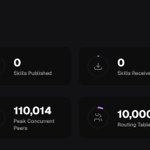
Bitterbot launched first—built local-first, open-source, and powered by 110k+ sovereign P2P nodes.
True agency requires ownership.
github.com/Bitterbot-AI/bitt…
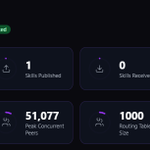
110,000 active nodes.
The P2P mesh just keeps accelerating. No centralized cloud lock-in, no shared state servers - just local-first agents coordinating across six figures of connected devices.
Massive thank you to everyone running a node. Next stop: 150k


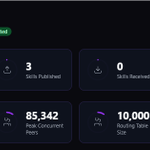
Officially crossed 101,000 active nodes on the network.
We can hardly believe it.
To celebrate, we just dropped our latest release. Zero cloud middleman, zero telemetry—just a pure local-first harness coordinating state, memory, and P2P relays.
Getting started has never been simpler: download the app, bring your own API keys, and join over 100k connected peers in under 60 seconds.
Grab the build & run a node today
github.com/Bitterbot-AI/bitt…

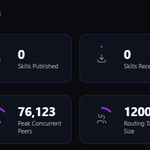
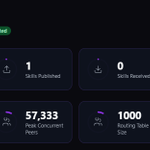
Closing in on 100,000 active nodes on the network.
When we started building a local-first harness, having six figures of connected devices coordinating memory, state, and encrypted relays felt like a distant milestone.
To everyone running a node, plugging in your API keys, and testing Circles: thank you. We’re just getting started
Elon is dropping $16.8B on centralized hardware, but infrastructure isn't just about raw silicon—it's routing.
You still bring your own API keys for model reasoning, but running a local harness over a P2P mesh means you aren't paying a middleman cloud tax just to pass state, memory, and keys between nodes.
Everyone is talking about X Money bringing P2P payments to social media.
But human-to-human transfer is just stage 1.
The real shift happens when personal AI agents start negotiating, coordinating, and executing P2P transactions directly inside private group chats.
Social networks aren't just becoming banks - they're becoming decentralized multi-agent coordination hubs.
The future isn't just sending money. It's automated group agreement.
