

Combining frontier AI & frontier biology to help scientists cure or prevent disease
Joined June 2017
- Tweets6.1K
- Following613
- Followers32.2K
- Likes4.9K
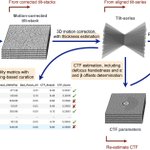




Shawn Zheng leads a computational group working to streamline cryo-electron tomography (cryoET), a cutting-edge technology that can image cellular structures in 3D at near-atomic resolution.
His team developed AreTomoLive, which automates cryoET reconstruction and denoising in real time and cuts processing from months to days.
“It feels like we’re on the eve of another revolution,” he says in this @SBGrid profile.
Read more:
sbgrid.org/software/tale/pro…

biohub retweeted

“Together, the organizations are investing $1.8B in funding, data, computation, and new measurement technology, the largest coordinated commitment to generating AI-ready biological data to date. The result will be an open resource for the research community that provides the foundation for greater understanding and ultimately treatment of human diseases.” 👏🏼👏🏼👏🏼
As drug design becomes better / faster / cheaper, knowing which targets to pursue will become even more important. Hope this resource helps our industry increase our collective probability of clinical success by picking the best disease targets
Thank you @biohub @NIH @ENERGY @GoogleDeepMind @IsomorphicLabs @Meta and all the contributing investigators and labs

🧵 Biohub, @ENERGY, @NIH, and new funding partners today announced a major expansion of an international effort to generate and make accessible the data enabling predictive AI models of biology. Together, the organizations are investing $1.8 billion in funding, data, computation and new measurement technology - largest coordinated commitment to map the biology of the cell to power development of digital models of biology. bit.ly/3UhjoxD

biohub retweeted

Why AlphaFold Didn't Solve Protein Folding: The Bitter Lesson of Biology, Virtual Cells, & Curing All Disease latent.space/p/biohub-deepmi…
@GoogleDeepMind’s @pushmeet and @biohub’s @salcandido explain why AlphaFold's breakthrough hasn't solved protein dynamics, why scaling AI compute and data alone isn't enough to understand biology, how protein language models contain hidden knowledge about structure, function, and evolution, why future frontier models may understand other AI systems better than humans, how better biological data and virtual cells could unlock the next wave of breakthroughs, and what it will take to achieve 10–100x faster drug discovery on the path to curing all disease.
Foundational models are evolving, and next-gen AI could unlock new ways of doing scientific discovery.
At AIxBio, @pushmeet and @salcandido discussed data and scaling, dynamics, function and design, interpretability, and the path to the clinic, moderated by Brandon Anderson of @latentspacepod.

Predicting a protein’s structure is only part of understanding it. The next frontier is connecting structure to dynamics and function: how proteins change shape, respond to their environment, and interact within biological systems.
biohub retweeted

US government, Google join Zuckerberg-backed Biohub in $1.8 billion push for AI biology data reut.rs/4zjjV0Q reut.rs/4zjjV0Q

During the Unlocking the Future of Biology panel at our AIxBio event, Brad Bower of @NIH, Biohub's @ShanaOKelley, and Dorothy Koch of @ENERGY brought up AI-ready data and why it takes an international effort.
Data generation is essential to building predictive models of life that let researchers ask, predict, and answer biological questions. Key takeaways ⬇️

biohub retweeted

JUST IN ‼️: Google DeepMind, Meta and Isomorphic Labs are backing Biohub’s $1.8B effort to build a “virtual cell.”
I’m at Biohub today. The idea is to let scientists test how a cell might respond to a potential treatment on a computer, then take the most promising ideas into the lab.
To get there, they need much more data about how cells actually behave. That’s what this partnership is helping build, with the Department of Energy and NIH also involved.
Of course, a computer prediction still has to hold up in real biology. But if scientists can test more ideas and figure out sooner which ones deserve a closer look, that could make a real difference.
Especially for people waiting for a treatment that doesn’t exist yet. Maybe in a few years?


biohub retweeted

NEARLY $2B NEWLY COMMITTED TO AI + BIOLOGY
Biohub, the U.S. Department of Energy, and the NIH announced a $1.8B international push to generate the foundational data behind AI models that can predict — and eventually treat — human disease. It's the largest commitment to AI-ready biological data to date.
Who's putting up what:
@biohub, $500M: the founding commitment. $400M for new measurement tech (cryo-electron tomography at near-atomic detail, microscopy imaging millions-to-billions of cells in living tissue, tools to build and perturb biology at every level), $100M for research outside Biohub.
@ENERGY, $500M+ over five years: through its Genesis Mission: cell measurement, AI analytics, modeling, and exascale supercomputing across the National Labs.
@NIH, coordinating datasets: built through $500M+ in prior federal investment, and working with Biohub to standardize them for AI model training (the Bio Genesis Mission).
@GoogleDeepMind, @IsomorphicLabs, @Meta, $300M collectively: into the Virtual Biology Initiative for the technologies and multi-modal datasets needed to build predictive models of life.
Plus: the @AllenInstitute, @broadinstitute, @GladstoneInst, Human Cell Atlas, Human Protein Atlas, and Wellcome Sanger Institute aligning the science; @nvidia on accelerated computing; @RenPhilanthropy expanding data-generation funding.
What it's all for: an open data commons to train a "virtual cell" letting researchers ask, predict, and answer biological questions *digitally* instead of running lab experiments first.
In Biohub head of science @alexrives's words: a predictive model of biology could "dramatically accelerate scientific discovery by enabling scientists to perform experiments digitally." I sat down with him to talk about what Biohub is building & what the current roadblocks are. That interview is coming soon.


biohub retweeted

Congrats on launching this initiative and bringing together such a diverse community at the announcement today!
🧵 Biohub, @ENERGY, @NIH, and new funding partners today announced a major expansion of an international effort to generate and make accessible the data enabling predictive AI models of biology. Together, the organizations are investing $1.8 billion in funding, data, computation and new measurement technology - largest coordinated commitment to map the biology of the cell to power development of digital models of biology. bit.ly/3UhjoxD
biohub retweeted

large, clean, diverse datasets are the drivers of progress

A universal predictive model of the cell would dramatically accelerate science, allowing biologists to perform experiments digitally. Today we’re announcing a major partnership with the DOE and NIH. The goal of this partnership is to generate the data that will be needed to build an accurate model of the cell with artificial intelligence.
Isomorphic, Google DeepMind, and Meta are joining us as founding partners in the Virtual Biology Initiative. This is the beginning of a large scale coordinated effort to map cellular biology to power the development of digital models of life. Other leading scientific institutions and consortia including the Allen Institute, Broad Institute, Gladstone Institutes, the Human Cell Atlas, the Human Protein Atlas, the Wellcome Sanger Institute, as well as NVIDIA, are working together as part of this international scientific project.
Creating a predictive model of the cell is one of the most important challenges for the next decade of science. The insights that come from this could unlock a far greater understanding of disease, and open new paths for cures.
We invite the worldwide scientific community and other funders to join us in this effort.
biohub retweeted

The most important thing we can apply AI to is improving medicine and human health - very excited about this partnership with the CZI and the Virtual Biology Initiative!

Today, Isomorphic Labs joins the Virtual Biology Initiative (VBI) as a founding member.
We are helping build an open resource for the global research community to accelerate how we understand and treat disease.
Read more here: isomorphiclabs.com/articles/…

biohub retweeted

The Zuckerberg-backed Biohub will use the investment to create AI datasets that help researchers ‘ask, predict, and answer biological questions digitally.’ theverge.com/tech/1006766/go…

biohub retweeted

Solving biology’s most important challenges using AI requires data that doesn’t exist today. The Virtual Biology Initiative is the necessary building block to make that happen - and thanks to visionary and committed partners, and team @Biohub, the scale now matches the ambition. Let’s do this!
A universal predictive model of the cell would dramatically accelerate science, allowing biologists to perform experiments digitally. Today we’re announcing a major partnership with the DOE and NIH. The goal of this partnership is to generate the data that will be needed to build an accurate model of the cell with artificial intelligence.
Isomorphic, Google DeepMind, and Meta are joining us as founding partners in the Virtual Biology Initiative. This is the beginning of a large scale coordinated effort to map cellular biology to power the development of digital models of life. Other leading scientific institutions and consortia including the Allen Institute, Broad Institute, Gladstone Institutes, the Human Cell Atlas, the Human Protein Atlas, the Wellcome Sanger Institute, as well as NVIDIA, are working together as part of this international scientific project.
Creating a predictive model of the cell is one of the most important challenges for the next decade of science. The insights that come from this could unlock a far greater understanding of disease, and open new paths for cures.
We invite the worldwide scientific community and other funders to join us in this effort.
biohub retweeted

Biology needs its own scaling laws: a quantitative understanding of how predictive power improves as we scale data, models, and experiments.
The crucial question is what to scale. More cells? More perturbations? More diverse biological contexts? We need to establish which combinations produce reliable gains in predicting how living systems respond.
Our own work , from scGPT to X-cell, has shown what foundation models can do with single-cell data. But building powerful models is only half the problem. The harder question is what it takes to make them reliably predictive: to move from describing biology to forecasting what happens when we intervene.
Without scaling laws to guide us, we risk investing enormous resources into models that describe biology beautifully but fail when it matters most.
That's what makes Biohub's expanded Virtual Biology Initiative significant. $1.8B in commitments across funding, data, compute, and measurement technology building an open data foundation for predictive biology.
#VirtualCell #AIforScience #DrugDiscovery

🧵 Biohub, @ENERGY, @NIH, and new funding partners today announced a major expansion of an international effort to generate and make accessible the data enabling predictive AI models of biology. Together, the organizations are investing $1.8 billion in funding, data, computation and new measurement technology - largest coordinated commitment to map the biology of the cell to power development of digital models of biology. bit.ly/3UhjoxD
biohub retweeted

@biohub's virtual biology initiate has partnered with the DoE, NIH, Google Deepmind, Meta, and Isomorphic labs with a 1.8B committed spend on creating the data that will power virtual biology!
I'm stoked - so much of biological understand will be unlocked by our ability to measure and understand it.
A universal predictive model of the cell would dramatically accelerate science, allowing biologists to perform experiments digitally. Today we’re announcing a major partnership with the DOE and NIH. The goal of this partnership is to generate the data that will be needed to build an accurate model of the cell with artificial intelligence.
Isomorphic, Google DeepMind, and Meta are joining us as founding partners in the Virtual Biology Initiative. This is the beginning of a large scale coordinated effort to map cellular biology to power the development of digital models of life. Other leading scientific institutions and consortia including the Allen Institute, Broad Institute, Gladstone Institutes, the Human Cell Atlas, the Human Protein Atlas, the Wellcome Sanger Institute, as well as NVIDIA, are working together as part of this international scientific project.
Creating a predictive model of the cell is one of the most important challenges for the next decade of science. The insights that come from this could unlock a far greater understanding of disease, and open new paths for cures.
We invite the worldwide scientific community and other funders to join us in this effort.
biohub retweeted

BREAKING: The U.S. government, Google, Meta & Zuckerberg-backed @biohub are launching a $1.8B push to build the data layer for AI biology.
The goal is to create the largest open, AI-ready biological dataset ever assembled, giving models the data needed to better predict how biology works & ultimately help treat disease.
The coalition is massive:
› Biohub committed $500M
› DOE is investing $500M+ across measurement, modeling & compute
› NIH is bringing $500M+ of federally funded datasets & repositories
› Meta, Google DeepMind & @IsomorphicLabs are jointly investing another $300M
This is effectively an infrastructure buildout for AI biology.
Instead of just building bigger models, they’re attacking one of the biggest bottlenecks in biology AI today, generating standardized, high-quality biological data at massive scale & making it openly available to researchers.
$1.8B committed to turning biology into something AI can increasingly model, predict & engineer.
