


And we're now published in Nature Methods 🥳 Full article here: nature.com/articles/s41592-0…


Finally biologists can also use numpy (array programming). Handling e.g. DNA and protein sequences with convenience and speed, like physicists and machine learners for decades have worked with numerical data: nature.com/articles/s41592-0… (1/3)


Finally, a cool example showing that there are fewer mapped reads on average around genomic variants. Check out this colab if you want to try out the examples: colab.research.google.com/gi…


Day 5/5 of short BioNumPy examples: Finding the most common kmers in a FASTQ-file.
Try out the code here: colab.research.google.com/gi…
Check out our documentation for more cool examples: bionumpy.github.io/bionumpy🤠


Day 4 of small #BioNumPy examples: Sequence matching (searching for a sequence in a set of reads).
Try out the code here: colab.research.google.com/gi…


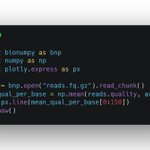
Day 3 of small BioNumPy examples: Plotting the mean base qualities across reads.
Try out the code here: colab.research.google.com/gi…
.. and remember to follow us for daily examples😋


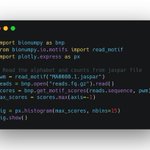
Day 2/5 of small BioNumPy examples: Motif matching.
We download a motif from Jaspar, compute max motif score per read in a FASTQ file and plot a histogram of the scores.
Run the code here: colab.research.google.com/gi…


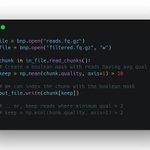
Every day this week, we'll share a small example of how BioNumPy can be used.
First out: FASTQ filtering
(try out the code yourself here: colab.research.google.com/gi…)
.. and remember to follow us for daily updates ☺️
